Gain a deeper understanding of the most used family history resources, and the use of correct research techniques. Topics covered: how to use online genealogical search websites in a professional way; how to interpret correctly census records, parish registers, birth, marriage and death certificates
Genealogy can offer thrilling discoveries: noble connections (rarely), forgotten family fortunes (rarely), or ancestors who served in a war. But what happens when you stumble across a darker thread in your family history — an ancestor who was transported across the globe as punishment or even executed for their crime? The 17th and 18th centuries were periods of enormous social, legal, and political upheaval, and thousands of people, many of who poor, voiceless, and desperate, found themselves facing the harsh elitist class-made early modern justice.
Discovering that an ancestor was transported or hanged can stir complex emotions: surprise, shame, curiosity, even pride. But these stories are also rich with historical insight and can offer a powerful glimpse into the struggles and injustices of the past.
In this article, I will explore:
How such discoveries are made in family history research;
The legal systems and punishments of the 17th and 18th centuries;
Common crimes and sentencing;
The experience of transportation and execution;
How these histories can enrich our understanding of our ancestors.
Many family historians come across an unexpected criminal ancestor while searching court records, assize reports, old newspaper reports, or transportation lists. It might begin with a cryptic note in a parish burial register: “Executed for theft.” Or a name in a convict register bound for Virginia or later, Australia. Perhaps it’s a court record from the Old Bailey detailing a trial and sentence.
Records that can yield this information include:
Assize court records: Regional courts that tried serious criminal offences.
Old Bailey Proceedings: Transcriptions of trials at London’s central criminal court from the late 17th century onward.
Gaol delivery rolls: Records of those tried and held in jail.
Transportation registers: Lists of those sent to the American colonies or later to Australia.
Calendars of prisoners: Often included details of prisoners awaiting trial or execution.
Newspapers and pamphlets: Public executions were widely reported and names often mentioned.
You might even find personal details — a description of your ancestor’s age, trade, or physical features. Occasionally, letters of appeal or petitions survive, especially if the case attracted local sympathy.
A Harsh and Unequal System
Law and Justice in the 17th and 18th Centuries
The English legal system of the early modern period was complex, deeply hierarchical, and often arbitrary. There was no single “police force” in the modern sense. Crimes were usually reported by victims, investigated by local constables, and tried by Justices of the Peace or Assize judges travelling on circuit which was very common.
The system was underpinned by a strong emphasis on property, and many punishments — particularly the death penalty — were directed at crimes against wealth and land, rather than violence. The legal framework was shaped by class. Wealthy offenders might be fined or pardoned, while the poor could face death for what today would be considered minor theft.
The Bloody Code
By the late 17th century, and especially into the 18th century, England’s legal system had developed what historians now call the “Bloody Code.” By 1815, over 200 offences were technically punishable by death. These included:
Stealing goods worth more than 1 shilling (5p);
Cutting down a young tree;
Being out at night with a blackened face (seen as a sign of intent to rob);
Stealing from a shipwreck;
Writing a threatening letter.
The aim was deterrence by using harsh punishment to maintain order, especially in a society where wealth and power were unequally distributed. But this also meant that the poor, desperate and often illiterate, were more likely to fall foul of the law.
Crime and Punishment
Common Offences
If your ancestor was executed or transported in this era, the most likely offences include:
Theft and burglary: The most common offences; stealing food, clothing, livestock, or money.
Poaching: Seen as theft from landowners and harshly punished.
Coin clipping or forgery: Considered treason and often led to execution.
Political rebellion: In times of unrest (such as the 1685 Monmouth Rebellion or the Jacobite risings), thousands were sentenced to death or transportation.
Infanticide: Desperate single mothers sometimes concealed pregnancies or disposed of infants — a capital offence.
Arson, highway robbery, and assault with intent to rob: These were capital offences.
Transportation: A Living Death?
From the early 17th century, transportation became a key form of punishment. England’s prisons were overcrowded, and rather than hang everyone, many were sent across the Atlantic to serve terms of hard labour in the colonies.
To the Americas (1615–1775): Convicts were sent to Virginia, Maryland, and the Caribbean.
To Australia (1787–1868): After the American War of Independence, transportation shifted to Botany Bay and Van Diemen’s Land (Tasmania).
Transported convicts could be sentenced to 7 years, 14 years, or life, and they often endured horrific sea journeys lasting months. Many died en route. Once there, they were sold or assigned to work on plantations, farms, or infrastructure projects. A few rose in status and even became free settlers; most endured hard labour and harsh conditions.
Transportation was sometimes commuted from a death sentence — so a record showing a person sentenced to death may also indicate a later reprieve. Many petitions for mercy survive in the National Archives, especially if local communities supported the prisoner.
Execution as Spectacle
If your ancestor was executed, their final moments were likely public and ritualised. Public executions were seen as a moral lesson — a deterrent — and could draw thousands of spectators. These events were held outside city gates, at crossroads, or in prominent public places such as Tyburn in London. The condemned might be paraded in a cart, allowed to speak or pray, and then hanged before the crowd. The body was sometimes left to hang as a warning, or in later years, sent for dissection under the Murder Act of 1752. Children were occasionally among the executed. For instance, 14-year-olds were hanged for theft, and younger children could be imprisoned or whipped.
Yet executions could also provoke sympathy. Some condemned prisoners were seen as victims of harsh justice — especially young women or first-time offenders. Popular ballads, pamphlets, and broadsides sometimes told their stories, creating folk heroes of the condemned.
Stories Behind the Names
To find your ancestor in these contexts is to uncover a story — not of shame, but of survival, desperation, and resistance in a brutal system. Here are just a few examples from historical records:
The Case of Mary Siddon, 1776
Mary, a 22-year-old servant, was convicted at the Old Bailey for stealing a handkerchief. The court sentenced her to death, but her sentence was later commuted to transportation for seven years to America. She was described as “a sober and industrious girl” and had no prior convictions. Her trial transcript survives, offering insight into her words and demeanour in court.
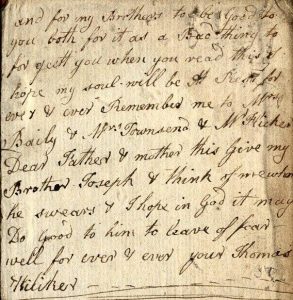
Thomas Hill, Executed 1723
Thomas, a farm labourer from Wiltshire, was caught poaching a deer on an aristocrat’s estate. As a repeat offender, he was sentenced to death. His execution at Salisbury was attended by hundreds. A local pamphlet described him as a “bold man with a disdain for cruel laws.” His story became part of local folklore.
Thomas’ letter written the night before his execution.https://www.salisburyjournal.co.uk/news/24097277.bygone-salisbury-thomas-helliker-last-words/
Thomas Helliker, Executed 1803
Thomas was a shearman who was hanged at Fisherton Gaol, Salisbury, on March 22, 1803. He was nineteen years old at the time of his execution. He was convicted for his alleged involvement in the destruction of a mill by fire and for shearing frames. His case is notable for the public outrage surrounding his execution, despite his claims of innocence and an alibi.
John Walsh, Irish Rebel
After the 1798 Irish Rebellion, many participants were captured and sentenced by British courts. John Walsh, a Catholic tenant farmer, was transported to New South Wales in 1800 for his involvement in a seditious meeting. He left behind a wife and children. His descendants still live in Australia.
Genealogical Tips: Researching Criminal Ancestors
If you suspect an ancestor may have been executed or transported, here is how to trace them:
British Newspaper Archive: Reports of executions and crimes.
Ancestry and Findmypast: Both have convict registers and transportation records.
National Archives (UK): Particularly HO (Home Office) series, for criminal petitions, transportation orders, and execution records.
Check Parish Registers
Sometimes the local clergy noted executions or transportations in burial or baptismal entries.
Explore Colonial Records
If your ancestor was transported, look for:
Convict musters and assignment records.
Pardons and tickets of leave (for early release).
Marriage or burial records in the colonies.
Interpreting Their Story
What should you make of an ancestor executed for theft or transported for rebellion? These are not just “criminals” but people shaped by their times: by poverty, injustice, and the immense inequalities of early modern Britain. Their stories are worth telling, not hiding. They reveal the lived experience of the lower classes, the operation of a harsh legal system, and the resilience of individuals who endured punishments unimaginable today.
Your ancestor might have stolen to feed a starving family, or rebelled against landlord injustice, or fallen foul of a system rigged against the poor. These are not tales of shame, but of history — and by exploring them, you can reclaim your family’s past with greater understanding and empathy.
Conclusion: From Stigma to Storytelling
Discovering a transported or executed ancestor opens a compelling window into the realities of the 17th and 18th centuries. These were times of repression, resistance, and of transformation. Ordinary people, your ancestors, bore the brunt of a brutal legal system designed to maintain the status quo. In telling their stories, we honour their struggles and shine a light on the injustices of the past. In doing so, we ensure their voices are not lost, that they, too, take their rightful place in the ever-evolving story of our families.
An 18th‑century copper engraving showing the hanging of a pirate at London’s Execution Dock in 1724, with officials and spectators gathered around. While visually striking, many prints are deliberately unsentimental to present hangings as orderly events rather than chaotic suffering.
A material surname change refers to a significant alteration in a family’s last name, often stemming from various factors such as cultural assimilation, marriage, or legal mandates. These changes can make it challenging to trace your ancestors through historical records, as they might have gone by different surnames at various points in their lives.
Common Causes of Surname Changes
Cultural and Linguistic Shifts: Immigrants arriving in a new country may anglicise or adapt their surnames to fit their new surroundings. For instance, “Schmidt” could become “Smith.”
Marriage: Traditionally, women often took their husband’s surname upon marriage. This practice still exists today, though it is becoming less common.
Legal Changes: Legal mandates, like name changes for citizenship or other reasons, can result in surname alterations. Individuals might change their names to avoid persecution, discrimination, or to simply start fresh.
Navigating Material Surname Changes in Your Research
Record Every Variation: As you uncover historical records, keep meticulous records of all surname variations. Note any aliases, nicknames, or alternate spellings you come across. These notations will prove invaluable in your research.
Document Events Surrounding Changes: Look for historical context that may explain a surname change. Marriage certificates, naturalization papers, or personal letters might provide clues.
Explore Alternate Records: When you encounter a dead end with one surname, try searching for the family using other possible variations. Remember, genealogical research can be a puzzle, and you may need to piece it together from different angles. I have discovered a ‘K’ being written as n ‘R’ on the census records = think out of the box.
Conclusion
Material surname changes can at times pose challenges. However, they also offer a deeper understanding of your family’s history, reflecting the ever-evolving nature of individuals and society. By documenting variations, understanding the reasons behind these changes, and using different research strategies, you can navigate the complexities and unearth the fascinating stories hidden within your family’s name changes.
The Agricultural Revolution, the Working Classes, and the Landless Labourer.
In the annals of British history, the majority of the population can trace their lineage back to ancestors who toiled as agricultural laborers, also known on the UK census as Ag. Lab. Their existence, while seemingly simple, was a tapestry woven with intriguing stories and customs. They predominantly resided in tied cottages, homes that belonged to their employers and were rented to them. An unusual twist of fate bound them to their workplace; if they left their job, they might find themselves without a roof over their heads. It was a peculiar form of attachment where employment and housing were intimately entwined.
Life in these tied cottages unfolded through both prosperous and challenging times, anchored by the enduring traditions and timeless festivals that had been celebrated for generations. These customs served as a constant thread connecting them to their roots and heritage.
Then change arrived in the form of the Agricultural and Industrial Revolutions. These revolutions, while pivotal in shaping the modern world, often upended the lives of Agricultural workers. The transition from agrarian to industrial economies brought about profound shifts in employment, technology, and society. For many, it meant bidding farewell to the familiar rhythms of rural life and embracing a new, industrialised era.
As we delve into the history of these remarkable individuals, we uncover a rich tapestry of stories that not only illuminate the past but also provide valuable insights into the human capacity to persevere and evolve in the face of transformation. Our British Agricultural ancestors were witnesses to history.
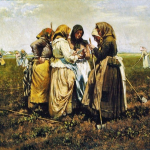
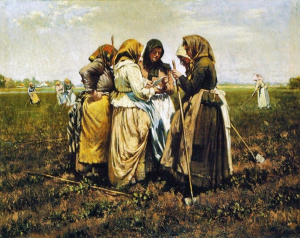
Turnip Hoeing
An examination of the radical consequences of the eighteenth century Agricultural Revolution upon the population of rural England. Women were particularly affected by the upheavals to a static way of life in the countryside. Often forced into factories away from their traditional support networks within their communities never to return. How did women (and their children) adapt to their new environments, and did the mass migrations into our towns benefit or hold women back?
This talk is now full. If you are interested in a repeat talk please contact Heritage Found
Journey into History – A reflection from a friend who read my shortly to be published book.
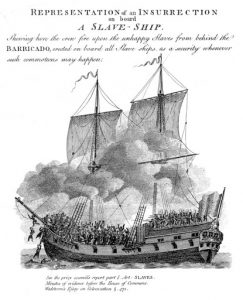
Prepare to be transported to the heart of a pivotal era with this upcoming new book. This compelling narrative uncovers the untold stories of the slave ship “Hannibal” its enslaved passengers and crew. It goes on to shed a much need new light into a dark chapter in human history with links to Brecon, Wales. Set against the backdrop of the transatlantic slave trade, the book brings the 17th century to life from Brecon, to the west coast of Africa and onto Barbados. Delve into the ship’s harrowing journey, from bustling ports, the exploitive mercantile capitalism of the Royal African Company, battles at sea, to the unimaginable suffering endured by the enslaved individuals who sailed upon her. Through meticulous research, personal accounts, and archival materials, the book resurrects the voices of those who history often forget. A harrowing and intriguing read which brings the world of a slave trading captain to life.
The life of a slave trading captain stands as a grim testament to the depths of human cruelty and the moral complexities of their era. These captains were both the architects and enforcers of a brutal system that traded in human lives, perpetuating untold suffering for profit. Born into a world where economic interests often trumped ethical considerations, these captains often grew up in societies where the practice of slavery was deeply ingrained. They were groomed from a young age to see enslaved individuals as mere commodities, stripped of their humanity and subjected to unspeakable horrors in the pursuit of monetary gain.
As they embarked on their voyages, these captains navigated treacherous waters both literally and morally. They faced the challenges of uncertain weather, navigational hazards, and hostile ships, all while being weighed down by the weight of their human ‘cargo’. The conditions on board the slave ships were deplorable, with enslaved people crammed into tight spaces, subjected to disease, malnutrition, and unimaginable suffering.
In their role as captains, they held authority and power over those unfortunate souls trapped in the hold of their ships. They had the capacity to demonstrate some semblance of kindness or, more commonly, to wield their power with brutality and violence. The choices they made had life-and-death consequences for those under their control.
The story of this slave trading captain, Captain Thomas Phillips of Brecon, serves as a haunting reminder of the darkest chapters of human history. It underscores the need for acknowledging the past, understanding the factors that led to such atrocities, and striving to ensure that such inhumane practices are never repeated. Through a broader historical lens, we’re reminded of the crucial importance of progress, empathy, and justice in shaping a more humane world for all.
Compelling excerpts from the book can be found in these articles posted HERE
“Hannibal” leaves an indelible mark, compelling us to confront the legacy of the transatlantic slave trade. By reflecting on the past, we’re empowered to address the ongoing injustices that shape our world, creating a more just and equitable future.
A UK birth certificate is an official document issued by the General Register Office (GRO) or a local registration office. It records essential information about an individual’s birth, including their full name, date and place of birth, parents’ names, and registration details. It is considered a primary source of evidence for establishing identity and citizenship in the UK.
Information Included on a UK Birth Certificate
a. Child’s Details:
Full name of the child: This is the name given to the child at birth and appears as the first entry on the certificate.
Date of birth: The exact date when the child was born.
Place of birth: The city or town and the country where the birth occurred.
b. Parents’ Details:
Full names of both parents: The names of the biological parents, including the mother’s maiden name.
Occupation of parents: This section may include the parents’ occupations at the time of the child’s birth but often the mothers occupation if she was married was not recorded..
Date of parents’ marriage/civil partnership: If applicable, the date of marriage or civil partnership between the child’s parents.
c. Registration Details:
Registration district and sub-district: The geographical area where the birth was registered.
Registration date: The date when the birth was officially registered.
Types of UK Birth Certificates
There are two main types of UK birth certificates:
a. Short/Abbreviated Certificate:
This type of certificate includes only the child’s details (name, date, and place of birth) and the registration details.
The short certificate does not include the parents’ information, making it unsuitable for legal and official purposes.
b. Full/Long Certificate:
The full certificate contains all the information present on the short certificate, along with the names and details of both parents.
This certificate is required for various legal purposes, such as obtaining a passport, opening a bank account, and applying for certain benefits.
Obtaining a UK Birth Certificate
If you need a copy of a UK birth certificate, there are several ways to obtain one:
a. Online Application: The General Register Office offers an online service where you can order a copy of a birth certificate for a fee.
b. In-Person: You can visit the local registration office where the birth was registered and request a copy in person.
c. Do not apply via ‘tracing your ancestors web-sites’ as they will charge you a lot more than the GRO and Heritage Found!
d. Contact Heritage_Found@yahoo.co.uk and we will take care of your orders for only a modest fee.
Conclusion
A UK birth certificate is an indispensable document that provides vital information about an individual’s birth and parentage. Understanding its contents and types can be crucial for various life events, official procedures and confirmation that you have found the right person to confirm your research is correct.
Discovering your Family History made easy: For complete beginners and the amateur Genealogist.
Delve into the fascinating world of ancestral exploration and gain valuable skills to trace your roots. Discover how to harness the power of online genealogical search websites, master UK and other countries census records and parish registers, and decipher birth, marriage, and death certificates with ease. Create a stunning family tree that showcases your heritage and avoid the pitfalls that often trap amateur genealogists. Embark on a thrilling journey of self-discovery and connect with your ancestors in ways you never thought possible. Enrol now and unearth the hidden treasures of your family history!
(I could take one more)
Wednesdays 6.30pm-8.30pm
10 sessions from 27th September at Stoke Lodge, Bristol
Thursday 28 April 2022 and 16 June – spaces available on these 5 week Family History Courses that will boost your research and social history knowledge!
New courses Family History Course for this Spring 2022 at Stoke Lodge Bristol now ready to book online. (Please note courses may move on line if government regulations change).
This week my class investigated searching for birth, marriage and death registrations. As our research progresses it is very rewarding to send off for copy certificates. I have sent off for a further two death certificates of ancestors or mine today. During the 19th century, and with couples usually having large families, it is sadly only too common to discover that several children had died during childhood within one household. I personally find it fascinating to find out what had caused these children’s early demise. Unfortunately I discovered one child had drowned in a pond, but many others died of contagious infections which we no longer fear, such as whopping cough.
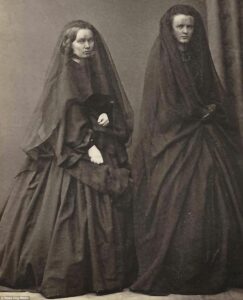
These tragedies would have affected the family very deeply, and this was perhaps one reason why people tended not to talk about their grief – because of the fear that life was very precarious for their children.
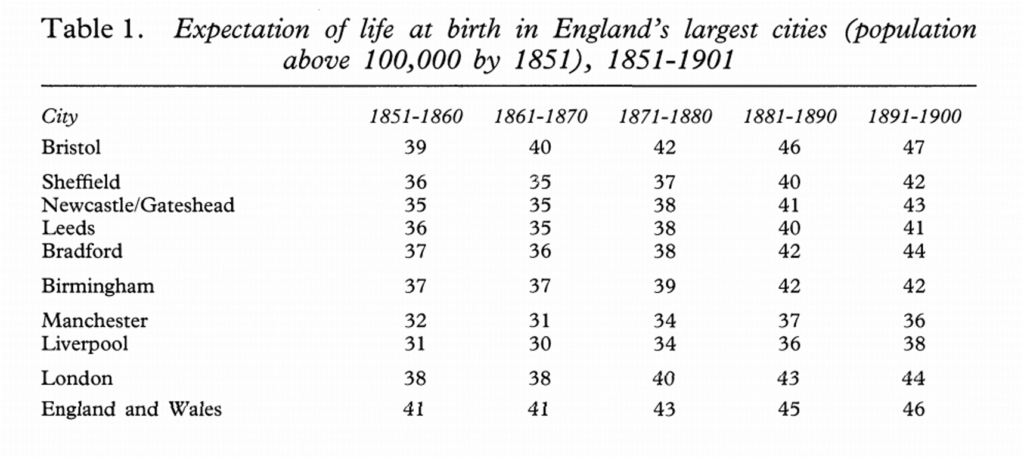
Life expectancy was low compared to today. One of the reasons was the death of infants and children from disease. However, poor housing, pollution, and lack of sanitation also resulted in causing early deaths in all ages.
To send off for a copy certificate is easy. As use the GRO web site as they are the cheapest option and the quickest. Send off HERE
Discover your Family History – Introduction to Researching your Family History
Part 2 – Discover your Family History and so much more!
An exploration of Family History. This course will be delivered at Stoke Lodge but will move online if necessary using ZOOM.
Course code FHR2C. Begins Thursday 10 March 2022 for 5 weeks. 14:00-16:00
A practical easy learning technique to learn how to research and record family history with confidence. A fun approach, in a safe, inclusive environment with other learners. Correct interpretation of vital records, including Parish Records, and tips on how to improve research techniques. Learners should be able to produce at least a 6-generation family tree by week 5. A fun approach, in a safe, inclusive environment with other learners. A mixture of lectures and practical work.
Join award winning tutor Rosemary Caldicott to better understand how to discover your ancestors.
FOR MORE INFORMATION ON ENROLMENT AND TO BOOK HERE