We can learn from history…

circ 1350

‘Alas when our relatives and neighbours came to welcome us,

 whole we were embracing them and in the midst of our kisses,

 we, who carried the arrows of death were constrained to give them the poison,

 so that when they returned home,

 soon whole families were infected and in less than three days succumbed to the attacks’.

Ref: Gabriel de Mussis. Reprinted in Geschichte der Medicin und Epidemische Krauheneiten, Jean. 1882. As cited in C.E. Boucher. “The Black Death in Bristol”. 1938. Bristol and Gloucestershire Archaeological Society. Vol. 60, pp.31-46.

The Bills of Mortality and The Great Plague of London

The London death toll during the great plagues of the seventeenth century.

“Bring out your Dead”

Today we listen to the media or check Twitter to discover the latest death and infection rates for the Covid pandemic and it often makes for grim news. We check our apps to find out the infection rate in our local area, scan ourselves into cafes, libraries, pubs, and schools so we can be aware for our own safety and that of others. Government and private sector developed apps to provide test track and trace interventions. We have the advantage because we understand how coronaviruses spread from human to human, and we also know that we have modern medical science on our side. But in the past people had little to no understanding of how plague was rapidly spreading from house to house, killing as many as 100,000 people in the City of London during the years 1665-66, about one quarter of the population of London.[1] The Great Plague of London, lasting from 1665 to 1666, was the last major epidemic of the bubonic plague to occur in England. It happened within the centuries-long Second Pandemic.

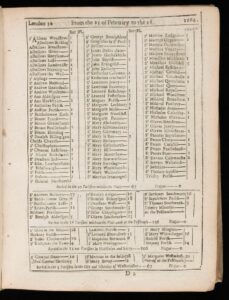
People would eagerly read, or as was more likely were read, the weekly Bill of Mortality double sided sheets informing citizens of the weekly death toll in all of the 130 parishes in London.

“the Bill of Mortality is of very great use…it giveth a general notice of the Plague, and a particular Accompt of the places which are therewith infected, to the end such places may be shunned and avoided.” [2]

Those that died from known illness would be recorded and in which parish they were buried. But for those who died of plague they were to become a disheartening numerical statistic at the bottom of the printed Bills, offering an early example of local public health initiative in an attempt to try and track the progress of the disease.

The Bills were particularly produced by the parishes of the City of London during outbreaks of plague. The first Bill is believed to date from November 1532 [3] and published on 21 December 1592 continuing until 18 December 1595. The practice was abandoned and then revived on 21 December 1603 when plague once again was in town. In 1611 the duty to produce weekly Bills each Thursday, was obligatory and the responsibility of the members of the Worshipful Company of Parish Clerks by a charter granted by James I. Annual returns were also printed each year on 21 December (the feast of St Thomas). New charters were granted by Charles I in 1636 and 1639. As London grew the Bills eventually covered 129 parishes at the granting of the 1639 charter. By 1570 the Bills included baptisms and in 1629 the cause of death was given. The Bills were published by the Worshipful Company of Parish Clerks in London, on a single double sided sheet of paper.

In the last week of July 1665, the London Bill of Mortality showed 3,014 deaths, of which 2,020 had died from the plague.
Corpses were buried quickly, often after being dropped out of upstairs windows or forcibly collected from their boarded-up houses, then to be placed unceremoniously into a mass grave pit such as the one hastily dug at Aldgate near the churchyard being 50 feet long and 20 feet wide. It is recorded that while labourers were still digging at one end dead-carts were tipping corpses in at the other end. When finally covered over 1,114 people were interned at this one site alone.

Such was the mental distress being caused to the people that it was ordered for dead-carts to only collect the bodies after dark. But eventually there were just too many victims and too few drivers that bodies were being stacked up along the sides of the very narrow streets. Daytime collection was resumed with the collector’s famously calling out around the city’s narrow streets “bring out your dead”.[4]

Usually there would be no member of the clergy to pray for the dead and oversee the burials; the clergy, along with the wealthy, had mostly fled to the countryside. Dignity in death for victims of the plague had all but vanished.

Continue reading “The Bills of Mortality and The Great Plague of London” →

Due to popular demand my virtual talk ‘Life in the Times of the Black Death Pandemic in Bristol’ running again on 17th June.

Due to popular demand my virtual talk is offered again! – 17th October and 2nd November, AD 2020
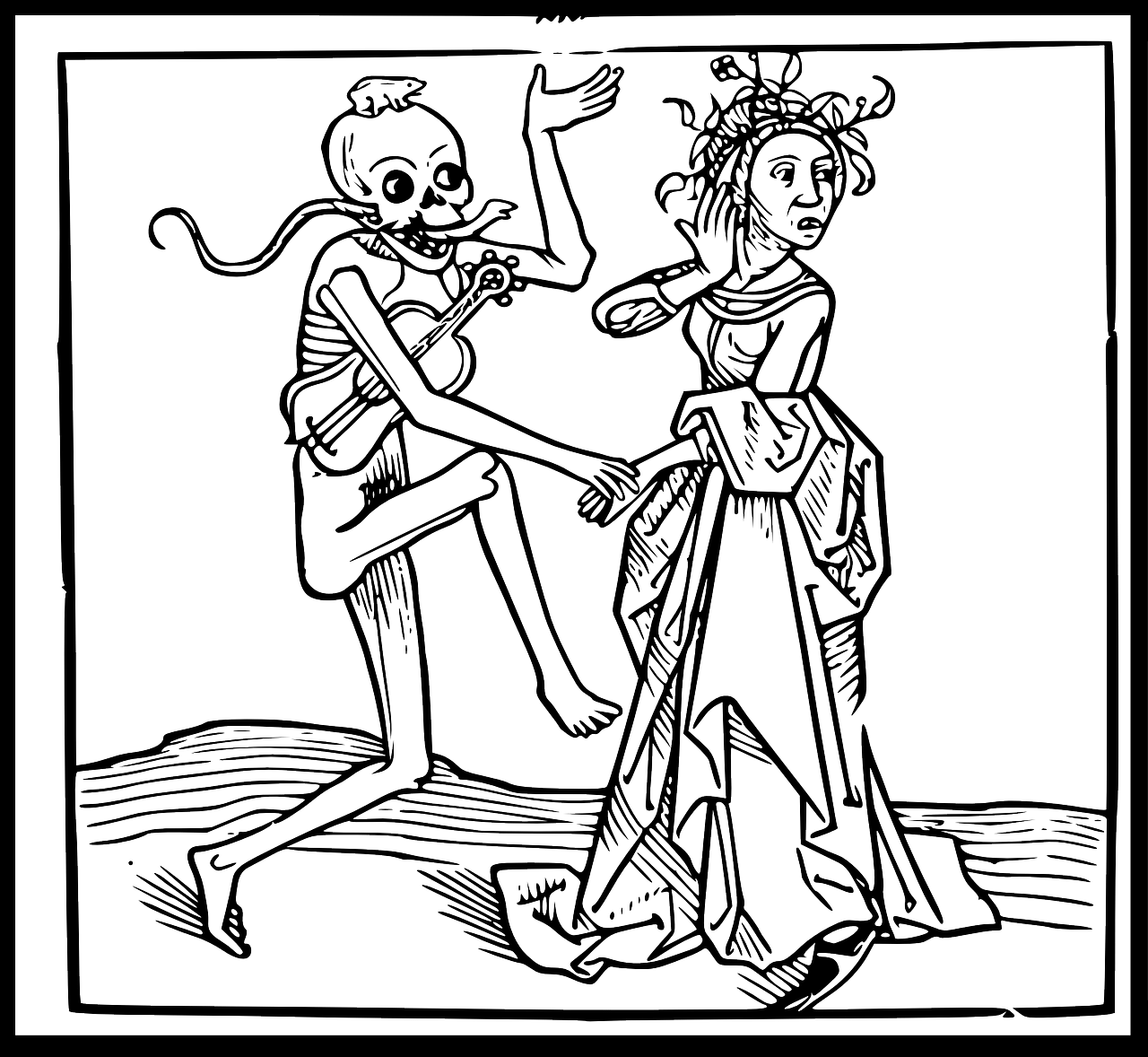
Dance of Death

Life in the Times of the Black Death Pandemic in Bristol, England 1348-1349

I will be giving a one off on-line history talk about the Black Death pandemic in Bristol during the years 1348 and 1349.

In the year 1348 the Black Death pandemic arrived in Bristol resulting in catastrophic economic consequences for the elite and manufacturing classes of Bristol.

Rosemary Caldicott will discuss how the local population reacted to the seismic changes that swept through Bristol: Did the immediate years that followed become the ‘golden age’ of English peasantry? Can we draw any parallels with today?

The talk will be delivered via zoom, with discussion time at the end.

The talk will take place on Monday 2 November 2-4pm

Enrol online or by phone HERE

Life in the Times of the Black Death in Bristol

Age of Adversity: Life in the Times of the Black Death in the City of Bristol, England. 1348-1349, and Beyond

By Rosemary L Caldicott

 ‘Alas when our relatives and neighbours came to welcome us, whole we were embracing them and in the midst of our kisses, we, who carried the arrows of death were constrained to give them the poison, so that when they returned home, soon whole families were infected and in less than three days succumbed to the attacks’.[1]

Although there appears to be very few primary sources recounting the consequences and changes inflicted upon the population of Bristol during the era of the Black Death[2] a few rare manuscripts of the time have survived. I am drawing particularly on the work of C. E. Boucher The Black Death in Bristol, written in 1938 due to his extensive research and insight into rare manuscripts relating to Bristol. I am writing this during university library closures, one of the many impacts of the coronavirus disease pandemic of 2020,[3] thereby solely relying on e-sources. However, despite this limitation I still think it is worth a review of how the Black Death pandemic of 1348-49 caused far reaching socioeconomic and political change for the people of Bristol and the surrounding area.

Up until 2020, in the developed world, phrases such as plague, pestilence and famine are words that appear in a far distant, often romanticised past even though new pandemics over the last twenty years have given rise to near misses in Europe. Even once common diseases such as diphtheria, cholera and smallpox seem an age away now. This has come about purely because of the introduction of mass immunisation in 1942. Tuberculosis, an illness of crowding and poverty is now extremely rare as most humans are immunised against this killer disease.  Yet today as I write, in March 2020, in Europe and across the world, we find ourselves and our governments once again facing up to the far-reaching realities of the sheer speed and disruption, both economic, and social, that Covid-19 is spreading through our societies.

Our distant ancestors who lived during the fourteenth century knew only too well about self-isolation, food shortages, no cure or immunisation, and how quickly a highly contagious disease had the potential to stagnate an economy already in crisis due to climate change and consequently failed harvests.[4] Continue reading “Life in the Times of the Black Death in Bristol” →