
New Review – Voyage of Despair. The Hannibal, its captain and all who sailed her, 1693-1695

Voyage of Despair is a remarkable achievement, tackling challenging material with skill and presenting it in a way that is both accessible and deeply engaging. The narrative takes readers on the harrowing journey of the Hannibal slave ship, a voyage that is as compelling as it is sobering. To say I “enjoyed” the journey feels like the wrong word, given the subject matter, but the book captivates in a way that few historical accounts manage.

What stands out is the careful pacing of the narrative. Questions naturally arise as you read—What happened to John Browne when left behind? Why does an image feature a tiger in a cage during events in Africa?—but rather than leaving readers in the dark, the author skilfully answers these queries in later chapters. This structure encourages thoughtful engagement and reflection throughout.

Beyond its readability, the book is academically rigorous, offering thorough references that firmly establish its place as an important contribution to the field. It balances scholarly depth with a compelling narrative style, a rare feat in historical writing.

The author’s voice is confident and assured, guiding the reader with the expertise of someone deeply immersed in the subject. There are moments where the passion and anger are palpable—particularly in the vivid descriptions of the ships’ appalling conditions by the time they reached Barbados. These passages are powerful and unforgettable.

Voyage of Despair is a masterful work—both a gripping read and a significant academic contribution. For anyone interested in the complexities of history and the human stories within, this book is not to be missed.

Mr Alan Canty (FRCS DDS)

Available to order HERE

New review – Voyage of Despair. The Hannibal, its captain and all who sailed in her. 1693-1695

New review from Liz Millman: Learning Links international (Black History Wales) 

In this amazing book Rosemary Caldicott shares the complex layers of the challenges faces in 2020 in Brecon, and then takes us back to around 1694 to gain some appreciation of the complexities of the trading done by sea captains with their funders, the Royal Africa Company and others, and with the local West African rulers and merchants.

Rosemary also uncovers stories about the victims, those African subjected to unimaginable abuse and terror not only by the God fearing European traders and sailors, but the treatment inflicted by their African captors.

But yet is a very readable book, a book for the times we are in, it is also extraordinarily complex, but Rosemary shares and explains the commonplace and everyday activities occurring more than 330 years ago, while remembering that we are reading this initially in 2024, and it records a story of the Black Lives Matter times.

At only £12, plus P&P this is a must read, really very timely and accessible, and although not perhaps your first choice of holiday reading, it’s worth having a copy to dip into as you start to face the grim realities of the times back then, or just to reflect and increase your understanding.

Order Here

New Book: “Voyage of Despair”

Voyage  of  Despair

The Hannibal, its captain and all who sailed in her, 1693-1695

by

Rosemary L. Caldicott


Explore the harrowing depths of the slave trade in this poignant microstudy centred on the Hannibal slave ship. Delve into the heart-wrenching realities of this brutal chapter in history.

Journey back to 1693, when Captain Thomas Phillips of Brecon, Wales, set sail from London to Guinea, tasked with procuring 700 enslaved Africans for the Royal African Company of England. Fast forward three centuries to 2010, when the decision of the Brecon Town Council to commemorate Captain Phillips with a plaque causes controversy. Explore this captivating narrative as Rosemary unravels the grim realities of the triangular trade, exposing the brutalities endured by its victims through forgotten stories and meticulous analysis of day-to-day life during this dark chapter in history.

Bristol Post review: “Brecon Town Council honoured a slave ship captain with a memorial plaque in 2010! Rosemary L. Caldicott’s book Voyage of Despair looks both at Phillips journal and other sources to reveal the absolute horrors of the trade in general and the Hannibal’s journey in particular. It also examines the campaign and arguments around the plagues removal. It’s an issue that Caldicott makes clear…the business of enslaving people, and the profits made on the back of it, reach deep into the U.K”

ISBN: 978-1-911522-63-8
Number of pages: 250

ORDER HERE


Title: “The Journal of Captain Thomas Phillips of Brecon, the Slave Ship Hannibal, and all who Sailed on Her” – Unveiling a Forgotten Voyage

Journey into History – A reflection from a friend who read my shortly to be published book.

Prepare to be transported to the heart of a pivotal era with this upcoming new book. This compelling narrative uncovers the untold stories of the slave ship “Hannibal” its enslaved passengers and crew. It goes on to shed a much need new light into a dark chapter in human history with links to Brecon, Wales. Set against the backdrop of the transatlantic slave trade, the book brings the 17th century to life from Brecon, to the west coast of Africa and onto Barbados. Delve into the ship’s harrowing journey, from bustling ports, the exploitive mercantile capitalism of the Royal African Company, battles at sea, to the unimaginable suffering endured by the enslaved individuals who sailed upon her. Through meticulous research, personal accounts, and archival materials, the book resurrects the voices of those who history often forget. A harrowing and intriguing read which brings the world of a slave trading captain to life.

The life of a slave trading captain stands as a grim testament to the depths of human cruelty and the moral complexities of their era. These captains were both the architects and enforcers of a brutal system that traded in human lives, perpetuating untold suffering for profit. Born into a world where economic interests often trumped ethical considerations, these captains often grew up in societies where the practice of slavery was deeply ingrained. They were groomed from a young age to see enslaved individuals as mere commodities, stripped of their humanity and subjected to unspeakable horrors in the pursuit of monetary gain.

As they embarked on their voyages, these captains navigated treacherous waters both literally and morally. They faced the challenges of uncertain weather, navigational hazards, and hostile ships, all while being weighed down by the weight of their human ‘cargo’. The conditions on board the slave ships were deplorable, with enslaved people crammed into tight spaces, subjected to disease, malnutrition, and unimaginable suffering.

In their role as captains, they held authority and power over those unfortunate souls trapped in the hold of their ships. They had the capacity to demonstrate some semblance of kindness or, more commonly, to wield their power with brutality and violence. The choices they made had life-and-death consequences for those under their control.

The story of this slave trading captain, Captain Thomas Phillips of Brecon, serves as a haunting reminder of the darkest chapters of human history. It underscores the need for acknowledging the past, understanding the factors that led to such atrocities, and striving to ensure that such inhumane practices are never repeated. Through a broader historical lens, we’re reminded of the crucial importance of progress, empathy, and justice in shaping a more humane world for all.

Compelling excerpts from the book can be found in these articles posted HERE

“Hannibal” leaves an indelible mark, compelling us to confront the legacy of the transatlantic slave trade. By reflecting on the past, we’re empowered to address the ongoing injustices that shape our world, creating a more just and equitable future.

Soon to be available from Bristol Radical History Group


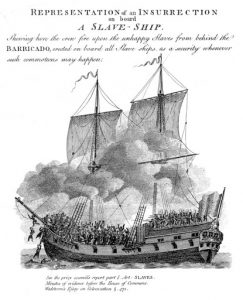
Revolt on a slave ship

Colonialism and Memory in Bristol

Rosemary Caldicott and Mark Steeds will be speaking at the Colonialism and Memory in Bristol as part of Mnemoscapes of the South West SWWDTP Memory Studies Research Cluster.

Join us for a public workshop on colonialism and memory in Bristol. Moving between the museum, the city, and space for discussion and reflection, we’ll be asking what decolonisation means, what it might look like in practice, as well as the challenges facing these efforts.

Join us at the M Shed in Bristol on 1st July,

The workshop is free and refreshments and lunch will be provided, but space is limited to 30 places.

10:45-12:45  – A city walking tour by Mark Steeds (Bristol Radical History Group) including the Colston plinth.

15:30-16:30  – BRHG members Mark Steeds and Rosemary Caldicott will be speaking.

Mark Steeds will talk about Stevenson’s story from San Francisco, where he undertook his voyage of the South Seas, travels to Hawaii and then on ultimately to Samoa. He became an activist, witnesses the king of Hawaii being usurped by the Americans, the Anglican attack on Father Damien and his Leper colony, and the first Samoan ‘Civil War’. His wife Fanny stayed on and witnessed the second Samoan civil war that led to western domination (British, American and German).  Marks research is in support of the Long John Silver Trust and our European Cultural Route: -“In the Footsteps of Robert Louis Stevenson”.

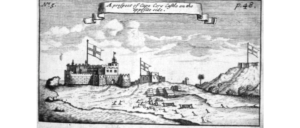
          Cape Coast Castle 1705


Rosemary Caldicott will be speaking about the maintenance and subsequent implications of the Royal African Company forts in West Africa. Her research is based upon her forthcoming book about the RAC Hannibal Slave-ship (1693-1695) and her previous publication Nautical Women – Women sailors & the Women of Sailortowns: A Forgotten  Diaspora c.1693–1902.

For further information about this event and the full program please link here

Event held on Saturday 1st July 10.00-1730

at M Shed Wapping Road Bristol BS1 4RN

“Nautical women-women sailors and the women of sailortowns: A forgotten diaspora c 1693-1902”

BOOK HERE

Tuesday, 29 November 2022, 14:00 – 15:30. 

Portishead Library 24 Harbour Road Portishead BS20 7AL

North Somerset Libraries are excited to host a series of talks by Bristol Radical History pamphleteers. Visit www.brh.org.uk to find out more about their publications and events. The talks are informal and accessible and would appeal to adults and older teens. Some Bristol Radical History pamphlets will also be available to purchase with cash.

In our third talk, Rosemary Caldicott brings to life Pamphlet number 43 which will be of particular interest to locals.

Nautical Women book cover
‘Nautical Women’, by Rosemary L Caldicott

The book explores the stories of women whose lives were inextricably linked to the sea. These include the women of sailortowns struggling to keep out of the dreaded workhouse and resisting the prowling press gangs; and of the courageous and skilful cross-dressing women sailors, some of Bristol, who went to extraordinary lengths to hide their gender. The stories of these women challenge our stereotypes of women in earlier societies and reveal the courage of those who ‘ran away to sea’ by exposing their struggles against poverty. Rosemary will discuss these women’s motivation as well as their adventures and inevitable exposure.

About the venue

Portishead Library is accessible, including a disabled toilet and baby change. The talk will be in the meeting room which will be set out in theatre style. Get in touch with us if you have additional support needs so that we can help you enjoy the event. Call us on 01934 426040 email us on portishead.library@n-somerset.gov.uk or pop in and see us Tuesday to Friday 9.30-5 and Saturday 9.30-1pm

Who can come?

Numbers are limited so we ask that you book a place via Eventbrite or by contacting Portishead Library. As we have limited spaces do let us know if your plans change. It is easy to cancel via Eventbrite.

More about the speaker

Rosemary Caldicott is a teacher of social history working in adult education, a writer of books and articles about working class women in history.

Rosemary is secretary of BRHG and has published several works for the group: The Life and Death of Hannah Wiltshire: A Case Study of Bedminster Union Workhouse and Victorian Social Attitudes on Epilepsy (2016); Lady Blackshirts: The Perils of Perception – suffragettes who became fascists (2017); Nautical Women. Women sailors and the Women of Sailortowns: A Forgotten Diaspora. c.1693 – 1902 (2019).

The Slave-Ship Hannibal 1693-1695. New Talk!

Black History Month Lecture 

The Slave-Ship Hannibal and all who sailed on Her. (1693-1695).

The voyage of the Hannibal slave-ship. 1693-1695. Credit Lisa Liebelt

Black History Month: Britain’s history and involvement in the Trans-Atlantic Slave Trade.

Come along and hear the tragic but enlightening story of the Brecon born slave trading captain Thomas Phillips, what happened to his crew, and the captured 700 enslaved people on his ship the Hannibal. This talk is based on my original research as discovered in the National Archives and the British Library. For the first time the human stories are revealed about all who sailed on her.


Thursday, 13 October.  2pm to 4pm by Rosemary Caldicott 

To book telephone Tel: 0117 903 8844

or Email: StokeLodge@bristol.gov.uk

 or BOOK HERE

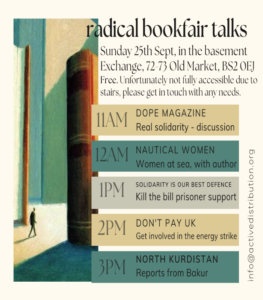
Nautical Women – a talk

A talk about the brave Nautical Women who ran away to sea to escape abuse and poverty. Come a long to this exciting book fair and discover the many aspects of our extraordinary working class history.

Rosemary Caldicott representing Bristol Radical History Group

12 noon at The Exchange, Old Market, Bristol BS2 0EK 

Sunday, 25 September 

Organised by Bristol Active Distribution Publishers

www.activedistributionshop.org

Congratulations to the Republic of Barbados!

On Tuesday 30 November 2021, marking the 55th anniversary of independence from Britain, Barbados proudly became a republic.

Barbados has a long and painful history with Britain which dates back to the era of the forced transportation of enslaved Africans to work on British owned plantations.

For the full article and to learn more about about the saga of the slave-ship Hannibal click here

The voyage of the Hannibal slave-ship. 1693-1695. Credit Lisa Liebelt

The Hannibal Slave Ship

After 18 months of research and many trips to visit the archives and libraries of London my new book is nearly ready to be published. I truly felt the end was nearly here when I was told at my local library yesterday that they will be putting in an order the minute it is published.  My first advance order!

My new book is about a slave trading captain, his ship the Hannibal, and the 803 people who sailed on her, with most of these people being forced to board as slaves in order to grow the profits for the Royal African Company of England and the plantocracy classes of Barbados.

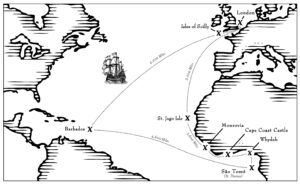
This epic and tragic true story takes place during the years 1693 to 1695 as the ship sailed between three continents, also known as the Triangular Trade. The map below from my book clearly charts the triangular route of the Hannibal. While at sea the ship was badly damaged by a French man-of-war, and the crew suffered considerable hardships under her captain. But worst of all was the horrific suffering inflicted upon the captured African people onboard the ship.

With thorough searching and detailed investigations undertaken in London’s archives, and now reproducing the evidence that has survived, it has been possible to piece together the tragic events that unfolded both onboard at sea and on the land. This is a true story that has laid dormant for over 300 years and now it is almost ready to be told for the first time.

The voyage of the Hannibal slave-ship. 1693-1695. Credit Lisa Liebelt