Guild of One-Name Studies. This event is a military seminar with a focus on our ancestors who served in wars and in keeping the merchant fleet afloat. #GuildMilitary
23 October, 2021, delayed from last year. I am very much looking forward to giving my talk next month – IN A ROOM WITH ACTUAL PEOPLE – for the –
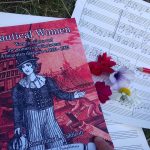
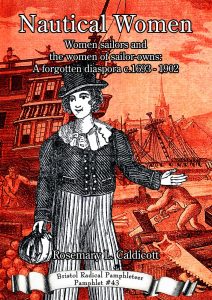
‘Nautical Women’, by Rosemary L Caldicott
‘Nearly every generation has known war. Whatever their reasons, whether press-ganged, patriotic or penniless, many of our ancestors served and their stories from Napoleonic times to the two World Wars can be revealed in the records. The search is on for further speakers to improve our strategy and strengthen our campaign!’
I will be talking about Nautical Women: Women Sailors and the Women of Sailortowns. Brave women in history who disguised themselves as men to work as merchant and navy sailors.
The talk is based on my book of the same name and can be purchased here.
Hello, Thank you so much for being involved in the Bristol Women’s Voice International Women’s Day 2021 programme – we have had some great feedback on the breadth of the programme and individual sessions and we couldn’t have done it without you!
It is always so nice to have positive feedback. I am so glad the attendees enjoyed by talk on Nautical Women. Great audience and some interesting questions at the end too.
I attended some of the other talks and events that BWV laid on, which I really enjoyed. Thank you for inviting me as a guest speaker BWV, and looking forward to another interesting program for next year.
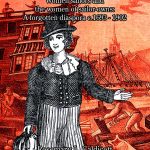
You can purchase my book Nautical Women. Women sailors and the women of sailor towns: A forgotten diaspora c.1693-1902.HERE
This year’s international theme is #ChooseToChallenge and we have programmed a week of online and remote activities from Monday, March 8th to Sunday, March 14th with a couple of activities each day and two full days of events on the weekend, as well as activities that are available all week and some interactive elements that people can join in with at home.
Bristol Women’s Voice are holding online Bristol International Women’s Day events. We have created an exciting and vibrant programme that enables people to stay safe but still connect to celebrate women and girls around this important day – which perhaps is needed now more than ever! This International Women’s Dayare unable to bring you our usual event at City Hall due to the pandemic, so have taken this opportunity to organise a week-long programme of online events. An eclectic mix of workshops, talks, films and panel discussions, playlists and more.
‘Nautical Women’, R L Caldicott.
In her talk Rosemary Caldicott will explore the stories of women whose lives were inextricably linked to the sea. These include women of sailortowns struggling to keep out of the dreaded workhouse and resisting the prowling press gangs; and of the courageous and skilful cross-dressing women sailors who went to extraordinary lengths to hide their gender. Rosemary will discuss the women’s motivation as well as their adventures and inevitable exposure. The stories of these women challenge our stereotypes of women in earlier societies by exposing their struggles against poverty and forced-labour and revealing the courage of those who ‘ran away to sea’.
Speaker:
Rosemary Caldicott is a teacher of social history working in adult education, a writer of books and articles about working class women in history and runs a small genealogy business. Rosemary is secretary of BRHG and has published several works for the group: The Life and Death of Hannah Wiltshire: A Case Study of Bedminster Union Workhouse and Victorian Social Attitudes on Epilepsy (2016) ; Lady Blackshirts: The Perils of Perception – suffragettes who became fascists (2017); Nautical Women. Women sailors and the Women of Sailortowns: A Forgotten Diaspora. c.1693 – 1902 (2019).
Following a talk I gave yesterday about the 1832 Cholera Epidemic in Bristol one the attendees very kindly sent me a fascinating link to a cholera outbreak in the village of Braunston, Northamptonshire, during the last months in 1834.
I have posted the article below, which was published on Braunston Village of the Waterways web site (https://www.braunston.org.uk/).* The article contains a primary source written by a Baptist Minister named the Reverend R Miller and published in a leaflet during 1835.
He wrote the record “for the parishioners of Braunston…to lead them to see “the hand invisible that performs works of judgement and mercy”…..
‘Cholera came to Braunston on the weekend of a Feast Day, the Feast of All Saints’tide. This was a great time in the village. There was no radio, no television, no outside entertainments to enjoy. The villagers congregated with friends and relatives, there were stalls on the Green, and the public houses were filled with folk.
The Rev Miller noted that no company was to abscene debauched, or viciously disposed to answer there purpose. He looked upon the Cholera as a divine intervention upon the evil ways of the villagers.’
In 1834, Cholera came to Braunston. It would seem likely that it had come from London by canal. It has been noted how the East End of London was badly infected by Cholera. Three suspicious cases were noted at Rotherhithe on the south bank of the Thames opposite Limehouse. The Regents Canal commences at the Regent Canal Dock in Limehouse. The canal proceeds north through London’s East End, then westward to reach the Grand Junction Canal at Brentford, from where the canal goes north to Braunston.
‘Our source for a description of the outbreak is in a leaflet printed by J Castell of High Street Daventry in 1835. It had been written by “A Looker-on”. We know that the” Looker-on” was the Baptist Minister at the time; the Rev R Miller. He wrote the record “for the parishioners of Braunston…to lead them to see “the hand invisible that performs works of judgement and mercy”
Cholera came to Braunston on the weekend of a Feast Day, the Feast of All Saints’tide. This was a great time in the village. There was no radio, no television, no outside entertainments to enjoy. The villagers congregated with friends and relatives, there were stalls on the Green, and the public houses were filled with folk.
The Rev Miller noted that no company was to abscene debauched, or viciously disposed to answer there purpose. He looked upon the Cholera as a divine intervention upon the evil ways of the villagers.
The first case occurred on 7th October 1834 from an infected boat. A bed from the boat was left with a Mrs L, for the bed to be washed. Mrs L caught Cholera and died.
About 2nd November, a legger named Patmore, who lived in Cross Lane in Braunston, died , but Cholera was not concidered to be the cause.
Then on 16th November, a Feast Sunday, a child of Patmore died, and another boatman named T Fall also died in Cross Lane. Fall had come from Derbyshire, and after feeling unwell, had left his boat at Crick Wharf a few days before.
The following Monday 17th November, the day of the Celebration of the Feast, there were stalls on the Green, side shows on the road and private parties in the houses with dancing and drinking. The public houses were full of people.
‘The Consequences of the African Slave Trade on Women’:
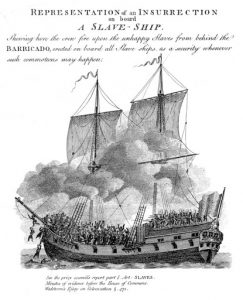
The story of the disastrous voyage of the slave ship Hannibal.
The true story of the slaver ship the Hannibal as told in the diary of its Captain, Thomas Phillips of Brecon and retold in my recently published book Nautical Woman. (To order the book click here link).
John Brown was a black woman found to be a sailor employed by the Royal African Company. As the events of her discovery unfold far more is disclosed about the 700 other people on board the ship.
My illustrated book Nautical Women, which includes the chapter ‘A few Known Black Women Sailors and the Slave Trade: (The Consequences of the African Slave Trade on Women).
‘Nautical Women’, by Rosemary L Caldicott
Can be purchased by emailing here Price £6 plus £2.00 p@p.
sample: On board the slave ship Hannibal in 1693, under Commander Thomas Phillips, a soldier-sailor called John Brown was discovered to be a woman. Phillips was a part owner of the Hannibal, having a £10,000 investment in the Royal African Company ship. During the voyage the ship carried 684-700 stolen African people of which 328 people perished while on-board. John Brown escaped the ship when it docked on the West Coast of Africa never to know the fate of the people that followed.
The book considers the fate of African women who were forced onto the vessels to be traded and sold as slaves and the life of Captain Phillips.
Pub:Bristol Radical History Group. Pamphlet #43. 2019. 108 pages with illustrations.
ISBN 978-1-911522-46-1
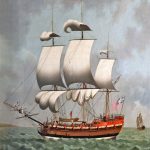
Merseyside Maritime Museum; Supplied by The Public Catalogue Foundation
International Women’s Day 2020 with Bristol Women’s Voice is back!
Join us at City Hall, College Green, Bristol on Saturday 7th March 2020 to celebrate with thousands of women from across Bristol. As usual, you can expect a day packed with performances, activities, discussions and workshops brought to you by many fantastic organisations. Let’s come together to celebrate, learn and inspire each other!
Bristol Radical History Group will be hosting their wonderful, diverse book stall and hopefully Rosemary will get to give a talk (yet to be confirmed).
I am excited to announce my upcoming talks in Bristol during 2020. There were 6 scheduled up until so far this year. The dates and venues to be confirmed during this coming week. The talks will cover both workhouse history and the history of women sailors.
Unfortunately now cancelled until further notice. Please watch this space.
They will be announced on here and on local radio once I am able to re-schedule.
By invitation of The Friends committee of Bishopston Library.
A talk to be given by Rosemary Caldicott
‘Nautical Women. Women sailors and the women of sailortowns.’
Sad, mad and tragic
Author Rosemary Caldicott will be talking about her new book in which she investigated the intriguing histories of nautical women. These include stories of cross-dressing women who went to sea to earn a living and the mad, tragic and often funny consequences they encountered and endured. Living in Bristol, we’re all quite familiar with images of sailing ships – but the focus is usually on the men who built or worked on them. Rosemary wants to bring to life a forgotten history – women sailors and the women of sailor towns.



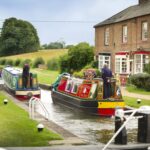 ‘Cholera came to Braunston on the weekend of a Feast Day, the Feast of All Saints’tide. This was a great time in the village. There was no radio, no television, no outside entertainments to enjoy. The villagers congregated with friends and relatives, there were stalls on the Green, and the public houses were filled with folk.