New Review – Voyage of Despair. The Hannibal, its captain and all who sailed her, 1693-1695

Voyage of Despair is a remarkable achievement, tackling challenging material with skill and presenting it in a way that is both accessible and deeply engaging. The narrative takes readers on the harrowing journey of the Hannibal slave ship, a voyage that is as compelling as it is sobering. To say I “enjoyed” the journey feels like the wrong word, given the subject matter, but the book captivates in a way that few historical accounts manage.

What stands out is the careful pacing of the narrative. Questions naturally arise as you read—What happened to John Browne when left behind? Why does an image feature a tiger in a cage during events in Africa?—but rather than leaving readers in the dark, the author skilfully answers these queries in later chapters. This structure encourages thoughtful engagement and reflection throughout.

Beyond its readability, the book is academically rigorous, offering thorough references that firmly establish its place as an important contribution to the field. It balances scholarly depth with a compelling narrative style, a rare feat in historical writing.

The author’s voice is confident and assured, guiding the reader with the expertise of someone deeply immersed in the subject. There are moments where the passion and anger are palpable—particularly in the vivid descriptions of the ships’ appalling conditions by the time they reached Barbados. These passages are powerful and unforgettable.

Voyage of Despair is a masterful work—both a gripping read and a significant academic contribution. For anyone interested in the complexities of history and the human stories within, this book is not to be missed.

Mr Alan Canty (FRCS DDS)

Available to order HERE

Talk! Rosemary Caldicott on her book Voyage of Despair for Newport Rising 2024 | Rosemary Caldicott yn trafod ei llyfr Voyage of Despair ar gyfer Gŵyl Gwrthryfel Casnewydd 2024

NEW TALK!

Rosemary Caldicott, Voyage of Despair | Hanes yn y Hwb | History at the Hub

Rosemary Caldicott on her book Voyage of Despair for Newport Rising 2024 | Rosemary Caldicott yn trafod ei llyfr Voyage of Despair ar gyfer Gŵyl Gwrthryfel Casnewydd 2024

Time & Location

Tuesday 29th October 2024   18:30 – 20:30

Newport Rising Hub, 170 Commercial St, Newport NP NP20 1JN

Rosemary Caldicott is recognized for her commitment to revealing untold narratives from history. Through her original research, she offers a new insight into the history of Captain Thomas Phillips and the Slave Ship Hannibal, delving into the intricacies and difficulties associated with the Phillips legacy in Brecon and all who sailed in her.

Question and answer time with the presenter.

This event is part of Newport Rising 2024 and available on a Pay-What-You Want basis. All funds raised support Newport Rising Festival and related educational activities for registered charity Our Chartist Heritage (Charity number: 1176673)

For more information and to pre-book donation tickets click here.

NEW BOOK OUT NOW! 

“VOYAGE OF DESPAIR: The Hannibal, its captain and all who sailed in her, 1693-1695” LINK HERE

New review – Voyage of Despair. The Hannibal, its captain and all who sailed in her. 1693-1695

New review from Liz Millman: Learning Links international (Black History Wales) 

In this amazing book Rosemary Caldicott shares the complex layers of the challenges faces in 2020 in Brecon, and then takes us back to around 1694 to gain some appreciation of the complexities of the trading done by sea captains with their funders, the Royal Africa Company and others, and with the local West African rulers and merchants.

Rosemary also uncovers stories about the victims, those African subjected to unimaginable abuse and terror not only by the God fearing European traders and sailors, but the treatment inflicted by their African captors.

But yet is a very readable book, a book for the times we are in, it is also extraordinarily complex, but Rosemary shares and explains the commonplace and everyday activities occurring more than 330 years ago, while remembering that we are reading this initially in 2024, and it records a story of the Black Lives Matter times.

At only £12, plus P&P this is a must read, really very timely and accessible, and although not perhaps your first choice of holiday reading, it’s worth having a copy to dip into as you start to face the grim realities of the times back then, or just to reflect and increase your understanding.

Order Here

New Book: “Voyage of Despair”

Voyage  of  Despair

The Hannibal, its captain and all who sailed in her, 1693-1695

by

Rosemary L. Caldicott


Explore the harrowing depths of the slave trade in this poignant microstudy centred on the Hannibal slave ship. Delve into the heart-wrenching realities of this brutal chapter in history.

Journey back to 1693, when Captain Thomas Phillips of Brecon, Wales, set sail from London to Guinea, tasked with procuring 700 enslaved Africans for the Royal African Company of England. Fast forward three centuries to 2010, when the decision of the Brecon Town Council to commemorate Captain Phillips with a plaque causes controversy. Explore this captivating narrative as Rosemary unravels the grim realities of the triangular trade, exposing the brutalities endured by its victims through forgotten stories and meticulous analysis of day-to-day life during this dark chapter in history.

Bristol Post review: “Brecon Town Council honoured a slave ship captain with a memorial plaque in 2010! Rosemary L. Caldicott’s book Voyage of Despair looks both at Phillips journal and other sources to reveal the absolute horrors of the trade in general and the Hannibal’s journey in particular. It also examines the campaign and arguments around the plagues removal. It’s an issue that Caldicott makes clear…the business of enslaving people, and the profits made on the back of it, reach deep into the U.K”

ISBN: 978-1-911522-63-8
Number of pages: 250

ORDER HERE


The role of Museums in constructing an understanding of the TransAtlantic Slave Trade: A Welsh perspective

As I worked on gathering pertinent words that will appear in the index of my forthcoming book: The Journal of Captain Thomas Phillips of Brecon, the Slave Ship Hannibal, and all who Sailed on Her (1693-1695) the key word ‘museum’ appears on my list. Why had a word associated with exhibition interjected itself into a narrative of events that had occurred over 330 years ago?

To answer this question, I refer to the plaque commissioned by Brecon Town Council in 2010 to honour the life of the slave trader Phillips, due to his journal writings. Remarkably, this plaque, which once occupied a public space, found a new home, first in the river Usk, and then within the confines of Y Gaer, Brecon Museum, where it resides in storage rather than on public exhibition.

In a section of my book, I carry out a critical examination of airbrushed history, particularly in light of the recent exposure of Welsh involvement in the trans-Atlantic slave trade. The history of which is now included in the new Welsh Schools curriculum and with Welsh government support in addressing a reassessment of Welsh history.[i] I now find myself regretting not probing deeper at the time of writing the book into museology’s ‘zone of obligation and responsibility’ to rectify and decolonise exhibits and interpretation, but then most factual authors discover new information after the publishers deadline.[ii]

So I will attempt to write here why it is important that our publicly funded museums are required to represent the most unsavoury aspects of British history.  It can be argued that museums are ‘reconstructed realities’ of the past, and therefore have a duty to represent all aspects of history and not just an over sanitised and romantic ‘folk’ history as can be seen in many of our museums. What am I going on about you might rightly ask? Well, for example during the seventeenth and early eighteenth century Welsh cottagers in rural regions toiled in their homes, spinning wool and weaving to produce a textile called ‘Welsh plains’, a type of flannel. At this time it is plausible that they may have had no knowledge that their products would be shipped off to west Africa to trade and profit from the enslavement of African people and to clothe enslaved people in the Americas. However, it is well documented that by the mid-eighteenth century, with the introduction of centralised production, the weavers were aware that Welsh plains were to be shipped to the plantations and west Africa by the merchants the clothe was sold to.[iii] I would argue that exhibitions about wool and textile weaving in Welsh and other communities should explain what the markets for this product were including the west African slave trade .

Our museums are evolving differing ways of how to depict historical events. For example, the layout of the physical building, methodologies, budget constraints, and the number of artefacts, and the role of media might all influence display. But I would argue, never, ever, must honesty in interpretation be compromised. However, when exhibiting an era of history that might include sites of slavery and colonial atrocities, geographical and local political ideology can regretfully come into play as has been experienced by founders of Holocaust museums worldwide.

The trans-Atlantic slave trade is one of the most painful and morally reprehensible chapters of modern human history. Displaying artefacts related to the ‘business’ of the trans-Atlantic slave trade in museums is of paramount importance for several reasons.

Firstly, the trans-Atlantic slave trade was a brutal and dehumanising system that forcibly transported millions of Africans to the Americas as slaves. By displaying trans-Atlantic slave trade artefacts, museums have an opportunity to raise awareness of the scale and  inhumanity of the practice. Artefacts such as removed statues of slave traders, paintings of merchants, plaques, African and colonial artefacts, written evidence, and illustrations, can be exhibited to ensure that our museums act as places of remembrance. Artefacts also serve as tangible evidence of the suffering endured by enslaved Africans and explain how the system operated.

Secondly, museums are invaluable as popular educational institutions, providing a platform for learning beyond books, social media, and television. Abolition artefacts offer a unique opportunity for visitors to engage with history on a personal level. These artefacts can include pamphlets written by Abolitionists, letters, journals, images of meetings, and other historical facts that shed light on the experiences and struggles of those who fought against the trade. Museums can contextualise artefacts, enabling visitors to understand the historical, social, political, and economic factors that drove the trans-Atlantic slave trade along with the efforts to dismantle it from within and without. Engaging with displays enhances the educational experience and develops critical thinking, compassion, and a deeper understanding of the complex issues surrounding slavery and its abolition.

I would argue that our museums should be used to honour the memory of those who suffered and died in the name of greed and exploitation while commemorating the resilience and courage of enslaved individuals and Abolitionists alike. Welsh history has many such examples that museums could draw upon. Abolitionists such as: William Partycelyn, William Dilwyn, Morgan Johnn Rhys, John Elias, and Iolo Morganhwg. Morganhwg is of particular interest. He was a political radical, poet, and as a youth a stonemason. But interestingly he not only refused to stock sugar grown by enslaved people in his shop in Cowbridge, stating that he sold only “East Indian Sweets, uncontaminated with human gore”, he also would not sell his publications to any person in Bristol who was connected to the slave trading merchants of Bristol.[iv]

Museums have the power to influence social change by confronting difficult truths and promoting justice and equality. One such example is when I helped curate the Anne Frank exhibition at Bristol Cathedral. I will never forget the school children’s ‘enlightened’ expressions of empathy with the Jewish girl Anne when they were invited to engage in the act of having to quickly choose three small items they could place into a tiny suit case before Anne was forcibly removed from her hiding place in Amsterdam by the Nazis. Displaying trans-Atlantic slave trade artefacts, begins conversations about contemporary issues such as racism, discrimination, social justice as well as the modern-day slave trade. It encourages visitors to reflect on the historical injustices that continue to shape our world and inspires action towards a more equitable and inclusive society. Museums that offer such experiences to the visitor are always superior in that they enact the past by bringing history into the present. In other words they bring history ALIVE.

My book is an earnest attempt to bring to life a single slave-trading voyage that had ramifications both in the past and in the present day. Phillips was a slaver and captain of the slave ship Hannibal which departed from London in the last months of 1693.  Phillips’s personal observations, along with the unsavoury elements of a devastating story, unfold during the interconnected three continent voyage. Phillips’s maritime journal (which can be viewed at the British Library) offers up evidence for the details of the voyage; details about the enslavers, plantation owners, merchants and goods carried to Africa are all examined in the book. The captain, the crew, the land-owning classes in Barbados and Wales are all examined. I have attempted to remember the hidden voices of his enslaved captives which were airbrushed out of history until recently. Whether I have succeeded will be judged by the reader. Phillips’s world is highly problematic to us today, but this is precisely the reason for exposing it. The real story of Phillips and the Hannibal should be displayed in Brecon Museum rather than as an airbrushed plaque which formerly publicly celebrated him as a ‘great sea captain’. Now is the time to put this right.

Bristol museums and Council are still deciding ‘if and how’ to display the Colston statue.. When (finally) the broken Colston statue was exhibited in M Shed in 2021 after being torn down by protesters the year before, the main protagonists in the campaign to expose the history of the slave-trader were largely written out. The historic defenders of the ‘cult of Colston’ the Society of Merchant Venturers and the Church of England were absent from the display and the role of long-standing campaigners, and the history of their activities was minimised. Instead it appeared that the battle over Colston was a so-called ‘culture war’ between angry ‘racist’ letter writers and protestors from Black Lives Matter, neither of whom had control over the Colston legacy. Since a brief public ‘consultative display’ in 2021 the Colston statue has languished in a secret location and Bristol Culture have kicked the can down the road. On top of this, the long-standing Abolition Shed campaign for a memorial and a dedicated museum/visitor centre to remember the trans-Atlantic slave trade has been variously ignored and undermined by the elected Mayor and the Labour group on Bristol City Council.

Displaying trans-Atlantic slave trade artefacts in museums is

[i] “Public Commemoration in Wales: New Guidance to Help Create a More Informed Relationship with Our History,” Published and updated in November, 2022. [https://www.gov.wales/public-commemoration-wales-new-guidance-help-create-more-informed-relationship-our-history] and, “Black and Ethnic Minority History Studies”. June, 2022.  [https://www.gov.wales/annual-report-implementation-recommendations-black-asian-and-minority-ethnic-communities]

[ii] Recent communication with Y Gaer, Brecon museum, has informed me that in the future there are plans to house a temporary exhibition of the Phillips plaque.

[iii]  See: Marian Gwyn. 2020, ‘Meirioneth and the Atlantic Slave Trade’, Journal of the Merioneth Historical and Record Society, vol 18, no 3, pp. 284-298. [https://www.academia.edu/es/51584736/Merioneth_Wool_and_the_Atlantic_Slave_Trade]

Also, Adam N. Coward. ‘Welsh Wool, Slavery, and the Built Environment’. Royal Commission on the Ancient and Historical Monuments of Wales. [https://rcahmw.gov.uk/welsh-wool-slavery-and-the-built-environment/]

[iv] Nick Skinner ‘The Welsh Abolitionist’s’ B:M2023 19 September, 2023. [https://www.blackhistorymonth.org.uk]


South Bristol History Festival – October through November 2023

South Bristol History Festival is back! Organised by Bristol Radical History Group

An exciting and engage programme has been arranged.

Bristol Radical History Group (BRHG) are putting on a series of events over the autumn of 2023 uncovering hidden histories of south Bristol.

The Bedminster-Southville history festival in October features history talks, a walk and an exhibition exploring the radical face of Bedminster before and after WW1, hidden histories of Ashton Court Estate and West Street, the storming of the New Gaol in 1831, women prisoners from Bedminster transported to Australia and strikes by British Army units at the White City.

In November we move further south to investigate the Knowle Wester who tried to kill fascist leader Oswald Mosely, launch Paul Smith’s book Hartcliffe Betrayed on the design of the estate and explore the history of some of its activists.

All the events are free as our libraries, the Tobacco factory, St Paul’s Church, United Reform Church, and community centres are offering their spaces for no cost.

Venue Date Session (pm) Title Speakers
Tobacco Factory Thurs 5th October 6.30-7.30 Haunting Ashton Court LIVE Elinor Lower, Jack Young
Tobacco Factory Thurs 12th October 6.30-7.30 The Dean Lane Pit disaster of 1886 Tony Dyer
Bedminster Library Tues 17th October 2.00-3.00 Trouble on the trams Bob Whitfield
Tobacco Factory Thurs 19th October 6.30-7.30 Trouble at the White City – strikes in the British armed forces in 1919 Roger Ball
Bedminster Library Tues 24th October 2.00-3.00 ACTA’s historical plays Ingrid Jones
Tobacco Factory Thurs 26th October 6.30-7.30 The rise and fall of Edward Colston – the real story Countering Colston
Walk: Ropewalk Pub Bedminster Parade Sun 29th October 2.00-4.00 The radical face of Bedminster in the early 20th Century. Trevor Houghton
Bedminster Library Tues 31st October 2.00-3.00 From Bedminster to Van Diemen’s Land Sheila Hannon
United Reform Church Tues 31st October 11.00-1.00 Soup and stories Jackie Smith
St Pauls’ Church Thurs 2nd November 2.00-3.30 The 1831 Bristol reform riot – a view from the Southbank Steve Poole, Roger Ball
United Reform Church Sat 4th November 1.00-5.00 West Street Stories Way Out West


Title: “The Journal of Captain Thomas Phillips of Brecon, the Slave Ship Hannibal, and all who Sailed on Her” – Unveiling a Forgotten Voyage

Journey into History – A reflection from a friend who read my shortly to be published book.

Prepare to be transported to the heart of a pivotal era with this upcoming new book. This compelling narrative uncovers the untold stories of the slave ship “Hannibal” its enslaved passengers and crew. It goes on to shed a much need new light into a dark chapter in human history with links to Brecon, Wales. Set against the backdrop of the transatlantic slave trade, the book brings the 17th century to life from Brecon, to the west coast of Africa and onto Barbados. Delve into the ship’s harrowing journey, from bustling ports, the exploitive mercantile capitalism of the Royal African Company, battles at sea, to the unimaginable suffering endured by the enslaved individuals who sailed upon her. Through meticulous research, personal accounts, and archival materials, the book resurrects the voices of those who history often forget. A harrowing and intriguing read which brings the world of a slave trading captain to life.

The life of a slave trading captain stands as a grim testament to the depths of human cruelty and the moral complexities of their era. These captains were both the architects and enforcers of a brutal system that traded in human lives, perpetuating untold suffering for profit. Born into a world where economic interests often trumped ethical considerations, these captains often grew up in societies where the practice of slavery was deeply ingrained. They were groomed from a young age to see enslaved individuals as mere commodities, stripped of their humanity and subjected to unspeakable horrors in the pursuit of monetary gain.

As they embarked on their voyages, these captains navigated treacherous waters both literally and morally. They faced the challenges of uncertain weather, navigational hazards, and hostile ships, all while being weighed down by the weight of their human ‘cargo’. The conditions on board the slave ships were deplorable, with enslaved people crammed into tight spaces, subjected to disease, malnutrition, and unimaginable suffering.

In their role as captains, they held authority and power over those unfortunate souls trapped in the hold of their ships. They had the capacity to demonstrate some semblance of kindness or, more commonly, to wield their power with brutality and violence. The choices they made had life-and-death consequences for those under their control.

The story of this slave trading captain, Captain Thomas Phillips of Brecon, serves as a haunting reminder of the darkest chapters of human history. It underscores the need for acknowledging the past, understanding the factors that led to such atrocities, and striving to ensure that such inhumane practices are never repeated. Through a broader historical lens, we’re reminded of the crucial importance of progress, empathy, and justice in shaping a more humane world for all.

Compelling excerpts from the book can be found in these articles posted HERE

“Hannibal” leaves an indelible mark, compelling us to confront the legacy of the transatlantic slave trade. By reflecting on the past, we’re empowered to address the ongoing injustices that shape our world, creating a more just and equitable future.

Soon to be available from Bristol Radical History Group


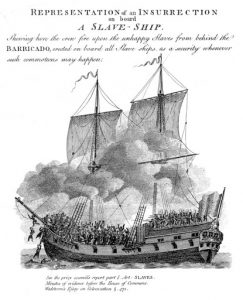
Revolt on a slave ship

Colonialism and Memory in Bristol

Rosemary Caldicott and Mark Steeds will be speaking at the Colonialism and Memory in Bristol as part of Mnemoscapes of the South West SWWDTP Memory Studies Research Cluster.

Join us for a public workshop on colonialism and memory in Bristol. Moving between the museum, the city, and space for discussion and reflection, we’ll be asking what decolonisation means, what it might look like in practice, as well as the challenges facing these efforts.

Join us at the M Shed in Bristol on 1st July,

The workshop is free and refreshments and lunch will be provided, but space is limited to 30 places.

10:45-12:45  – A city walking tour by Mark Steeds (Bristol Radical History Group) including the Colston plinth.

15:30-16:30  – BRHG members Mark Steeds and Rosemary Caldicott will be speaking.

Mark Steeds will talk about Stevenson’s story from San Francisco, where he undertook his voyage of the South Seas, travels to Hawaii and then on ultimately to Samoa. He became an activist, witnesses the king of Hawaii being usurped by the Americans, the Anglican attack on Father Damien and his Leper colony, and the first Samoan ‘Civil War’. His wife Fanny stayed on and witnessed the second Samoan civil war that led to western domination (British, American and German).  Marks research is in support of the Long John Silver Trust and our European Cultural Route: -“In the Footsteps of Robert Louis Stevenson”.

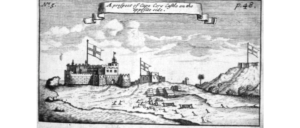
          Cape Coast Castle 1705


Rosemary Caldicott will be speaking about the maintenance and subsequent implications of the Royal African Company forts in West Africa. Her research is based upon her forthcoming book about the RAC Hannibal Slave-ship (1693-1695) and her previous publication Nautical Women – Women sailors & the Women of Sailortowns: A Forgotten  Diaspora c.1693–1902.

For further information about this event and the full program please link here

Event held on Saturday 1st July 10.00-1730

at M Shed Wapping Road Bristol BS1 4RN

The Slave-Ship Hannibal 1693-1695. New Talk!

Black History Month Lecture 

The Slave-Ship Hannibal and all who sailed on Her. (1693-1695).

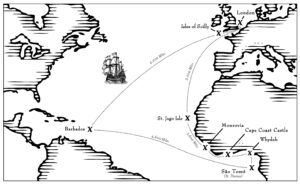
The voyage of the Hannibal slave-ship. 1693-1695. Credit Lisa Liebelt

Black History Month: Britain’s history and involvement in the Trans-Atlantic Slave Trade.

Come along and hear the tragic but enlightening story of the Brecon born slave trading captain Thomas Phillips, what happened to his crew, and the captured 700 enslaved people on his ship the Hannibal. This talk is based on my original research as discovered in the National Archives and the British Library. For the first time the human stories are revealed about all who sailed on her.


Thursday, 13 October.  2pm to 4pm by Rosemary Caldicott 

To book telephone Tel: 0117 903 8844

or Email: StokeLodge@bristol.gov.uk

 or BOOK HERE

Congratulations to the Republic of Barbados!

On Tuesday 30 November 2021, marking the 55th anniversary of independence from Britain, Barbados proudly became a republic.

Barbados has a long and painful history with Britain which dates back to the era of the forced transportation of enslaved Africans to work on British owned plantations.

For the full article and to learn more about about the saga of the slave-ship Hannibal click here

The voyage of the Hannibal slave-ship. 1693-1695. Credit Lisa Liebelt