As I worked on gathering pertinent words that will appear in the index of my forthcoming book: The Journal of Captain Thomas Phillips of Brecon, the Slave Ship Hannibal, and all who Sailed on Her (1693-1695) the key word ‘museum’ appears on my list. Why had a word associated with exhibition interjected itself into a narrative of events that had occurred over 330 years ago?
To answer this question, I refer to the plaque commissioned by Brecon Town Council in 2010 to honour the life of the slave trader Phillips, due to his journal writings. Remarkably, this plaque, which once occupied a public space, found a new home, first in the river Usk, and then within the confines of Y Gaer, Brecon Museum, where it resides in storage rather than on public exhibition.
In a section of my book, I carry out a critical examination of airbrushed history, particularly in light of the recent exposure of Welsh involvement in the trans-Atlantic slave trade. The history of which is now included in the new Welsh Schools curriculum and with Welsh government support in addressing a reassessment of Welsh history.[i] I now find myself regretting not probing deeper at the time of writing the book into museology’s ‘zone of obligation and responsibility’ to rectify and decolonise exhibits and interpretation, but then most factual authors discover new information after the publishers deadline.[ii]
So I will attempt to write here why it is important that our publicly funded museums are required to represent the most unsavoury aspects of British history. It can be argued that museums are ‘reconstructed realities’ of the past, and therefore have a duty to represent all aspects of history and not just an over sanitised and romantic ‘folk’ history as can be seen in many of our museums. What am I going on about you might rightly ask? Well, for example during the seventeenth and early eighteenth century Welsh cottagers in rural regions toiled in their homes, spinning wool and weaving to produce a textile called ‘Welsh plains’, a type of flannel. At this time it is plausible that they may have had no knowledge that their products would be shipped off to west Africa to trade and profit from the enslavement of African people and to clothe enslaved people in the Americas. However, it is well documented that by the mid-eighteenth century, with the introduction of centralised production, the weavers were aware that Welsh plains were to be shipped to the plantations and west Africa by the merchants the clothe was sold to.[iii] I would argue that exhibitions about wool and textile weaving in Welsh and other communities should explain what the markets for this product were including the west African slave trade .
Our museums are evolving differing ways of how to depict historical events. For example, the layout of the physical building, methodologies, budget constraints, and the number of artefacts, and the role of media might all influence display. But I would argue, never, ever, must honesty in interpretation be compromised. However, when exhibiting an era of history that might include sites of slavery and colonial atrocities, geographical and local political ideology can regretfully come into play as has been experienced by founders of Holocaust museums worldwide.
The trans-Atlantic slave trade is one of the most painful and morally reprehensible chapters of modern human history. Displaying artefacts related to the ‘business’ of the trans-Atlantic slave trade in museums is of paramount importance for several reasons.
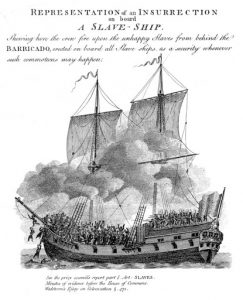
Firstly, the trans-Atlantic slave trade was a brutal and dehumanising system that forcibly transported millions of Africans to the Americas as slaves. By displaying trans-Atlantic slave trade artefacts, museums have an opportunity to raise awareness of the scale and inhumanity of the practice. Artefacts such as removed statues of slave traders, paintings of merchants, plaques, African and colonial artefacts, written evidence, and illustrations, can be exhibited to ensure that our museums act as places of remembrance. Artefacts also serve as tangible evidence of the suffering endured by enslaved Africans and explain how the system operated.
Secondly, museums are invaluable as popular educational institutions, providing a platform for learning beyond books, social media, and television. Abolition artefacts offer a unique opportunity for visitors to engage with history on a personal level. These artefacts can include pamphlets written by Abolitionists, letters, journals, images of meetings, and other historical facts that shed light on the experiences and struggles of those who fought against the trade. Museums can contextualise artefacts, enabling visitors to understand the historical, social, political, and economic factors that drove the trans-Atlantic slave trade along with the efforts to dismantle it from within and without. Engaging with displays enhances the educational experience and develops critical thinking, compassion, and a deeper understanding of the complex issues surrounding slavery and its abolition.
I would argue that our museums should be used to honour the memory of those who suffered and died in the name of greed and exploitation while commemorating the resilience and courage of enslaved individuals and Abolitionists alike. Welsh history has many such examples that museums could draw upon. Abolitionists such as: William Partycelyn, William Dilwyn, Morgan Johnn Rhys, John Elias, and Iolo Morganhwg. Morganhwg is of particular interest. He was a political radical, poet, and as a youth a stonemason. But interestingly he not only refused to stock sugar grown by enslaved people in his shop in Cowbridge, stating that he sold only “East Indian Sweets, uncontaminated with human gore”, he also would not sell his publications to any person in Bristol who was connected to the slave trading merchants of Bristol.[iv]
Museums have the power to influence social change by confronting difficult truths and promoting justice and equality. One such example is when I helped curate the Anne Frank exhibition at Bristol Cathedral. I will never forget the school children’s ‘enlightened’ expressions of empathy with the Jewish girl Anne when they were invited to engage in the act of having to quickly choose three small items they could place into a tiny suit case before Anne was forcibly removed from her hiding place in Amsterdam by the Nazis. Displaying trans-Atlantic slave trade artefacts, begins conversations about contemporary issues such as racism, discrimination, social justice as well as the modern-day slave trade. It encourages visitors to reflect on the historical injustices that continue to shape our world and inspires action towards a more equitable and inclusive society. Museums that offer such experiences to the visitor are always superior in that they enact the past by bringing history into the present. In other words they bring history ALIVE.
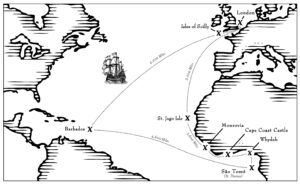
My book is an earnest attempt to bring to life a single slave-trading voyage that had ramifications both in the past and in the present day. Phillips was a slaver and captain of the slave ship Hannibal which departed from London in the last months of 1693. Phillips’s personal observations, along with the unsavoury elements of a devastating story, unfold during the interconnected three continent voyage. Phillips’s maritime journal (which can be viewed at the British Library) offers up evidence for the details of the voyage; details about the enslavers, plantation owners, merchants and goods carried to Africa are all examined in the book. The captain, the crew, the land-owning classes in Barbados and Wales are all examined. I have attempted to remember the hidden voices of his enslaved captives which were airbrushed out of history until recently. Whether I have succeeded will be judged by the reader. Phillips’s world is highly problematic to us today, but this is precisely the reason for exposing it. The real story of Phillips and the Hannibal should be displayed in Brecon Museum rather than as an airbrushed plaque which formerly publicly celebrated him as a ‘great sea captain’. Now is the time to put this right.
Bristol museums and Council are still deciding ‘if and how’ to display the Colston statue.. When (finally) the broken Colston statue was exhibited in M Shed in 2021 after being torn down by protesters the year before, the main protagonists in the campaign to expose the history of the slave-trader were largely written out. The historic defenders of the ‘cult of Colston’ the Society of Merchant Venturers and the Church of England were absent from the display and the role of long-standing campaigners, and the history of their activities was minimised. Instead it appeared that the battle over Colston was a so-called ‘culture war’ between angry ‘racist’ letter writers and protestors from Black Lives Matter, neither of whom had control over the Colston legacy. Since a brief public ‘consultative display’ in 2021 the Colston statue has languished in a secret location and Bristol Culture have kicked the can down the road. On top of this, the long-standing Abolition Shed campaign for a memorial and a dedicated museum/visitor centre to remember the trans-Atlantic slave trade has been variously ignored and undermined by the elected Mayor and the Labour group on Bristol City Council.
Displaying trans-Atlantic slave trade artefacts in museums is
[i] “Public Commemoration in Wales: New Guidance to Help Create a More Informed Relationship with Our History,” Published and updated in November, 2022. [https://www.gov.wales/public-commemoration-wales-new-guidance-help-create-more-informed-relationship-our-history] and, “Black and Ethnic Minority History Studies”. June, 2022. [https://www.gov.wales/annual-report-implementation-recommendations-black-asian-and-minority-ethnic-communities]
[ii] Recent communication with Y Gaer, Brecon museum, has informed me that in the future there are plans to house a temporary exhibition of the Phillips plaque.
[iii] See: Marian Gwyn. 2020, ‘Meirioneth and the Atlantic Slave Trade’, Journal of the Merioneth Historical and Record Society, vol 18, no 3, pp. 284-298. [https://www.academia.edu/es/51584736/Merioneth_Wool_and_the_Atlantic_Slave_Trade]
Also, Adam N. Coward. ‘Welsh Wool, Slavery, and the Built Environment’. Royal Commission on the Ancient and Historical Monuments of Wales. [https://rcahmw.gov.uk/welsh-wool-slavery-and-the-built-environment/]
[iv] Nick Skinner ‘The Welsh Abolitionist’s’ B:M2023 19 September, 2023. [https://www.blackhistorymonth.org.uk]