New Course Spring 2026 – Discovering your Family History Made Easy

Discovering your Family History Made Easy 

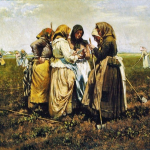
Women Turnip Hoeing
Turnip Hoeing

Gain a deeper understanding of the most used family history resources, and the use of correct research techniques. Topics covered: how to use online genealogical search websites in a professional way; how to interpret correctly census records, parish registers, birth, marriage and death certificates

Location: Stoke Lodge, Bristol (BS9 1BN)

Start Date: 14 Jan 2026 (Spring)   Times: Wed 18:30-20:30   Duration: 10 weeks

Places selling fast – only a few places left.

BOOK NOW HERE

The Birth of Civil Registration: Unveiling the Early Years (1837-1875)

When researching family history, there is an often overlooked era that played a crucial role in shaping how we trace our roots: the period of early civil registration in England and Wales, spanning from 1837 to 1875. While these dates might seem unassuming, they mark the onset of a significant transformation in record-keeping, which eventually led to a more streamlined and accessible way of documenting vital life events, such as births, marriages, and deaths.

When you begin your journey into genealogy in England and Wales, you typically start with birth, marriage, and death certificates. These documents are your initial gateway to uncovering your family’s past. As you delve deeper into census data, parish records, and historical documents, it’s easy to get caught up in the thrill of the hunt without pausing to reflect on the origins and intricacies of the records you’re using.

In 1832, a bill proposing the registration of births was introduced but failed to pass into law. Subsequent attempts in 1834 and 1836 were met with numerous amendments. The 1836 legislation, although imperfect, managed to navigate the legislative hurdles, primarily because the alternative was to abandon the change to the system. The background to BM&D registration was to establish a secular, neutral system of registering vital events – a concept already implemented in other countries like France, thanks to Napoleon’s efficient civil registration system.

Notably, the proponents of civil registration were often non-conformists and liberals. Before civil registration, the Church of England held a de facto monopoly on vital records, granting their registers a special legal status. Even other religious groups, despite maintaining meticulous records, did not enjoy the same legal recognition. As more people from diverse religious backgrounds emerged, the Church of England’s grip began to loosen.

The Church’s resistance to civil registration was rooted in a combination of ideological beliefs and financial interests. The Church had a financial stake in the process, which included probate, poor relief, and registration. Over time, these functions shifted from religious authorities to secular institutions, resulting in the Church losing substantial revenue.

The battle over civil registration played out in politics. The House of Lords was a stronghold for the Church of England, populated by bishops and a conservative Tory majority. In contrast, the House of Commons oscillated between Whigs and Tories, which led to vigorous debates throughout the 1830s. Legislation required approval from both houses, and with many alterations, the 1836 bill finally passed, albeit with several ambiguities.

Civil registration utilised existing poor law unions established in 1834, which became registration districts, creating a seamless system. However, the lords introduced some significant changes. Originally, all marriages were to occur by certificate, regardless of religious affiliation. The lords reinstated banns for church marriages, and for civil or non-Church of England ceremonies, they mandated the reading of notices in public places.

The birth of civil registration ushered in a new era, replacing the church-based system and offering secular registration. In those early years, civil marriage ceremonies were infrequent; the primary role of civil registrars was to oversee marriages conducted in various religious denominations, from Catholic churches to Baptist congregations. Pure civil marriages were exceedingly rare in the 19th century.

The General Register Office initially focused on record-keeping and financial aspects, evolving over time to incorporate a statistical role. However, the statistics were not the primary concern in the earliest years of civil registration. The GRO was divided into departments, each with a specific function: records, accounts, and correspondence. The statistical branch emerged later, reflecting the changing priorities of the office and governance.
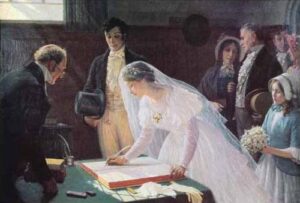
Civil registration records were used to validate existing knowledge rather than uncover new information. The certification requirement, which still prevails in England and Wales, was essential to provide official documentation of birth, marriage, or death, ensuring its legal recognition. The cost of certification reflects the rigorous security measures involved in producing certified copies, including special secure paper and meticulous record-keeping.

While the Church of England played a significant role in opposing civil registration, it was not the sole adversary with some members of the clergy resisted registration efforts.

Civil registration was not without its challenges and opposition, but it was a milestone in the quest for a secular, neutral system to record vital life events. The birth of civil registration in 1837 marked a significant shift away from church-based records and toward a more inclusive and standardised method of recording life’s most crucial events. As we explore our family history, let’s not forget the stories and struggles behind the records we so often take for granted. Civil registration’s journey is a testament to the enduring importance of preserving and accessing our family heritage.

Researched from The National Archives.

Why use a professional genealogist?

Using a professional genealogist, like Heritage Found can offer several valuable benefits for individuals seeking to research and understand their family history. Here are some reasons why someone might choose to work with a professional genealogist:

  1. Expertise and Experience: Professional genealogists have a deep understanding of research methodologies, historical records, and resources related to genealogy. They possess the knowledge and skills to navigate complex and often obscure archives, databases, and documents that may not be easily accessible to the general public.
  2. Efficiency: Genealogy research can be time-consuming and require a significant investment of effort. Professional genealogists know where to look and how to optimize their research process, potentially saving you countless hours of searching.
  3. Accurate and Reliable Information: Genealogists are trained to critically analyse sources, cross-reference information, and validate facts. This helps ensure that the information you receive is accurate and reliable, reducing the risk of propagating incorrect family histories.
  4. Access to Resources: Many professional genealogists have access to subscription-based databases, archives, and libraries that might not be accessible to the general public. These resources can provide vital information and clues to uncovering your family’s history.
  5. Brick Wall Breakthroughs: If you’ve hit a dead end or encountered a “brick wall” in your research, a professional genealogist can bring fresh perspectives and innovative approaches to overcome these challenges.
  6. Customized Research Plans: Genealogists can tailor their research strategies to your specific goals and needs. Whether you’re interested in tracing a specific ancestor, exploring a particular lineage, or discovering your ethnic heritage, a professional genealogist can focus their efforts accordingly.
  7. Organized Documentation: Genealogists are skilled at documenting and organizing their research findings in a clear and coherent manner. This documentation can be invaluable for future reference, sharing with family members, or preserving your family’s history for generations to come.
  8. Language and Regional Expertise: If your ancestry spans different countries or regions with varying languages and cultural nuances, a professional genealogist with expertise in those areas can navigate challenges associated with language barriers, changing borders, and differing record-keeping practices.
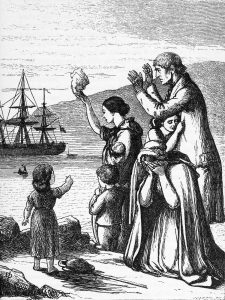
  9. Leaving Ireland, Henry Doyle 1827-1892. Mary Frances Cusack. Illustrated History of Ireland, 1968.

    Resolving Family Mysteries: If your family has long-standing mysteries, myths, or unanswered questions, a professional genealogist can help uncover the truth and shed light on hidden aspects of your family history.

  10. Educational Opportunities: Many professional genealogists offer educational services alongside their research, helping you understand the methods they use, the historical context of your family’s story, and how to continue your own research in the future.
  11. Preserving Heritage: Genealogists can assist in preserving family stories, traditions, and cultural heritage. They can uncover narratives that might have been forgotten, ensuring that your family’s history is passed down accurately..

Back to Basics – What is a UK Birth Certificate? and What can it tell us about our Ancestors?

What is a UK Birth Certificate?

A UK birth certificate is an official document issued by the General Register Office (GRO) or a local registration office. It records essential information about an individual’s birth, including their full name, date and place of birth, parents’ names, and registration details. It is considered a primary source of evidence for establishing identity and citizenship in the UK.

  1. Information Included on a UK Birth Certificate

a. Child’s Details:

  • Full name of the child: This is the name given to the child at birth and appears as the first entry on the certificate.
  • Date of birth: The exact date when the child was born.
  • Place of birth: The city or town and the country where the birth occurred.

b. Parents’ Details:

  • Full names of both parents: The names of the biological parents, including the mother’s maiden name.
  • Occupation of parents: This section may include the parents’ occupations at the time of the child’s birth but often the mothers occupation if she was married was not recorded..
  • Date of parents’ marriage/civil partnership: If applicable, the date of marriage or civil partnership between the child’s parents.

c. Registration Details:

  • Registration district and sub-district: The geographical area where the birth was registered.
  • Registration date: The date when the birth was officially registered.
  1. Types of UK Birth Certificates

There are two main types of UK birth certificates:

a. Short/Abbreviated Certificate:

  • This type of certificate includes only the child’s details (name, date, and place of birth) and the registration details.
  • The short certificate does not include the parents’ information, making it unsuitable for legal and official purposes.

b. Full/Long Certificate:

  • The full certificate contains all the information present on the short certificate, along with the names and details of both parents.
  • This certificate is required for various legal purposes, such as obtaining a passport, opening a bank account, and applying for certain benefits.
  1. Obtaining a UK Birth Certificate

If you need a copy of a UK birth certificate, there are several ways to obtain one:

a. Online Application: The General Register Office offers an online service where you can order a copy of a birth certificate for a fee.

b. In-Person: You can visit the local registration office where the birth was registered and request a copy in person.

c. Do not apply via ‘tracing your ancestors web-sites’ as they will charge you a lot more than the GRO and Heritage Found!

d. Contact Heritage_Found@yahoo.co.uk and we will take care of your orders for only a modest fee.

Conclusion

A UK birth certificate is an indispensable document that provides vital information about an individual’s birth and parentage. Understanding its contents and types can be crucial for various life events, official procedures and confirmation that you have found the right person to confirm your research is correct.

New Family History Course beginning September in Bristol

Discover your Family History –

Discovering your Family History made easy: For complete beginners and the amateur Genealogist.                                                                                       

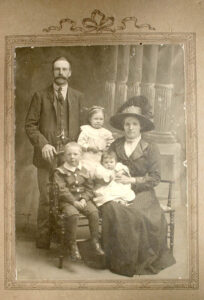
Heritage Found black and white image of family

Delve into the fascinating world of ancestral exploration and gain valuable skills to trace your roots. Discover how to harness the power of online genealogical search websites, master UK and other countries census records and parish registers, and decipher birth, marriage, and death certificates with ease. Create a stunning family tree that showcases your heritage and avoid the pitfalls that often trap amateur genealogists. Embark on a thrilling journey of self-discovery and connect with your ancestors in ways you never thought possible. Enrol now and unearth the hidden treasures of your family history!                 

(I could take one more)


Wednesdays 6.30pm-8.30pm                                                           

10 sessions from 27th September at Stoke Lodge, Bristol

To enquire or book please click HERE

New course: Researching you Family History – Part 2

Discover your Family History –  Introduction to Researching your Family History

Part 2 – Discover your Family History and so much more!

An exploration of Family History. This course will be delivered at Stoke Lodge but will move online if necessary using ZOOM.Heritage Found black and white image of family

Course code FHR2C.  Begins Thursday 10 March 2022 for 5 weeks. 14:00-16:00

A practical easy learning technique to learn how to research and record family history with confidence. A fun approach, in a safe, inclusive environment with other learners. Correct interpretation of vital records, including Parish Records, and tips on how to improve research techniques. Learners should be able to produce at least a 6-generation family tree by week 5. A fun approach, in a safe, inclusive environment with other learners. A mixture of lectures and practical work.

Join award winning tutor Rosemary Caldicott to better understand how to discover your ancestors.

FOR MORE INFORMATION ON ENROLMENT AND TO BOOK HERE

The U.K. 1921 Census will be released on 6 January 2022

What is the 1921 Census of England and Wales?

The 1921 Census gives us the names, ages, occupations and addresses of 38 million people living in the U.K. and are available online from 6 January 2022

The 1921 Census is very important due to the fact that the 1931 Census was destroyed in a fire. Then, the 1941 Census was cancelled due to the Second World War. Therefore the 1921 Census is the only record to become available for the next 30 years other than the 1939 registration war time mini-census.
It’s also the most documented record set up to that time because it was the first census to recognise divorce. For the first time we have documents that will reveal family secrets and surprises that this interwar census brings. These documents will also sadly reveal the many widows and children now living without husbands and fathers due to WWI.

The 1921 Census can be viewed at  findmypast.co.uk from 6 January 2022. The National Archives, Kew have worked with Find my Past to digitalise the documents.

For help to discover you family history contact Heritage Found!

Reading Old Handwriting

Tips for Reading Old Handwriting

Family history is all about finding and reading documents, whether you look at scanned images on line or hunt for the originals in record offices. As you work your way back from recent certificates to older wills and parish registers, the writing on older documents becomes tricky. The words and their meanings—and even the shapes of the letters themselves—have changed over time. Understanding these documents correctly is time consuming but be the key to comprehending your ancestors’ lives.
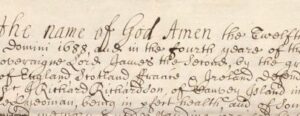
Much of the reading relies on contextual clues because the language is outdated and will use an old-fashioned spelling and consistency of spelling prior to the introduction of compulsory schooling and advent of the modern dictionary.[i]

As you move into the 17th and 18th centuries, you will find far more variation. Spelling can be particularly difficult, as spellings were not standardized until compulsory education began around 1870. Surnames and place names in particular can have a wide variety of spellings, even on the same page! During this time most of the population could not write, so there was little need for a universal style.

Different styles of handwriting

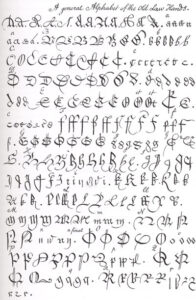
The first style you will come across is Round Hand, a free-flowing, expressive way of writing is common in personal papers and letters from the 18th century. It’s not too far away from how we write today, although early examples may use different shapes for capital letters, almost interchangeable i’s and j’s, and a long s, f replaces s.

These variations are a hangover from the precursor to round hand, secretary hand. This style emerged in the 16th century and dominated in England for almost 200 years, so you will often come across it on parish registers. Secretary hand can look like nothing but scribbles at first but if you take the time to look at individual letters in turn you will often find you can decipher it.

Tips

  • Print or enlarging the image.
  • Scan or photograph original documents to zoom in.
  • Read wills in short bursts and revisit from time to time.

Tricky letters, spellings, and abbreviations

  • There were no standard spelling rules before 1755 in England and before 1828 in the United States.
  • In the past, a long form of the letter s looked like our contemporary letter f.
  • Words currently spelled with the letter i were often formerly spelled with the letter y; for example, “mine” was spelled “myne.”
  • The letters u and v were frequently interchanged; the word “ever,” for example, was often spelled “euer.”
  • The letter j was often replaced with i, so the name “James” may appear as “Iames.”
  • The word cousin often meant niece or nephew.
  • The title Mrs. could show high social status, not necessarily marital status.
  • Good brother or good sister in a document means brother- or sister-in-law.
  • The term in-law was also used to describe step-parents.

Common shorthand

The letter y often replaced the letters th; for example, “the” was often written “ye.”

The symbol @ sometimes replaced the word per, for example if you come across @week it most likely means “per week.”

Recommended

  1. Look up unfamiliar or archaic words and abbreviations online.
  2. Research the kind of document you are working with; certain documents may have specific phrases, jargon, and abbreviations. Understanding the document’s historical context can help you read the handwriting and understand its meaning.
  3. Read the document aloud; hearing it may help you to recognize unfamiliar words.
  4. Write the words yourself by placing tracing paper over a photocopy of your document and tracing each word. Creating the characters of the text may help you understand the words and the context.
  5. Make an alphabet chart as you go. Write out the alphabet on a separate piece of paper, then copy examples from the document for each letter, both lower- and uppercase. It is usually easiest to identify letters in more obvious words like names and places, then refer to your chart to help with more difficult words.

[i] Graham Jaunay. Cracking the code of old handwriting. Unlock the past. 2011

International Women’s Day – Our Ancestors and Divorce

Occasionally we come across an old divorce petition, a legal document that will bare all.  These documents make incredibly sad reading, but at the same time offer us a fascinating insight into the lives of our ancestors. They can be a deeply private and intimate glimpse into a couple’s marriage; heart wrenching to read, with each person’s account laid bare in blunt legal descriptions, leaving us to judge which side is telling the truth.

Divorce cases were heard in public in open court during the 19th century and a legal separation or divorce was only for the very wealthy. A married woman’s property automatically became her husband’s, and upon divorce the children remained the property of their father which was of course used as a means to control women residing in unhappy marriages. Mothers who left a marriage risked being prevented from seeing their children following a divorce or separation.

Things begin change a little after the 1857 Matrimonial Causes Act, but the law was still stacked in favour of the man. Under the new law, women divorcing on the grounds of adultery not only had to prove that their husbands had been unfaithful, but also had to prove additional faults, which included cruelty, rape and incest. Men, of course, just had to prove their wives had been unfaithful and in an age before cameras, videos and smartphones, this was often a tricky task! Before 1857, divorce was mainly open only to men, and had to be granted by an Act of Parliament.

In 1858 the handling of the legal process for divorce was transferred from the ecclesiastical courts to a newly established civil court, the Court for Divorce and Matrimonial Causes. In 1873 responsibility was passed to a division of the new Supreme Court. All divorce cases took place in London, yet again restricting divorce to wealthier couples only.

Recently, while researching a family tree I came across a divorce petition document dated 1875 which is stored at the National Archives in London. The couple were a moderate middle class farming couple who had been married for 25 years and were childless. This is a surprising case not only because of the financial implications for particularly the woman involved, but also because in the 19th century, divorce was extremely rare, and generally considered unthinkable for social, financial, and religious reasons. Unhappy couples would often separate but not legally get divorced as can be seen in family history archives. The petitioner in this case was the husband. I have changed the names and addresses in the following reproduction due to the sensitive nature of some of the central claims in the original legal document.
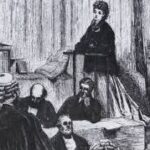
Victorian woman in divorce courtWe begin with the wife’s petition in this divorce case, dated February 1875 and claiming that her husband:
  • ‘the she denies that she was guilty of adultery as alleged.’
  • ‘That in or about the year 1865 the petitioner beat, assaulted and otherwise illtreated her threaten to kill her and greatly terrified her and on two occasions turned his wife out the house and kept her locked out all night refusing to allow her to enter’.
  • ‘That the petitioner on the 13th day of 1872 in ……….. Road, ……… swore at and threatened the wife and took from her her watch and guard wedding ring earrings cloak fur bag umbrella and other articles and insulted and swore at her on the public road in the presence of divers [others] persons strangers.’
  • ‘That on the 13th December 1872 at the house he refused her entry and has thrice hitherto refused to allow her to reside at or enter his said house and thence hitherto has wilfully separated himself from his wife without reasonable excuse and has deserted her.’
  • That in 1873 E.B. [servant] went to reside at the house with her husband that lived and cohabited and committed adultery with the said. E.B was delivered of a male child in said house on the 18th of January 1875 and the husband was the father.’
  • The respondent therefore humbly pray that your Lordship’s will be pleased to reject the pray of the said petitioner and to decree that the said marriage between the petitioner and his respondent be dissolved and that this respondent have such further and other relief in the premises as to your Lordships may [? ].

Her husband responds.

  • ‘That I am informed and verily believe that at divers [many] times …..that the aforesaid committed adultery with Thomas G the younger a butcher.’
  • ‘That I am informed and verily believe that on the 18th of July 1871, at Bath also committed adultery with the said Thomas G the younger.’
  • ‘That I am informed and verily believe that on the 5th day of July 1871 at Reading also committed adultery with the said Thomas G the younger.’
  • ‘That I am informed and verily believe that on the 5th day of January 1873 my wife in a lane call Gypsy Lane in the county of Somerset also committed adultery with the said Thomas G the younger.’
  • ‘That I am informed and verily believe that on the 14th day of April 1873 my wife at Cadbury Hill also committed adultery with the said Thomas G the younger’.
  • ‘That I am informed and verily believe that on a Sunday in the month of May 1873 my wife in a lane leading to the said Cadbury Hill also committed adultery with the said Thomas G the younger’.
  • ‘That I am informed and verily believe that on the 25th day of August 1873 my wife in a field at Hamstead also committed adultery with Thomas G the younger’.
  • ‘That I am informed and verily believe that on the 6th day of April 1874 my wife at Cadbury Hill also committed adultery with the said Thomas G the younger’.
  • ‘that there is no collusion or connivance between me and my wife in any way whatever’.

Thomas G, the butcher swore in his statement presented to the court that he denied any involvement or adultery with the wife.

The above 1875 petition document reveals the fees paid to take this case to court was a staggering £34,000 in today’s money. Unfortunately, the outcome and settlement of this case is not shown but it is doubtful if the wife in this case at this time had any claim over the family house, lands or other effects.

Divorce did not really open up for all classes until the 1920s with the provision of some local courts. In the 1920s and 1930s, English law did not allow for divorce by mutual consent, but rather required proof of adultery, or violence by one party; misconduct by both parties could lead to the divorce being refused. A further hurdle for a couple to obtain a divorce was that the law strictly prohibited “collusion” by the parties, and this is why in the above example the couple had to swear that they had not colluded.  A private members’ bill in 1923 made it easier for women to petition for divorce for adultery – but it still had to be proved.

The Matrimonial Causes Act 1937 changed the law to make divorce easier to access, particularly for women, who until then could not get a divorce merely on the grounds of adultery because a woman needed to show more causes than adultery, such as on the grounds of incest, sodomy, drunkenness, insanity, desertion, or cruelty. The need for the reforms was illustrated in the best-selling satirical novel Holy Deadlock by A E Herbert and published in 1934 which influenced a changing attitude towards a reform to English divorce law. However, there was a bar on petitions for the first three years of the marriage. In the late 1960s divorce was taken over by the county courts and most divorces now take place at county courts.

Finally, in 1969 the Divorce Reform Act was passed, allowing couples to divorce after they had been separated for two years (or five years if only one of them wanted a divorce, however this has proved controversial for some). A marriage could be ended if it had irretrievably broken down, and neither partner no longer had to prove “fault”.

What of our unhappy couple?

The 1881 census discloses that the ex-wife was now living in a neighbouring town with a Richard Pike who was a carpenter, and she is a recorded as a general servant, a term commonly used when a man and woman who were not married co-habited together. Interestingly she also says that her condition was being as married, perhaps meaning that a divorce was not granted in this case, and that Richard Pike was a widower.

The baby born in February 1875 was baptised with the father’s full name and with the mother’s maiden name appearing in the church register because she was an unmarried mother. The couple probably planned to be married once the divorce was finalised, but very sadly the mother (E.B.) died just four months following the child’s birth. The child remained at the family home and was brought up by another woman following the mother’s tragic death. The new couple lived together for over 35 years until the father finally died in 1908. They never married.

‘The Dig’ the true story of a Kings burial who could be an Ancestor: A review

Last night I watched the new Netflix movie The Dig. Beautifully filmed and acted, and directed by Simon Stone. But to my huge disappointment nothing was said of who the mound was created for, or to share with the audience images of the exquisite finds, now mainly housed in the British Museum in London. The magnificent finds were and still are; incredibly beautiful, delicate gold artefacts, many encrusted with jewels, crafted in the Byzantine Empire, his swords and a shield, all acquired by the grave owner from across the known world at the time.

The site at Sutton Hoo, near to Woodbridge, Suffolk, England was first excavated by amateur archaeologist Basil Brown in 1939 who was employed by landowner and wealthy heiress Edith Pretty. When the significance of the site as a great and rare ship burial became apparent, national experts took over. During the 1960s,1980s and during 2000, the wider area was explored by archaeologists and many other individual burials were revealed. The spectacular artefacts comprise of what is considered the greatest treasure ever discovered in the UK.

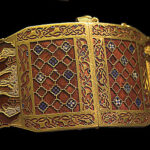
Sutton Hoo treasure arm ringThere are in fact twenty burial mounds at the site but some have been very eroded over the centuries by weather, robber human interference and agricultural activity. The mounds are located close to the river Deben estuary meaning that there would have been a harbour nearby. The burials date to the seventh-century AD. The people buried at the site left no written records that have survived, so it is impossible to know exactly who they were, but historians strongly suspect that Sutton Hoo was the cemetery for the royal dynasty of East Anglia, the Wuffingas, who claimed to be descended from the god Woden.
Most of the mounds were robbed over the centuries, apparently largely in the Tudor period, meaning that much was lost, but luckily two of the larger mounds escaped plunder – the Great Ship Burial or King’s Mound One and the Horseman’s Mound.

The movie also fails to approach the obvious question that the viewer would be asking: Who was the king buried at Sutton Hoo? All we can imaged is that he was a great trader. holder of many lands and highly revered by his subjects to have been buried in such a manner. Historians with circumstantial, but strong evidence, believe that the man was probably the Anglo-Saxon named Raedwald, who was King of East Anglia. He controlled lands south of the Humber, Norfolk and Suffolk at the beginning of the 7th century. In the 9th century tone the Anglo-Saxon Chronical he is named as Bretwalda which in old English means Britain-ruler, or wider-ruler.

Raedwald reigned from about 599 until his death in 624 but little is known about his reign. The royal records were probably destroyed by Viking raiders a two hundred years later because the monasteries stored the court records in their libraries. But coins found at the grave site have been dated to around Raedwald’s death. The acclaimed historian Max Adams states that the burial at Sutton Hoo is the legacy of Scandinavian contact in that ship burials are a memorial to Danish and Nordic culture linked with the sea and boats.

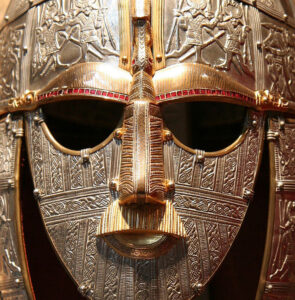
Sutton Hoo burial maskWhat we do know about this man is the evidence based on the burial goods: He was a music lover; a warrior, a seafaring commander, incredibly wealthy, and a collector of beautiful objects from around the world. He was a statesman in the high order during his era.

For millions of people with British East Anglian heritage a DNA analysis will usually reveal Saxon and or Nordic ancestry, our forbearers being invaders from the east and north east.

What the movie does inform us of is the divisions in a class conscious England at the out break of WW2 and the competitive nature of academia.

Today there is a nearby visitor centre which contains some of the original artefacts, replicas of finds, and a reconstruction of the ship burial chamber. The site is know in the care of the National Trust.

If you would like to read more about the site head to wiki here for a brief outline.

Sources:

The Dig. Director Simon Stone. N Film, Netflix. released Jan 2021

Wikipedia

Ben Macintyre. The Times. 30 Jan 2021. p35

Max Adams. Aelfred’s Britain: War and Peace in the Viking Age. Head of Zeus Ltd. 2017

@HeritageFound