

Occasionally we come across an old divorce petition, a legal document that will bare all. These documents make incredibly sad reading, but at the same time offer us a fascinating insight into the lives of our ancestors. They can be a deeply private and intimate glimpse into a couple’s marriage; heart wrenching to read, with each person’s account laid bare in blunt legal descriptions, leaving us to judge which side is telling the truth.
Divorce cases were heard in public in open court during the 19th century and a legal separation or divorce was only for the very wealthy. A married woman’s property automatically became her husband’s, and upon divorce the children remained the property of their father which was of course used as a means to control women residing in unhappy marriages. Mothers who left a marriage risked being prevented from seeing their children following a divorce or separation.
Things begin change a little after the 1857 Matrimonial Causes Act, but the law was still stacked in favour of the man. Under the new law, women divorcing on the grounds of adultery not only had to prove that their husbands had been unfaithful, but also had to prove additional faults, which included cruelty, rape and incest. Men, of course, just had to prove their wives had been unfaithful and in an age before cameras, videos and smartphones, this was often a tricky task! Before 1857, divorce was mainly open only to men, and had to be granted by an Act of Parliament.
In 1858 the handling of the legal process for divorce was transferred from the ecclesiastical courts to a newly established civil court, the Court for Divorce and Matrimonial Causes. In 1873 responsibility was passed to a division of the new Supreme Court. All divorce cases took place in London, yet again restricting divorce to wealthier couples only.
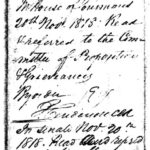 Recently, while researching a family tree I came across a divorce petition document dated 1875 which is stored at the National Archives in London. The couple were a moderate middle class farming couple who had been married for 25 years and were childless. This is a surprising case not only because of the financial implications for particularly the woman involved, but also because in the 19th century, divorce was extremely rare, and generally considered unthinkable for social, financial, and religious reasons. Unhappy couples would often separate but not legally get divorced as can be seen in family history archives. The petitioner in this case was the husband. I have changed the names and addresses in the following reproduction due to the sensitive nature of some of the central claims in the original legal document.
 We begin with the wife’s petition in this divorce case, dated February 1875 and claiming that her husband:
- ‘the she denies that she was guilty of adultery as alleged.’
- ‘That in or about the year 1865 the petitioner beat, assaulted and otherwise illtreated her threaten to kill her and greatly terrified her and on two occasions turned his wife out the house and kept her locked out all night refusing to allow her to enter’.
- ‘That the petitioner on the 13th day of 1872 in ……….. Road, ……… swore at and threatened the wife and took from her her watch and guard wedding ring earrings cloak fur bag umbrella and other articles and insulted and swore at her on the public road in the presence of divers [others] persons strangers.’
- ‘That on the 13th December 1872 at the house he refused her entry and has thrice hitherto refused to allow her to reside at or enter his said house and thence hitherto has wilfully separated himself from his wife without reasonable excuse and has deserted her.’
- That in 1873 E.B. [servant] went to reside at the house with her husband that lived and cohabited and committed adultery with the said. E.B was delivered of a male child in said house on the 18th of January 1875 and the husband was the father.’
- The respondent therefore humbly pray that your Lordship’s will be pleased to reject the pray of the said petitioner and to decree that the said marriage between the petitioner and his respondent be dissolved and that this respondent have such further and other relief in the premises as to your Lordships may [? ].
Her husband responds.
- ‘That I am informed and verily believe that at divers [many] times …..that the aforesaid committed adultery with Thomas G the younger a butcher.’
- ‘That I am informed and verily believe that on the 18th of July 1871, at Bath also committed adultery with the said Thomas G the younger.’
- ‘That I am informed and verily believe that on the 5th day of July 1871 at Reading also committed adultery with the said Thomas G the younger.’
- ‘That I am informed and verily believe that on the 5th day of January 1873 my wife in a lane call Gypsy Lane in the county of Somerset also committed adultery with the said Thomas G the younger.’
- ‘That I am informed and verily believe that on the 14th day of April 1873 my wife at Cadbury Hill also committed adultery with the said Thomas G the younger’.
- ‘That I am informed and verily believe that on a Sunday in the month of May 1873 my wife in a lane leading to the said Cadbury Hill also committed adultery with the said Thomas G the younger’.
- ‘That I am informed and verily believe that on the 25th day of August 1873 my wife in a field at Hamstead also committed adultery with Thomas G the younger’.
- ‘That I am informed and verily believe that on the 6th day of April 1874 my wife at Cadbury Hill also committed adultery with the said Thomas G the younger’.
- ‘that there is no collusion or connivance between me and my wife in any way whatever’.
Thomas G, the butcher swore in his statement presented to the court that he denied any involvement or adultery with the wife.
The above 1875 petition document reveals the fees paid to take this case to court was a staggering £34,000 in today’s money. Unfortunately, the outcome and settlement of this case is not shown but it is doubtful if the wife in this case at this time had any claim over the family house, lands or other effects.
Divorce did not really open up for all classes until the 1920s with the provision of some local courts. In the 1920s and 1930s, English law did not allow for divorce by mutual consent, but rather required proof of adultery, or violence by one party; misconduct by both parties could lead to the divorce being refused. A further hurdle for a couple to obtain a divorce was that the law strictly prohibited “collusion” by the parties, and this is why in the above example the couple had to swear that they had not colluded. A private members’ bill in 1923 made it easier for women to petition for divorce for adultery – but it still had to be proved.
The Matrimonial Causes Act 1937 changed the law to make divorce easier to access, particularly for women, who until then could not get a divorce merely on the grounds of adultery because a woman needed to show more causes than adultery, such as on the grounds of incest, sodomy, drunkenness, insanity, desertion, or cruelty. The need for the reforms was illustrated in the best-selling satirical novel Holy Deadlock by A E Herbert and published in 1934 which influenced a changing attitude towards a reform to English divorce law. However, there was a bar on petitions for the first three years of the marriage. In the late 1960s divorce was taken over by the county courts and most divorces now take place at county courts.
Finally, in 1969 the Divorce Reform Act was passed, allowing couples to divorce after they had been separated for two years (or five years if only one of them wanted a divorce, however this has proved controversial for some). A marriage could be ended if it had irretrievably broken down, and neither partner no longer had to prove “fault”.
What of our unhappy couple?
The 1881 census discloses that the ex-wife was now living in a neighbouring town with a Richard Pike who was a carpenter, and she is a recorded as a general servant, a term commonly used when a man and woman who were not married co-habited together. Interestingly she also says that her condition was being as married, perhaps meaning that a divorce was not granted in this case, and that Richard Pike was a widower.
The baby born in February 1875 was baptised with the father’s full name and with the mother’s maiden name appearing in the church register because she was an unmarried mother. The couple probably planned to be married once the divorce was finalised, but very sadly the mother (E.B.) died just four months following the child’s birth. The child remained at the family home and was brought up by another woman following the mother’s tragic death. The new couple lived together for over 35 years until the father finally died in 1908. They never married.