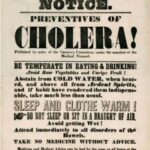
Following a talk I gave yesterday about the 1832 Cholera Epidemic in Bristol one the attendees very kindly sent me a fascinating link to a cholera outbreak in the village of Braunston, Northamptonshire, during the last months in 1834.
I have posted the article below, which was published on Braunston Village of the Waterways web site (https://www.braunston.org.uk/).* The article contains a primary source written by a Baptist Minister named the Reverend R Miller and published in a leaflet during 1835.
He wrote the record “for the parishioners of Braunston…to lead them to see “the hand invisible that performs works of judgement and mercy”…..
 ‘Cholera came to Braunston on the weekend of a Feast Day, the Feast of All Saints’tide. This was a great time in the village. There was no radio, no television, no outside entertainments to enjoy. The villagers congregated with friends and relatives, there were stalls on the Green, and the public houses were filled with folk.
The Rev Miller noted that no company was to abscene debauched, or viciously disposed to answer there purpose. He looked upon the Cholera as a divine intervention upon the evil ways of the villagers.’
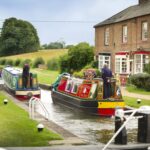
In 1834, Cholera came to Braunston. It would seem likely that it had come from London by canal. It has been noted how the East End of London was badly infected by Cholera. Three suspicious cases were noted at Rotherhithe on the south bank of the Thames opposite Limehouse. The Regents Canal commences at the Regent Canal Dock in Limehouse. The canal proceeds north through London’s East End, then westward to reach the Grand Junction Canal at Brentford, from where the canal goes north to Braunston.
‘Our source for a description of the outbreak is in a leaflet printed by J Castell of High Street Daventry in 1835. It had been written by “A Looker-on”. We know that the” Looker-on” was the Baptist Minister at the time; the Rev R Miller. He wrote the record “for the parishioners of Braunston…to lead them to see “the hand invisible that performs works of judgement and mercy”
Cholera came to Braunston on the weekend of a Feast Day, the Feast of All Saints’tide. This was a great time in the village. There was no radio, no television, no outside entertainments to enjoy. The villagers congregated with friends and relatives, there were stalls on the Green, and the public houses were filled with folk.
The Rev Miller noted that no company was to abscene debauched, or viciously disposed to answer there purpose. He looked upon the Cholera as a divine intervention upon the evil ways of the villagers.
The first case occurred on 7th October 1834 from an infected boat. A bed from the boat was left with a Mrs L, for the bed to be washed. Mrs L caught Cholera and died.
About 2nd November, a legger named Patmore, who lived in Cross Lane in Braunston, died , but Cholera was not concidered to be the cause.
Then on 16th November, a Feast Sunday, a child of Patmore died, and another boatman named T Fall also died in Cross Lane. Fall had come from Derbyshire, and after feeling unwell, had left his boat at Crick Wharf a few days before.
The following Monday 17th November, the day of the Celebration of the Feast, there were stalls on the Green, side shows on the road and private parties in the houses with dancing and drinking. The public houses were full of people.
Continue reading “1834 Cholera came to the village of Braunston” →