Discovering your Family History made easy: For complete beginners and the amateur Genealogist.
Delve into the fascinating world of ancestral exploration and gain valuable skills to trace your roots. Discover how to harness the power of online genealogical search websites, master UK and other countries census records and parish registers, and decipher birth, marriage, and death certificates with ease. Create a stunning family tree that showcases your heritage and avoid the pitfalls that often trap amateur genealogists. Embark on a thrilling journey of self-discovery and connect with your ancestors in ways you never thought possible. Enrol now and unearth the hidden treasures of your family history!
(I could take one more)
Wednesdays 6.30pm-8.30pm
10 sessions from 27th September at Stoke Lodge, Bristol
Discover your Family History – Introduction to Researching your Family History
Part 2 – Discover your Family History and so much more!
An exploration of Family History. This course will be delivered at Stoke Lodge but will move online if necessary using ZOOM.
Course code FHR2C. Begins Thursday 10 March 2022 for 5 weeks. 14:00-16:00
A practical easy learning technique to learn how to research and record family history with confidence. A fun approach, in a safe, inclusive environment with other learners. Correct interpretation of vital records, including Parish Records, and tips on how to improve research techniques. Learners should be able to produce at least a 6-generation family tree by week 5. A fun approach, in a safe, inclusive environment with other learners. A mixture of lectures and practical work.
Join award winning tutor Rosemary Caldicott to better understand how to discover your ancestors.
FOR MORE INFORMATION ON ENROLMENT AND TO BOOK HERE
Occasionally we come across an old divorce petition, a legal document that will bare all. These documents make incredibly sad reading, but at the same time offer us a fascinating insight into the lives of our ancestors. They can be a deeply private and intimate glimpse into a couple’s marriage; heart wrenching to read, with each person’s account laid bare in blunt legal descriptions, leaving us to judge which side is telling the truth.
Divorce cases were heard in public in open court during the 19th century and a legal separation or divorce was only for the very wealthy. A married woman’s property automatically became her husband’s, and upon divorce the children remained the property of their father which was of course used as a means to control women residing in unhappy marriages. Mothers who left a marriage risked being prevented from seeing their children following a divorce or separation.
Things begin change a little after the 1857 Matrimonial Causes Act, but the law was still stacked in favour of the man. Under the new law, women divorcing on the grounds of adultery not only had to prove that their husbands had been unfaithful, but also had to prove additional faults, which included cruelty, rape and incest. Men, of course, just had to prove their wives had been unfaithful and in an age before cameras, videos and smartphones, this was often a tricky task! Before 1857, divorce was mainly open only to men, and had to be granted by an Act of Parliament.
In 1858 the handling of the legal process for divorce was transferred from the ecclesiastical courts to a newly established civil court, the Court for Divorce and Matrimonial Causes. In 1873 responsibility was passed to a division of the new Supreme Court. All divorce cases took place in London, yet again restricting divorce to wealthier couples only.
Recently, while researching a family tree I came across a divorce petition document dated 1875 which is stored at the National Archives in London. The couple were a moderate middle class farming couple who had been married for 25 years and were childless. This is a surprising case not only because of the financial implications for particularly the woman involved, but also because in the 19th century, divorce was extremely rare, and generally considered unthinkable for social, financial, and religious reasons. Unhappy couples would often separate but not legally get divorced as can be seen in family history archives. The petitioner in this case was the husband. I have changed the names and addresses in the following reproduction due to the sensitive nature of some of the central claims in the original legal document.
We begin with the wife’s petition in this divorce case, dated February 1875 and claiming that her husband:
‘the she denies that she was guilty of adultery as alleged.’
‘That in or about the year 1865 the petitioner beat, assaulted and otherwise illtreated her threaten to kill her and greatly terrified her and on two occasions turned his wife out the house and kept her locked out all night refusing to allow her to enter’.
‘That the petitioner on the 13th day of 1872 in ……….. Road, ……… swore at and threatened the wife and took from her her watch and guard wedding ring earrings cloak fur bag umbrella and other articles and insulted and swore at her on the public road in the presence of divers [others] persons strangers.’
‘That on the 13th December 1872 at the house he refused her entry and has thrice hitherto refused to allow her to reside at or enter his said house and thence hitherto has wilfully separated himself from his wife without reasonable excuse and has deserted her.’
That in 1873 E.B. [servant] went to reside at the house with her husband that lived and cohabited and committed adultery with the said. E.B was delivered of a male child in said house on the 18th of January 1875 and the husband was the father.’
The respondent therefore humbly pray that your Lordship’s will be pleased to reject the pray of the said petitioner and to decree that the said marriage between the petitioner and his respondent be dissolved and that this respondent have such further and other relief in the premises as to your Lordships may [? ].
Her husband responds.
‘That I am informed and verily believe that at divers [many] times …..that the aforesaid committed adultery with Thomas G the younger a butcher.’
‘That I am informed and verily believe that on the 18th of July 1871, at Bath also committed adultery with the said Thomas G the younger.’
‘That I am informed and verily believe that on the 5th day of July 1871 at Reading also committed adultery with the said Thomas G the younger.’
‘That I am informed and verily believe that on the 5th day of January 1873 my wife in a lane call Gypsy Lane in the county of Somerset also committed adultery with the said Thomas G the younger.’
‘That I am informed and verily believe that on the 14th day of April 1873 my wife at Cadbury Hill also committed adultery with the said Thomas G the younger’.
‘That I am informed and verily believe that on a Sunday in the month of May 1873 my wife in a lane leading to the said Cadbury Hill also committed adultery with the said Thomas G the younger’.
‘That I am informed and verily believe that on the 25th day of August 1873 my wife in a field at Hamstead also committed adultery with Thomas G the younger’.
‘That I am informed and verily believe that on the 6th day of April 1874 my wife at Cadbury Hill also committed adultery with the said Thomas G the younger’.
‘that there is no collusion or connivance between me and my wife in any way whatever’.
Thomas G, the butcher swore in his statement presented to the court that he denied any involvement or adultery with the wife.
The above 1875 petition document reveals the fees paid to take this case to court was a staggering £34,000 in today’s money. Unfortunately, the outcome and settlement of this case is not shown but it is doubtful if the wife in this case at this time had any claim over the family house, lands or other effects.
Divorce did not really open up for all classes until the 1920s with the provision of some local courts. In the 1920s and 1930s, English law did not allow for divorce by mutual consent, but rather required proof of adultery, or violence by one party; misconduct by both parties could lead to the divorce being refused. A further hurdle for a couple to obtain a divorce was that the law strictly prohibited “collusion” by the parties, and this is why in the above example the couple had to swear that they had not colluded. A private members’ bill in 1923 made it easier for women to petition for divorce for adultery – but it still had to be proved.
The Matrimonial Causes Act 1937 changed the law to make divorce easier to access, particularly for women, who until then could not get a divorce merely on the grounds of adultery because a woman needed to show more causes than adultery, such as on the grounds of incest, sodomy, drunkenness, insanity, desertion, or cruelty. The need for the reforms was illustrated in the best-selling satirical novel Holy Deadlock by A E Herbert and published in 1934 which influenced a changing attitude towards a reform to English divorce law. However, there was a bar on petitions for the first three years of the marriage. In the late 1960s divorce was taken over by the county courts and most divorces now take place at county courts.
Finally, in 1969 the Divorce Reform Act was passed, allowing couples to divorce after they had been separated for two years (or five years if only one of them wanted a divorce, however this has proved controversial for some). A marriage could be ended if it had irretrievably broken down, and neither partner no longer had to prove “fault”.
What of our unhappy couple?
The 1881 census discloses that the ex-wife was now living in a neighbouring town with a Richard Pike who was a carpenter, and she is a recorded as a general servant, a term commonly used when a man and woman who were not married co-habited together. Interestingly she also says that her condition was being as married, perhaps meaning that a divorce was not granted in this case, and that Richard Pike was a widower.
The baby born in February 1875 was baptised with the father’s full name and with the mother’s maiden name appearing in the church register because she was an unmarried mother. The couple probably planned to be married once the divorce was finalised, but very sadly the mother (E.B.) died just four months following the child’s birth. The child remained at the family home and was brought up by another woman following the mother’s tragic death. The new couple lived together for over 35 years until the father finally died in 1908. They never married.
Do not miss my FREE short talk on Friday 22nd January 2021 in the evening at 7pm hosted on Eventbrite.
Introduction to Researching your Family History Correctly.
The short talk will include easy to follow examples on how to fully understand the UK census returns, how to send off for birth, marriage and death certificates and many time saving tips shared!
To sign up copy and paste the link below which will take you to my free ticket page.
Every now and then an ancestor pops up to give an unexpected surprise. In my case this was a 2nd great aunt named Louisa Maria Raven Rowe (1843-1914). She was the sister of my 2nd great grandmother, Mary Ann Rowe (1848-1929) on my father’s side. However, Louisa was also known by no less than three stage names as well as her married name, and to make research even more complicated she often mixed these names up.
Known Names:
Louisa Maria Raven Rowe – born name.
Louisa Maria Raven Brittain – married name.
Adelaide Russell and Adelle/Adelaide Roselle – first known stage names.
Adelaide Merry – third known stage name (Merry being her husband’s stage name, Harley Merry).
Part One: Her life in England
A few weeks ago, when I had some free time to catch up on my own family history research, I returned to undertake in depth research to further understand the narrative of my 2nd great aunt who became a distinguished actress, singer, and possible comedian during the latter half of the 19th century.
Her birth name was Louisa Maria Raven Rowe being baptised in October 1843 in Colchester, Essex, England. Her father was Daniel Walter Rowe who was a ginger beer manufacturer living at 24 Half Moon Street, Bishopsgate, London as recorded on the 1861 census along with her mother Martha Maria Dennis nee Simpson. (See appendix 1). The family cannot be found listed on the 1841 census, although her parents married in 1839. The family moved to London between 1844-1851. [1] As yet I do not know the origin of her unusual middle name of Raven and this still requires further investigation. But it is possible that the surname is the name of the clergyman who baptised her because some of Louisa’s siblings also had unusual middle names that were in fact surnames.
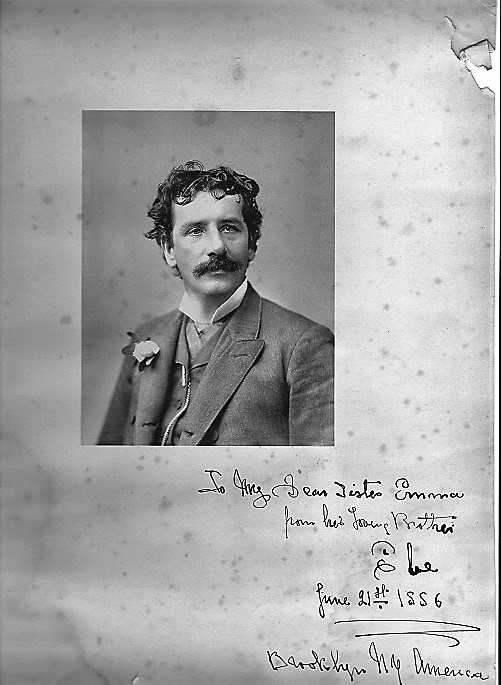
At the age of 17, and as documented on the 1861 census, Louisa was living at home on Half Moon Street, Bishopsgate, London with her parents and working as a milliner. Louisa appears next on her marriage record as having married the actor and scene artist Ebenezer Joseph Brittain (1841-1911) in Dover, Kent, England. [2] They married on 16 May 1864 in St. Mary-The-Virgin Church, Dover, Kent, England.
Why was Louisa in Dover? I can only guess that by this time she was already working on the stage perhaps as a comic actress, and it is feasible to believe she was by this time touring in a Company which included Ebenezer Britten. His stage name was Harley Merry.
The next reference of the couple appears in the London press on 18 March 1866:
Mr Harley Merry, Principle Scenic Artist at the New Theatre Royal Dewsbury is open for an engagement First or Second Scene Artist to open at Easter; also Miss Adelaide Russell, for First Walking Ladies. Address, Temperance Hotel, Dewsbury Yorkshire. [3]
On the 15 July 1866, a further advertisement appeared in the London press:
Mr Harley Merry Scenic Artist late of Theatre Royal and Operetta, Edinburgh, Ashleys and Surrey, London. Also, Miss Adelaide Russell for light Comedy and First Walking Ladies. Replies to Post Office, Marlow’s, Hemel Hempstead, Herts.
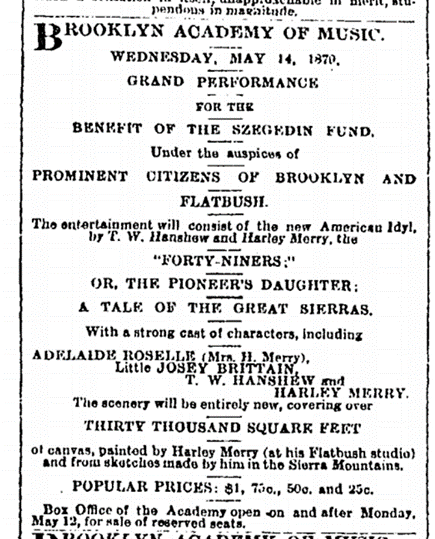
Their first son, Everleigh Frederick Harley Brittain (also known as Frederick Merry), was born in Poplar, London in 1867. The next record documenting Louise’s name is that of the birth of their daughter in Scotland on the 22 April 1869 named as Adelaide Louisa Edith Josephine Brittain. Her daughter was called Adelaide being Louisa’s stage name. Just a year later baby Adelaide was listed as ‘Little Josie Brittain’ when she appeared in a stage production on 15 May 1870 in a show ‘The Forty-Niners” that her father and mother were involved in producing.
Apparently Louisa first appeared on the stage at the age of seventeen. She was a leading lady to Edward Booth, William H Crane a fellow singing comedian and the famous American actor John McCullough. [4] Incidentally Edwin Booth was one of the most highly acclaimed Shakespearian tragic actors of all time in the USA and the most famous actor in the nineteenth century America. He achieved his fame through tragedy, ironically interconnecting with his interpretations of Shakespeare’s tragic heroes, a great real-life American tragedy, with the assassination of President Abraham Lincoln. The assassin was none other than his younger brother and fellow actor, John Wilkes Booth. This threatened to undermine his life and career and for 5 months Edwin hid away, but his actor friends encouraged him to work again, and his stage success continued.
Adelaide Roselle
I next discover Louisa and Harley Merry on a passenger ship list visiting or immigrating to America: The family arrived on the 21 May 1869 from Glasgow when their daughter was only six weeks old and Louisa was 26 years old. Why did they travel to The United States? Perhaps they were going to tour there with an acting company, or maybe they wanted to try their chances on the now booming Broadway theatres. But I believe that Ebenezer may have seen an opportunity to promote his artistic skills in stage scene painting, which was now to become his primary income, but more about this later.
Ebenezer Brittain 1886
Part Two: A new life in New York
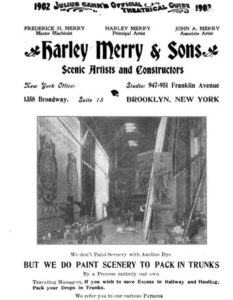
Their third and last child a son, John A Brittain was born in 1870 in Brooklyn, N.Y. [5] after they arrived in the city in 1869. All their children were eventually to become involved in the family theatrical business: Harley Merry & Sons. Scenic Artists and Contractors. Ebenezer and his sons offered a flat pack stage scenery service to provincial theatres around the country as well as to leading New York theatres. Adelaide Josephine Merry Brittain, their daughter, worked as an actress before she married on 12 February 1888.
Ebenezer became a naturalized citizen on 3 July 1879 [6] and it has been said that Louisa became a naturalised citizen on May 26, 1871. However, the date of her naturalisation has been miss quoted. In an obituary published on 28 February 1914 it states:
‘Controversy arose over her claim. Her claim was disputed by Lillian Langtry [the famous British actress] but her papers showed she was naturalised in 1871, some years before “Lily” became a citizen.’ (Lillian Langtry naturalised on 13 May 1879).
According to her obituary published in the Indianapolis Star, Adelaide Roselle (Louisa’s current stage name) was the first female to become a naturalised citizen of the United States. [7] However the actual date of her naturalisation was in fact 26 May 1883, so Lilly was correct in her claim. [8] Interestingly her and her husband’s stage names were given to their children as middle names which might have be a gesture to Louise’s family tradition of using surnames as middle names. On the 1880 census they listed their stage names as Harley Merry and Adelaide Merry as well as their three children but on the 1900 census they listed themselves with their true names.
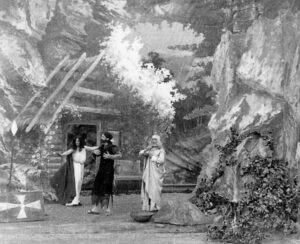
Her husband was very soon to become a famous and renowned stage scenery designer and stage set painter after establishing a large studio on Franklin Avenue, Flatbush N.Y. near to the family home (See image 3). There are various newspaper reports published in the late 19th century describing his beautiful sets which were also mentioned on posters advertising plays.
Example of a Harley Merry stage scene
The couple did return to England on at least one occasion. A London newspaper notice states that they were to be in London from the 17 June until 8 July 1872. The reason for their trip is not stated but undoubtedly, they would have been visiting family and seeing to business interests. They stayed at Batley Villas, Tonsley Hill, Wandsworth, London. [9]
Scandal struck the Brittain family in 1903. Wagner’s widow attempted to sue Harley Merry in an attempt to stop a performance of Parsifal of Obearammerau by the Metropolitan Opera in New York. (See Appendix 3.)
Louisa Maria Raven Brittain nee Rowe died aged 70 on 26 February 1915, four years after her husband, at her daughter’s house in Flushing, New York after three years of illness.
So, what do I now understand to be the life story of Louisa Maria Raven Rowe? Louisa was born in Colchester, England to a simple working-class family whose father was a carman as noted on the 1851 census. After her birth, the family migrated to central London for work, where her father had a small business making seasonal ginger beer. Her family would have visited the much-loved music halls at this time that were flourishing in London particularly for the working classes, being an affordable form of entertainment. During her teenage years Louisa began her acting career, probably as a comic actor and also a singer. She then married an actor, and it appears that they travelled around the provinces being employed as a touring company of actors.
During 1869-1870 the family emigrated to New York and once in New York Louisa was appearing in classic plays as well as in Shakespearian tragedies which were immensely popular with the middle classes in theatres at the time. [10] Her husband launched a remarkably successful stage scenery business in a studio near their home in Flatbush, N.Y. enabling them to live a comfortable and well-connected lifestyle. Louisa retired from the stage in 1885.
Once established in New York society Louisa must have led an interesting life, mixing with other well-known actors and other influencers. They were social climbers: Her husband was a member of the Elk Lodge; the Actors’ Fund, the Actors’ Order of Friendship, a director and founder of the Old Mill Creek Yacht Club N.Y., which still survives today as a not-for-profit company, a founder of a County Club in Amityville, Long Island, a member of the influential Green Room Club, a New York fraternal organisation founded on December 20, 1902 for men involved in the dramatic arts. He was also a collector of pictures during the final years of life according his obituary. [11]
Much of the information I have discovered about Louisa’s remarkable life has been found in the archives written about her husband. Commonly this was the case at this time, the wife was incidental and subordinate to that of her husband and high achieving women rarely received the recognition they deserved. Louisa lived in a era when women had no rights, could not vote, or set up their own businesses. but by marrying into the theatrical world this would have given her access to work, investments and a degree of respectability.
Her obituary was published in the Brooklyn Daily Eagle on the 27 February 1914. The following copy is an abridged version:
‘She appeared in many stock companies in England and was in the Mrs F. B. Conway Stock Company in Brooklyn under the name of Adelaide Roselle. She went to the coast with R. M. Hooley’s dramatic combination, appearing with other dramatic stars of prominence. She appeared at the Chestnut Street Opera House, Philadelphia in 1878, as the Countess in “The Two Orphans”, at its first presentation after the Brooklyn fire. (See Appendix 4 and 5).
She was a woman of great beauty and an actress of ability. For many years she lived in Flatbush [N.Y.], where she was well known and much interested in works of charity. She retired from professional life in 1885. Her death was due to paralysis, with which she had been suffering from for some years. She leaves a son, Frederick, a daughter Josephine and 12 grandchildren’.
The Merry Family on the Stage 1870
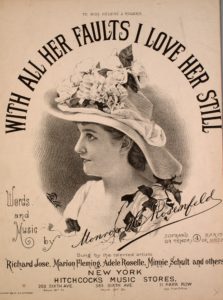
This article has been written during the 2020-21 pandemic and lockdown, so it has not been possible to visit museums and archives. Further research needs to be undertaken to locate illustrated posters that may have survived in various theatre archives advertising her stage appearances. If these and other accounts have survived, they would offer evidence and further acclaim to the full genre of her repertoire and performances, and hopefully with images of her. Louisa was listed as a ‘First Walking Ladies [Lady]’,[12] for which she was distinguished, in order to fully attain the depth of the remarkable, independent, and vibrant life of my 2nd great aunt – a very extraordinary woman.
Appendix 1
The Small Ginger Beer Brewer in London
Abridged extract from Victorian London – Publications. Social Investigation/Journalism –Street Life in London – by J. Thomson and Adolphe Smith, 1877.
According to a rough estimate there must be about 300,000 gallons of ginger-beer sold per annum in the streets and immediate neighbourhood of London. This summer beverage represents an important trade, and it has the further advantage of giving employment to a number of indigent persons who would otherwise, probably, fall on the rates. The trade requires little capital, no skill, and scarcely any knowledge. A pound or thirty shillings would suffice to start a man or woman in this business, and a recipe for the brewing of ginger-beer is easily obtained. The difficulty, if any, consists of boiling the ginger in the large volume of water employed. For instance, three pounds of ginger are generally used for nine gallons of water and will make altogether a gross of ginger-beer. The poor who make ginger-beer do not, however, possess stew-pans that will hold nine gallons; and, therefore, do not scruple to resort to the copper. This disgusting habit of boiling ginger in the same vessel which serves for washing the dirty linen of several families is, I fear, extensively practised, nor is it thought in any way derogatory to the value and popularity of the drink. The ginger-beer seller who initiated me into this mystery acknowledged that he used the copper in his house, after the other lodgers had finished washing and boiling their clothes and did not for a moment anticipate that I should take exception to such a practice. When the strength of the ginger has been extracted by boiling, a little lemon acid, some essence of cloves, loaf sugar, and yeast have to be added. The mixture can then be bottled and should be left to stand twenty-four hours. Further, to add to the sharpness which should result from the essence of lemon, some makers do not hesitate to employ a little oil of vitriol so that, after all, it is problematical whether the strict temperance advocate who remains faithful, even during the dog-days, to ginger-beer and lemonade, does not run as much risk of poisoning himself as the frequenters of public-houses. The various forms of lemonade, which are so often preferred to ginger-beer, present the same dangers, and may at times be productive of considerable mischief.
The present generation of street vendors have had, however, to compete against the great wholesale manufacturers, who employ the powerful aid of steam. The soda- water, lemonade, &c., produced in these large factories has at least the advantage of being clean, though often impregnated with lead.
The following story appeared in the press. Toledo, Ohio. 15 Dec. 1898.
‘…Cuba’s Vow company playing at Burt’s Theatre, were injured last night during a performance by the premature explosion of powder…[Harley] Merry [was] badly burnt about the head’. Newspapers.com
Appendix 3
In 1903, Wagner’s widow unsuccessfully attempted to stop a performance of Parsifal of Obearammerau by the Metropolitan Opera in New York, causing a great scandal. In 1904, Harley Merry acquired the motion picture rights and brought in director Edwin S Porter and Thomas Edison. Edison had been experimenting with ways to combine silent films with recorded music. Porter’s version of Parsifal employed Edison’s Kinetophone, “a primitive, synchronized sound-mix device, but this machine does not represent the era of silent film, since it had a short life with no great success.”[13]
Appendix 4
‘At the Brooklyn Theatre, on the 5th of December 1876, at the beginning of the final act of a melodrama called “The Two Orphans,” a portion of the scenery was ignited by a lamp. The fire spread quickly and while patrons in the lower part of the theatre got out, those in the gallery were trapped by suffocating smoke and a too-narrow stairway. In less than half an hour from the time the first flame was seen, part of the building collapsed and the flames devoured the building. The police officers and fire officials on the scene had not seen anyone in the theatre, nor had anyone responded to their calls. It was assumed that there had been no fatalities. The next day, when the building was inspected further, the cellar, which looked like it was full of the usual debris from a fire—was found to be choked with burned human bodies. Given the state of the remains, no accurate body count could be made and estimates range from 278 to over 300. 103 victims were buried in a mass grave in Greenwood Cemetery.’ Passage from www.hauntedohiobooks.com.
For the full history of this fated building see: http://hauntedohiobooks.com/news/ghosts-brooklyn-theater/
Appendix 5
‘Each theatre had a standard complement of wing and drop scenery used for all productions. These most often included a Gothic chamber, a rocky cliff, a forest glade, a drawing room, a peasant cottage, a kitchen, and a city street. Gas lighting was introduced in the Chestnut Street Theatre in Philadelphia in 1816, in the Camp Street Theatre in New Orleans in 1824 and in the Bowery Theatre in New York in 1826, but in 1830 most theatres were still lighted by oil or candles.’[14]
References
[1] Half Moon Street, London had many pubs and breweries during the nineteenth century.
[2] Ebenezer Brittain had briefly been married before to Emma Lane who he married when she was aged 16 on 18 August 1861 in Battersea, London. However, tragically only 11 months later Emma was dead, perhaps in childbirth. There is no record of Ebenezer on the 1861 April census, but Emma appears as working as a house servant in Lambeth before their wedding.
[4]The Indianapolis Star, Indianapolis, Indiana. 28 Feb 1914, Sat. p 5.
[5] ‘Wife dead, Man Ends Life’. John A Britton, son of “Harley Merry” Britton the scenic artist, committed suicide at his Brooklyn home yesterday by shooting. Continued grief over the death of his wife, which occurred a year ago, is said to have made the suicide mentally irresponsible. Press and Sun Bulletin. 30 Jan 1907. p.1.
[12] The usual company consisted of first and second male and female lead, a first and second walking gentleman and walking lady (ingenue) [an innocent or unsophisticated pretty young woman], first and second old man and woman, first and second juveniles, a first and second comedian (or leading comedian and first comedian), a chambermaid and servant (often comic), and several utility actors and actresses, plus apprentices. Brooks Mona R. The Development of American Theatre Management Practices Between 1830 and 1896. Texas Tech University. Diss DPhil. Aug 1981 p.37 & p.39
Film: Parsifal of Obearammerau 1904 production. https://alchetron.com/Parsifal-(1904-film)
Recommended further reading on the history of theatre in 19th century America I suggest reading Mona R. Brooks The Development of American Theatre Management Practices Between 1830 and 1896. Texas Tech University. Diss DPhil. Aug 1981. On-line link file:///C:/Users/r_cal/Downloads/31295002680881%20(1).pdf
The British Library. The growth of theatres in London in the 19th century. https://www.bl.uk/romantics-and-victorians/articles/19th-century-theatre
For more information about the life works of Harley Merry:
As you travel further back into your ancestors past and into the realms of parish records you will stumble upon wills. Millions of these old documents are now available on sites such as Ancestry and at county and national archive record sites.
Bequests in early wills often included bed linen, a bed, silver spoons and brassware, these were items of great value. Terms used such as cousin, stepson or daughter-in-law did not have the same meaning as they do now, so modern interpretations of old wills can be tricky. They are a good source of discovering other members of the family not previously know about.
The handwriting will vary greatly, from fine quilled scripted writing, to Latin and incomprehensible scribble, suggesting they were hastily written up by candlelight in the dying persons bed chamber. But the more you train your eye to read these documents the easier it will become. Much of these documents will mention at great length ‘duty to god’ which will sometimes be laid down in Latin: the effect of Christianity upon the will was very marked. In England and Wales until 1858 the Church ran probate courts to ensure the terms of a will were followed. Members of the clergy often drew up parishioners’ wills if they could not afford a lawyer, or by choice.
Wills written in the 19th century tend to follow a general pattern, usually beginning with the words, ‘In the name of God Amen’. The testator then states his mental competence. Often, will writing only took place when death was imminent, and wills usually contained instructions about the disposal of the body and what form the memorial took. Gifts for mourners, favoured servants and local residents also featured in many wills, then the list of bequests. Wills usually ended with the date and the point that all former wills were revoked. Then, the testator and two witnesses signed the document. It can be exciting to see an ancestor’s signature (often by shaky hand) on a sixteenth century will.
In 1858, the authorities established the Principal Probate Registry where a copy of every will provided was kept, as well as letters of administration. When the registry was established, district probate registries were created around the country.
However, it must be remembered that in the mid-19th century, the bulk of people did not leave wills thanks to the vast differences between the rich and poor. However, I have come across poor cottagers’ wills, leaving only a few pieces of furniture to a son or daughter being written up by the local curate.
Also, to be encouraged, before embarking on a long sea voyage or taking part in military campaigns was often for people (men) to leave wills. We must remember that in the not so distant past sudden deaths happened frequently, and often family members were forced to apply for letters of administration when a person who held substantial assets died intestate.
Over the summer I have been offering my courses and talks online for the first time ever. For me this proved to be an enjoyable experience and I hope for my learners too!
Learners, who participated over the internet have been very supportive and kind, and here is a sample of feedback emails I have received. Thank you very much, your comments are very much appreciated and help me to improve delivery of courses and talks ‘In the Time of Covid’.
Many thanks Rosemary- excellent lecture as always- I’ve already signed up for the Hannah Wiltshire and Black Death lectures in the autumn so look forward to joining you again then! S.S. Aug. 2020
Thank you to or SUCH an interesting talk this afternoon. I really enjoyed it. June 2020 M.C.
Firstly, thank you very much for running the course – I found it very interesting and very helpful. When the lockdown first came in, I assumed that the course wouldn’t be running, so it was a pleasant surprise (and very good timing from the point of view of my own research) to hear that it would be. We all seem to be doing everything by Zoom nowadays, so thank you for getting to grips with the process and making it work so well. Your presentations came over fine on the screen. My only comment would be that it might be an idea to break them up a bit more, maybe pause every 20 minutes or so and do a short Q&A session or something before resuming. G.P.
Thanks so much for the Family History classes. I’ve really enjoyed them and found them very useful. I appreciate all the work you have done to put the classes online – from my supply-teaching experience I know it can’t have been easy. J.
Thanks again Rosemary for great content, entertaining delivery and incredible patience with the technology. I’m so glad you persevered and will look forward to more. J.P.
This is a very belated e mail to say thank you very much for all of the very interesting material regarding the workhouses P.D.
Many thanks for the attached. It was a very interesting talk particularly as you concentrated on the Bristol area. When I was thinking about the talk I was reminded that up until the 60’s if a girl became pregnant outside wedlock in Bristol she could be sent to the local mental home to have her baby without anyone knowing. There was a home in Stoke Bishop as well where the babies were prepared to fostering and adoption. A.E
The 1841 census is the first census that was undertaken to cover England and Wales to include family names, street names, occupation and if born in the county or not.
A key feature to be considered when searching back through British census records is that the 1841 census rounded down adult ages to the nearest 5 years. For example, 53 becomes 50 and 28 becomes 25. This can easily throw us off course when looking for similar names in a small geographical area, a common problem my learners come across! However, matching up occupation can help us have some confidence that we have in fact found the correct people. Luckily though children’s ages up to 14 are given their exact age even down to the day of a newborn which I find rather touching.
You will not find house or flat numbers under the address column, only a street name, or less. In 1841 the state in the U.K. did not consider it necessary to know such facts. Also, it must be remembered that postage was hardly used at this time and that government were simply not interested to know precisely where each person lived. Most homes did not have a number with the feature only being developed as urbanization grew larger across the country. However, by the coming of the 1851 census dwelling numbers were beginning to be added to the census schedules.
e research day running from 10.30 a.m. to 3.30. p.m.
The day is designed to run via zoom to advance your ancestral research development. There will be a mixture of talks, guidance, several breaks with time to undertake your own research the assistance of an expert genealogist tutor to hand.
1 session only this summer term on 16 May
To book or for more information just telephone 0117 903 884 or book on line here Book
Today was the last day of my Stage 2 Family History Course that I run at Stoke Lodge Bristol.
Some of the learners gave fabulous presentations of their family history research and very interesting their research proved to be! We all learned a lot from how they undertook their research, and I was impressed at the hard work and many hours that had been undertaken.
Thank you to the whole class for making this course very interesting for all of us. I hope you continue to to pursue your wonderful research and that my course has inspired you to overcome the inevitable obstacles that will pop up from time to time.


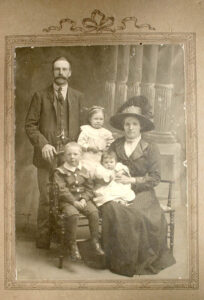

 Recently, while researching a family tree I came across a divorce petition document dated 1875 which is stored at the National Archives in London. The couple were a moderate middle class farming couple who had been married for 25 years and were childless. This is a surprising case not only because of the financial implications for particularly the woman involved, but also because in the 19th century, divorce was extremely rare, and generally considered unthinkable for social, financial, and religious reasons. Unhappy couples would often separate but not legally get divorced as can be seen in family history archives. The petitioner in this case was the husband. I have changed the names and addresses in the following reproduction due to the sensitive nature of some of the central claims in the original legal document.
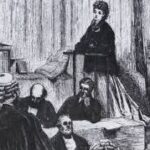 We begin with the wife’s petition in this divorce case, dated February 1875 and claiming that her husband:
 Scandal struck the Brittain family in 1903. Wagner’s widow attempted to sue Harley Merry in an attempt to stop a performance of Parsifal of Obearammerau by the Metropolitan Opera in New York. (See Appendix 3.)
 As you travel further back into your ancestors past and into the realms of parish records you will stumble upon wills. Millions of these old documents are now available on sites such as Ancestry and at county and national archive record sites.
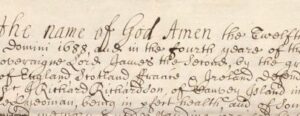 Wills written in the 19th century tend to follow a general pattern, usually beginning with the words, ‘In the name of God Amen’. The testator then states his mental competence. Often, will writing only took place when death was imminent, and wills usually contained instructions about the disposal of the body and what form the memorial took. Gifts for mourners, favoured servants and local residents also featured in many wills, then the list of bequests. Wills usually ended with the date and the point that all former wills were revoked. Then, the testator and two witnesses signed the document. It can be exciting to see an ancestor’s signature (often by shaky hand) on a sixteenth century will.