

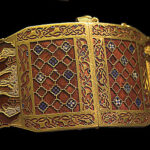
Last night I watched the new Netflix movie The Dig. Beautifully filmed and acted, and directed by Simon Stone. But to my huge disappointment nothing was said of who the mound was created for, or to share with the audience images of the exquisite finds, now mainly housed in the British Museum in London. The magnificent finds were and still are; incredibly beautiful, delicate gold artefacts, many encrusted with jewels, crafted in the Byzantine Empire, his swords and a shield, all acquired by the grave owner from across the known world at the time.
The site at Sutton Hoo, near to Woodbridge, Suffolk, England was first excavated by amateur archaeologist Basil Brown in 1939 who was employed by landowner and wealthy heiress Edith Pretty. When the significance of the site as a great and rare ship burial became apparent, national experts took over. During the 1960s,1980s and during 2000, the wider area was explored by archaeologists and many other individual burials were revealed. The spectacular artefacts comprise of what is considered the greatest treasure ever discovered in the UK.
 There are in fact twenty burial mounds at the site but some have been very eroded over the centuries by weather, robber human interference and agricultural activity. The mounds are located close to the river Deben estuary meaning that there would have been a harbour nearby. The burials date to the seventh-century AD. The people buried at the site left no written records that have survived, so it is impossible to know exactly who they were, but historians strongly suspect that Sutton Hoo was the cemetery for the royal dynasty of East Anglia, the Wuffingas, who claimed to be descended from the god Woden.
Most of the mounds were robbed over the centuries, apparently largely in the Tudor period, meaning that much was lost, but luckily two of the larger mounds escaped plunder – the Great Ship Burial or King’s Mound One and the Horseman’s Mound.
The movie also fails to approach the obvious question that the viewer would be asking: Who was the king buried at Sutton Hoo? All we can imaged is that he was a great trader. holder of many lands and highly revered by his subjects to have been buried in such a manner. Historians with circumstantial, but strong evidence, believe that the man was probably the Anglo-Saxon named Raedwald, who was King of East Anglia. He controlled lands south of the Humber, Norfolk and Suffolk at the beginning of the 7th century. In the 9th century tone the Anglo-Saxon Chronical he is named as Bretwalda which in old English means Britain-ruler, or wider-ruler.
Raedwald reigned from about 599 until his death in 624 but little is known about his reign. The royal records were probably destroyed by Viking raiders a two hundred years later because the monasteries stored the court records in their libraries. But coins found at the grave site have been dated to around Raedwald’s death. The acclaimed historian Max Adams states that the burial at Sutton Hoo is the legacy of Scandinavian contact in that ship burials are a memorial to Danish and Nordic culture linked with the sea and boats.
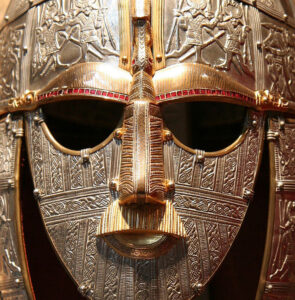 What we do know about this man is the evidence based on the burial goods: He was a music lover; a warrior, a seafaring commander, incredibly wealthy, and a collector of beautiful objects from around the world. He was a statesman in the high order during his era.
For millions of people with British East Anglian heritage a DNA analysis will usually reveal Saxon and or Nordic ancestry, our forbearers being invaders from the east and north east.
What the movie does inform us of is the divisions in a class conscious England at the out break of WW2 and the competitive nature of academia.
Today there is a nearby visitor centre which contains some of the original artefacts, replicas of finds, and a reconstruction of the ship burial chamber. The site is know in the care of the National Trust.
If you would like to read more about the site head to wiki here for a brief outline.
Sources:
The Dig. Director Simon Stone. N Film, Netflix. released Jan 2021
Wikipedia
Ben Macintyre. The Times. 30 Jan 2021. p35
Max Adams. Aelfred’s Britain: War and Peace in the Viking Age. Head of Zeus Ltd. 2017
@HeritageFound