
New Review – Voyage of Despair. The Hannibal, its captain and all who sailed her, 1693-1695

Voyage of Despair is a remarkable achievement, tackling challenging material with skill and presenting it in a way that is both accessible and deeply engaging. The narrative takes readers on the harrowing journey of the Hannibal slave ship, a voyage that is as compelling as it is sobering. To say I “enjoyed” the journey feels like the wrong word, given the subject matter, but the book captivates in a way that few historical accounts manage.

What stands out is the careful pacing of the narrative. Questions naturally arise as you read—What happened to John Browne when left behind? Why does an image feature a tiger in a cage during events in Africa?—but rather than leaving readers in the dark, the author skilfully answers these queries in later chapters. This structure encourages thoughtful engagement and reflection throughout.

Beyond its readability, the book is academically rigorous, offering thorough references that firmly establish its place as an important contribution to the field. It balances scholarly depth with a compelling narrative style, a rare feat in historical writing.

The author’s voice is confident and assured, guiding the reader with the expertise of someone deeply immersed in the subject. There are moments where the passion and anger are palpable—particularly in the vivid descriptions of the ships’ appalling conditions by the time they reached Barbados. These passages are powerful and unforgettable.

Voyage of Despair is a masterful work—both a gripping read and a significant academic contribution. For anyone interested in the complexities of history and the human stories within, this book is not to be missed.

Mr Alan Canty (FRCS DDS)

Available to order HERE
The Remarkable Lives of British Ancestors: The Agricultural Revolution

The Agricultural Revolution, the Working Classes, and the Landless Labourer.

In the annals of British history, the majority of the population can trace their lineage back to ancestors who toiled as agricultural laborers, also known on the UK census as Ag. Lab. Their existence, while seemingly simple, was a tapestry woven with intriguing stories and customs. They predominantly resided in tied cottages, homes that belonged to their employers and were rented to them. An unusual twist of fate bound them to their workplace; if they left their job, they might find themselves without a roof over their heads. It was a peculiar form of attachment where employment and housing were intimately entwined.

Life in these tied cottages unfolded through both prosperous and challenging times, anchored by the enduring traditions and timeless festivals that had been celebrated for generations. These customs served as a constant thread connecting them to their roots and heritage.

Then change arrived in the form of the Agricultural and Industrial Revolutions. These revolutions, while pivotal in shaping the modern world, often upended the lives of Agricultural workers. The transition from agrarian to industrial economies brought about profound shifts in employment, technology, and society. For many, it meant bidding farewell to the familiar rhythms of rural life and embracing a new, industrialised era.

As we delve into the history of these remarkable individuals, we uncover a rich tapestry of stories that not only illuminate the past but also provide valuable insights into the human capacity to persevere and evolve in the face of transformation. Our British Agricultural ancestors were witnesses to history.

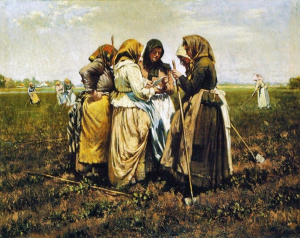
Women Turnip Hoeing
Turnip Hoeing

An examination of the radical consequences of the eighteenth century Agricultural Revolution upon the population of rural England.  Women were particularly affected by the upheavals to a static way of life in the countryside. Often forced into factories away from their traditional support networks within their communities never to return. How did women (and their children) adapt to their new environments, and did the mass migrations into our towns benefit or hold women back?

This talk is now full. If you are interested in a repeat talk please contact Heritage Found

Colonialism and Memory in Bristol

Rosemary Caldicott and Mark Steeds will be speaking at the Colonialism and Memory in Bristol as part of Mnemoscapes of the South West SWWDTP Memory Studies Research Cluster.

Join us for a public workshop on colonialism and memory in Bristol. Moving between the museum, the city, and space for discussion and reflection, we’ll be asking what decolonisation means, what it might look like in practice, as well as the challenges facing these efforts.

Join us at the M Shed in Bristol on 1st July,

The workshop is free and refreshments and lunch will be provided, but space is limited to 30 places.

10:45-12:45  – A city walking tour by Mark Steeds (Bristol Radical History Group) including the Colston plinth.

15:30-16:30  – BRHG members Mark Steeds and Rosemary Caldicott will be speaking.

Mark Steeds will talk about Stevenson’s story from San Francisco, where he undertook his voyage of the South Seas, travels to Hawaii and then on ultimately to Samoa. He became an activist, witnesses the king of Hawaii being usurped by the Americans, the Anglican attack on Father Damien and his Leper colony, and the first Samoan ‘Civil War’. His wife Fanny stayed on and witnessed the second Samoan civil war that led to western domination (British, American and German).  Marks research is in support of the Long John Silver Trust and our European Cultural Route: -“In the Footsteps of Robert Louis Stevenson”.

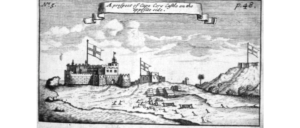
          Cape Coast Castle 1705


Rosemary Caldicott will be speaking about the maintenance and subsequent implications of the Royal African Company forts in West Africa. Her research is based upon her forthcoming book about the RAC Hannibal Slave-ship (1693-1695) and her previous publication Nautical Women – Women sailors & the Women of Sailortowns: A Forgotten  Diaspora c.1693–1902.

For further information about this event and the full program please link here

Event held on Saturday 1st July 10.00-1730

at M Shed Wapping Road Bristol BS1 4RN

“Nautical women-women sailors and the women of sailortowns: A forgotten diaspora c 1693-1902”

BOOK HERE

Tuesday, 29 November 2022, 14:00 – 15:30. 

Portishead Library 24 Harbour Road Portishead BS20 7AL

North Somerset Libraries are excited to host a series of talks by Bristol Radical History pamphleteers. Visit www.brh.org.uk to find out more about their publications and events. The talks are informal and accessible and would appeal to adults and older teens. Some Bristol Radical History pamphlets will also be available to purchase with cash.

In our third talk, Rosemary Caldicott brings to life Pamphlet number 43 which will be of particular interest to locals.

Nautical Women book cover
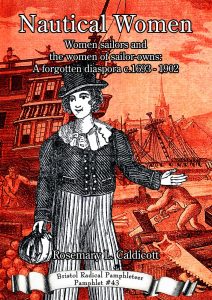
‘Nautical Women’, by Rosemary L Caldicott

The book explores the stories of women whose lives were inextricably linked to the sea. These include the women of sailortowns struggling to keep out of the dreaded workhouse and resisting the prowling press gangs; and of the courageous and skilful cross-dressing women sailors, some of Bristol, who went to extraordinary lengths to hide their gender. The stories of these women challenge our stereotypes of women in earlier societies and reveal the courage of those who ‘ran away to sea’ by exposing their struggles against poverty. Rosemary will discuss these women’s motivation as well as their adventures and inevitable exposure.

About the venue

Portishead Library is accessible, including a disabled toilet and baby change. The talk will be in the meeting room which will be set out in theatre style. Get in touch with us if you have additional support needs so that we can help you enjoy the event. Call us on 01934 426040 email us on portishead.library@n-somerset.gov.uk or pop in and see us Tuesday to Friday 9.30-5 and Saturday 9.30-1pm

Who can come?

Numbers are limited so we ask that you book a place via Eventbrite or by contacting Portishead Library. As we have limited spaces do let us know if your plans change. It is easy to cancel via Eventbrite.

More about the speaker

Rosemary Caldicott is a teacher of social history working in adult education, a writer of books and articles about working class women in history.

Rosemary is secretary of BRHG and has published several works for the group: The Life and Death of Hannah Wiltshire: A Case Study of Bedminster Union Workhouse and Victorian Social Attitudes on Epilepsy (2016); Lady Blackshirts: The Perils of Perception – suffragettes who became fascists (2017); Nautical Women. Women sailors and the Women of Sailortowns: A Forgotten Diaspora. c.1693 – 1902 (2019).

The Slave-Ship Hannibal 1693-1695. New Talk!

Black History Month Lecture 

The Slave-Ship Hannibal and all who sailed on Her. (1693-1695).

The voyage of the Hannibal slave-ship. 1693-1695. Credit Lisa Liebelt

Black History Month: Britain’s history and involvement in the Trans-Atlantic Slave Trade.

Come along and hear the tragic but enlightening story of the Brecon born slave trading captain Thomas Phillips, what happened to his crew, and the captured 700 enslaved people on his ship the Hannibal. This talk is based on my original research as discovered in the National Archives and the British Library. For the first time the human stories are revealed about all who sailed on her.


Thursday, 13 October.  2pm to 4pm by Rosemary Caldicott 

To book telephone Tel: 0117 903 8844

or Email: StokeLodge@bristol.gov.uk

 or BOOK HERE

Nautical Women – a talk

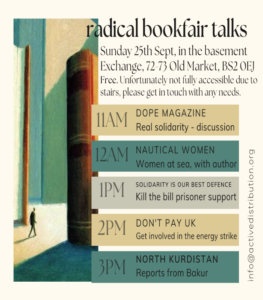
A talk about the brave Nautical Women who ran away to sea to escape abuse and poverty. Come a long to this exciting book fair and discover the many aspects of our extraordinary working class history.

Rosemary Caldicott representing Bristol Radical History Group

12 noon at The Exchange, Old Market, Bristol BS2 0EK 

Sunday, 25 September 

Organised by Bristol Active Distribution Publishers

www.activedistributionshop.org

Congratulations to the Republic of Barbados!

On Tuesday 30 November 2021, marking the 55th anniversary of independence from Britain, Barbados proudly became a republic.

Barbados has a long and painful history with Britain which dates back to the era of the forced transportation of enslaved Africans to work on British owned plantations.

For the full article and to learn more about about the saga of the slave-ship Hannibal click here

The voyage of the Hannibal slave-ship. 1693-1695. Credit Lisa Liebelt

The Hannibal Slave Ship

After 18 months of research and many trips to visit the archives and libraries of London my new book is nearly ready to be published. I truly felt the end was nearly here when I was told at my local library yesterday that they will be putting in an order the minute it is published.  My first advance order!

My new book is about a slave trading captain, his ship the Hannibal, and the 803 people who sailed on her, with most of these people being forced to board as slaves in order to grow the profits for the Royal African Company of England and the plantocracy classes of Barbados.

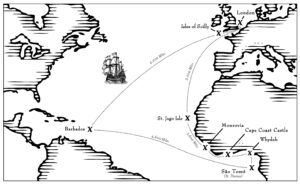
This epic and tragic true story takes place during the years 1693 to 1695 as the ship sailed between three continents, also known as the Triangular Trade. The map below from my book clearly charts the triangular route of the Hannibal. While at sea the ship was badly damaged by a French man-of-war, and the crew suffered considerable hardships under her captain. But worst of all was the horrific suffering inflicted upon the captured African people onboard the ship.

With thorough searching and detailed investigations undertaken in London’s archives, and now reproducing the evidence that has survived, it has been possible to piece together the tragic events that unfolded both onboard at sea and on the land. This is a true story that has laid dormant for over 300 years and now it is almost ready to be told for the first time.

The voyage of the Hannibal slave-ship. 1693-1695. Credit Lisa Liebelt

Guild of One-Name Studies. Speaking at Military Seminar

Guild of One-Name Studies. This event is a military seminar with a focus on our ancestors who served in wars and in keeping the merchant fleet afloat. #GuildMilitary

23 October, 2021, delayed from last year. I am very much looking forward to giving my talk next month – IN A ROOM WITH ACTUAL PEOPLE – for the –

Nautical Women book cover
‘Nautical Women’, by Rosemary L Caldicott

‘Nearly every generation has known war. Whatever their reasons, whether press-ganged, patriotic or penniless, many of our ancestors served and their stories from Napoleonic times to the two World Wars can be revealed in the records. The search is on for further speakers to improve our strategy and strengthen our campaign!’

I will be talking about Nautical Women: Women Sailors and the Women of Sailortowns. Brave women in history who disguised themselves as men to work as merchant and navy sailors.

The talk is based on my book of the same name and can be purchased here.

Event details LINK

The National Archives are open again!

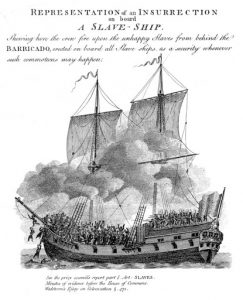
Revolt on a slave ship

At last Kew has re-opened,

and I am hot-footing it down there on Thursday. My research into the story of the slave ship Hannibal has been held up over the last year due to the prolonged closure of the N.A. It is crucial that I read the original Royal African Company documents and Admiralty records to complete the book: A tragic story about a huge 450 ton slave ship, and the captain’s disastrous voyage for both the 700 Africans and 70 crew onboard.

The captains’ will, dated 1713, has luckily survived, and discloses quite a lot about his wealth and family connections. The will was a valuable document in helping me understand his family position and connections within the Royal African Company and he owners of the salve ship Hannibal.