

New talk on census records for beginners 2 February 2021 at 7pm

New talk online!
During the session learners will be given examples of how to undertake family history correctly, therefore saving you time so mistakes are not made. The U.K. Census records will be examined using examples with potential pitfalls explained in an easy to understand way. The talk is focused on U.K. records and visual images will be used to offer examples. Join me and learn lots of tips!
The talk is perfect for beginners and those that have had problems researching family history.
The session is presented live by award winning family history tutor.

To sign up click HERE

What you will learn:

  • How to read a census document correctly
  • How to understand the key elements of the documents
  • How to manage difficult handwriting and marks
  • How to usefully interpret the information
  • How to work through the document logically
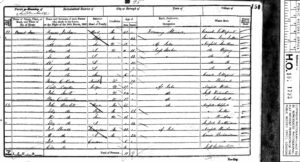
A handy list of census abbreviations

The census undertaken in the past in the U,K. included the use of abbreviations to describe professions. Here are some examples of the more common abbreviations that you will come across.

Ag. Lab – Agricultural labourer

Ap. – Apprentice

Army – Member of HM land forces of whatever rank

Cl. – Clerk

FS. – Female servant

H.P. – Members of HM armed forces on half-pay

Ind. – Independent – people living on their own means

J. – Journeyman

M. – Manufacturer

m. – Maker e.g. Boot m.

MS. – Male servant

Navy – Member of HM naval forces of whatever rank including marines

N.S. – Not Stated

P. – Pensioners of HM armed forces

Sh. – Shop man

1851
1851 census. England and Wales

1841 Census – pit falls

The 1841 census is the first census that was undertaken to cover England and Wales to include family names, street names, occupation and if born in the county or not.

A key feature to be considered when searching back through British census records is that the 1841 census rounded down adult ages to the nearest 5 years. For example, 53 becomes 50 and 28 becomes 25.  This can easily throw us off course when looking for similar names in a small geographical area, a common problem my learners come across!  However, matching up occupation can help us have some confidence that we have in fact found the correct people.  Luckily though children’s ages up to 14 are given their exact age even down to the day of a newborn which I find rather touching.

You will not find house or flat numbers under the address column, only a street name, or less.  In 1841 the state in the U.K. did not consider it necessary to know such facts. Also, it must be remembered that postage was hardly used at this time and that government were simply not interested to know precisely where each person lived. Most homes did not have a number with the feature only being developed as urbanization grew larger across the country. However, by the coming of the 1851 census dwelling numbers were beginning to be added to the census schedules.

Intensive Family History research day – Saturday 16th May

Intensiv

e research day running from 10.30 a.m. to 3.30. p.m.

The day is designed to run via zoom to advance your ancestral research development.  There will be a mixture of talks, guidance, several breaks with time to undertake your own research the assistance of an expert genealogist tutor to hand.

  • 1 session only this summer term on 16 May

To book or for more information just telephone 0117 903 884 or book on line here Book

New Family History course starts on-line Thursday 23 April 2020

Dear Bristol Learners

Thank you for your support whilst we have been converting our courses to a virtual format. 

My courses will run on zoom, with lecture notes, lectures, Q&A time and discussion.

To book my Family History courses just visit the Bristol Adult Learning page here 

Family History Stage One begins on Thursday 23 April at 1.30 pm.  

We will create an invigorating and supportive e-teaching space. This is a great way to pass the time, and discover your amazing family history.

New class starts this week

Family History and ancestry classes, Bristol

I am very much looking forward to meeting my new learners on Thursday at Stoke Lodge.

Its that time of year again and a new year begins with family history and ancestry classes in Bristol.  I wonder what intrigues await the learners this year? They will uncover their ancestors lives and learn the correct methodology to undertake their research successfully. Correct interpretation is key to stay focused on their sources. The step by step course will go through each basic area of family history research with plenty of time to do lots of online searches.

Welcome everyone!


Discovering Scottish Ancestry – which McIntosh am I looking at?

During my latest new teaching session there were quite a few learners who were trying to discover their Scottish links.  Scottish records can be difficult as so many families share the same surnames and lived relatively near to each other.  However, there are a few ways to check that you have the right people in your line.  For example, are the names of the children concurrent with baptism parental names, in particular the mother’s surname? Also, are there any middle names?  The registrration of birth, deaths and marriages has been conpulsory in Scotland since 1 January 1855.

Another clue can be found under occupations that appear on the Scottish census returns. (1851-1911). People tended to remain within their ‘born into occupational class’.  It is highly unlikely that a boy of sixteen working in a mill will appear thirty years later as a lawyer.  Yet the 2 differing lines may have even given their children all the same names!  So double check the children’s birth year and baptism record (if you have found it), and with time you can even crossing reference with cousins and other family members to see if there is a match.

Earlier Scottish records can be found in church records and these can be found on line if they have survived. Before 1855 Scottish births, deaths and marriages and burials will be found in the church registers.  However, they often contain only a simple index of names depending on the church and parish recorder. Presbyterian church records are available from 1716.

Heritage Found can help you with this research.

More information can been found at http://www.scotlandspeople.gov.uk/guides/


18th May 2017 a talk about Bedminster Workhouse

The Life and Death of Hannah Wiltshire

I will be giving a talk on Bedminster Union Workhouse. Bristol to the Clevedon History Group on the 18th May, 2017.  The talk will illustrate how during the year 1855 the workhouse Guardians neglected in their care and duty to protect a vulnerable young women, which resulted in her death. This lead to a public outcry and calls for the first mental health asylum to be built in Bristol.

Bedminster Union Workhouse was located Flax Burton, in North Somerset, England and served the parishes in the region of south west Bristol as well as Bedminster, Bristol.

Let me search for your ancestors and see if any of them were in a workhouse click

The British Census a beginner’s guide 1851

1851 Census

Following the first census that is of use to us as family history researchers came the second census of 1851, taken on the night of 30 March.   This was to set the pattern for a census to be held every 10 years, which still happens to the present day.

The census of 1851 was taken in slightly more detail than the 1841 census.  It shows us a persons true age (or what they thought was their correct age!), as well as the relationships between the people living in any one household, institution or vessel.  Disabilities were also recorded, which were listed as either blind, deaf, or imbecile.  Also, the documents reveal to us where a person was born.  This is an incredibly important piece of information for the researcher because it aids us to find baptism, marriage and perhaps other records such as property records that exist before 1851.  Therefore, helping us to trace a family line further into the past.

So, in brief the 1851 census will tell us:

  • Place of birth
  • Martial status
  • Relationship to the head of the household
  • Disability
  • Exact age to the nearest year
  • Occupation  (the number of people employed)

Reaction to the 1851 census. Punch, April, 1851 p.152


The British Census, a beginner’s guide 1841

1841

The first British census, which covered England and Wales, was undertaken in 1841.  The census was carried out by literate persons who had to visit each and every household, institution and vessel on the xxxxx 1841.  We can view all the records on line at various sites, which you will have to pay for.  The 1841 census gives us the names, age, occupation, where they lived and whether born in the county where they were living.  This was noted as a simple y for yes, or n for no.  An S was recorded for those born in Scotland and an I for those of Irish birth.  If a person was born abroad an F was marked instead to note this, although it does not tell us in which country they were born. The 1841 census rarely gives us full addresses and never states the relationship of the people within one household.

Another important fact that you need to be aware of is that age was marked down to the nearest 5 years.  So if a person was 38 their age was recorded as 35!   Why would they do this, when it would have been just as easy to put the persons real, known age?  Well, some people did not know their exact age in 1841, and the government were really just interested in where people were living.  There had been a huge wave of migration in the early to mid 19th century as people moved off the land into the cities and towns to find work.  The Industrial Revolution had caused many families to move to find work in the new mills, coal mines and factories that were now covering large areas of the new urban regions.

So, in brief the 1841 census will tell us:

  • The persons first name and surname (last) name
  • Age of person
  • Gender
  • Occupation
  • Where born