New talk – Outcasts of Medicine: Epilepsy, Poverty, and the Workhouse System

Rosemary Caldicott will be giving a talk –

Outcasts of Medicine: Epilepsy, Poverty, and the Workhouse System

Discover how epilepsy was misunderstood, feared, and stigmatised in the 19th century, often leading sufferers into the harsh realities of the workhouse. Rosemary uncovers the intersection of medical prejudice, social class, and poverty, revealing hidden lives at the margins of history. This talk brings to light stories of resilience and injustice, challenging how we view the treatment of illness and the poor.

This is a full day event and prebooking a place essential.   

The full programme ‘History around us’  https://www.bristolmedchi.co.uk/about-6-4

Cost £20; £10 for students to include food and refreshments.  

Please contact bristolmedhist@gmail.com by 10 November to book a place.

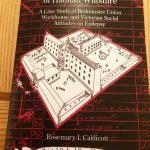
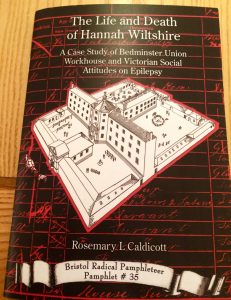
The talk is based on Rosemary’s pamphlet The Life and Death of Hannah Wiltshire: A Case Study of Bedminster Union Workhouse and Victorian Social Attitudes on Epilepsy. Available for purchase HERE

The Life and Death of Hannah Wiltshire
by Rosemary L Caldicott

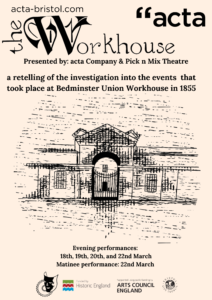
Tickets Now on Sale for a Gripping Retelling of Bedminster’s Workhouse Darkest History!

Get Your Tickets Now for a Gripping Retelling of Bedminster’s Workhouse Dark History!

Running from March 18th to 22nd, 2025

Step back in time to 1855 and experience the chilling tale of Bedminster Union Workhouse through a powerful, immersive production by two acta groups. This is more than just a play—it’s a journey into the past, where you’ll uncover the tragic death of inmate Hannah Wiltshire from Walton in Gordano, North Somerset, and the ensuing investigation that shocked Bristol and exposed the harsh realities of life in the workhouses.

As you move between locations, you’ll be immersed in the struggles, resilience, and humanity of those who lived and died within the workhouse walls. The gripping re-enactment of the investigation will leave you with a deeper understanding of this dark chapter in British history and how the voices of the oppressed continue to resonate today.

Don’t miss this unique, factual drama that sheds light on the forgotten stories of the past.

With thanks to the Bristol Radical History Group and Rosemary Caldicott for her invaluable publication, The Life and Death of Hannah Wiltshire.

Age Recommendation: 11+ (Contains descriptions of violence; not intended for children.)

Ticket Pricing:
Our open pricing structure means you choose the price that feels right for you.

  • £3 for a concession ticket
  • £5 for a full price ticket
  • £10 ticket option (includes a donation towards our £40,000 fundraising goal to celebrate acta’s 40th year)

We’re grateful for any additional support through donations to help secure acta’s future.

Important Access Information:
Please note: Front row seats for the 3pm show on Saturday, March 22nd, are already reserved. For front row seating, please choose another performance.

Get your tickets today at the link below and be part of this unforgettable experience!

Click for ticket information and booking

Purchase Rosemary L Caldicott’s pamphlet that inspired this important play HERE

Author Rosemary Caldicott writes: “During the year of 1855 rumours of murder and cover up were circulating in the small north Somerset village of Walton-in-Gordano.  An epileptic destitute country girl had died in the local institution known as the Bedminster Union Workhouse. Her death caused public outrage after letters were written to the local newspapers. The Board of Guardians were suspected of concealing the true magnitude of neglect at the workhouse, leading to accusations of medical negligence.”

The Workhouse by acta Company and Pick N Mix Theatre


Talk – Thursday 24 November, 7.00-8.30pm. Life and Death in Bedminster Workhouse

BOOK HERE ON EVENTBRITE

North Somerset Libraries are excited to host a series of talks by Bristol Radical History pamphleteers. Visit www.brh.org.uk to find out more about their publications and events. The talks are informal and accessible and would appeal to adults and older teens. Some Bristol Radical History pamphlets will also be available to purchase with cash.

In our second talk, Rosemary Caldicott brings to life Pamphlet number 35 which will be of particular interest to locals.

During the year of 1855 rumours of murder and cover up were circulating in the small north Somerset

The Life and Death of Hannah Wiltshire
by Rosemary L Caldicott

village of Walton-in-Gordano. An epileptic destitute country girl had died in the local institution known as the Bedminster Union Workhouse. Her death caused public outrage after letters were written to the local newspapers. The Board of Guardians were suspected of concealing the true magnitude of neglect at the workhouse, leading to accusations of medical negligence. In this pamphlet, Victorian social attitudes on epilepsy are investigated within the context of how the draconian workhouse system typically caused particular hardship to people who suffered with epilepsy and other mental health issues.

The Life and Death of Hannah Wiltshire illustrates the treatment imposed upon the vulnerable poor living in rural England during the mid-nineteenth century and how a campaign for transparency, accountability and social justice was fought for by the local community.

About the venue

Pill Library and Children’s Centre is accessible, including a disabled toilet and baby change. The talk will be in the main library which will be set out in theatre style. Get in touch with us if you have additional support needs.

South Bristol Festival – Bedminster Union Workhouse

SOUTH BRISTOL HISTORY FESTIVAL!

Rosemary Caldicott will be giving a talk about Bedminster Union Workhouse

Tuesday, 20 September 2022 at 2pm-3pm

To be held at Bedminster Library, 4 Bedminster Parade, Bedminster, Bristol BS3 4AQ

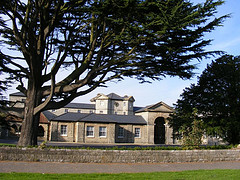
In 1855 rumours of murder and a cover up were circulating in the small north Somerset village of Walton-in-Gordano.  An epileptic destitute country girl, Hannah Wiltshire, had died in the Bedminster Union Workhouse at Flax Bourton.

This talk illustrates the treatment imposed upon the vulnerable poor living in England during the mid-nineteenth century and how a campaign for transparency, accountability and social justice was fought for by the local community. The talk will include newly discovered letters of complaint written to the Poor Law Board by Sir Arthur Elton of Clevedon.

This talk is one of a series of talks about working class history in South Bristol and has been organised by Bristol Radical History Group as part of the South Bristol History Festival. For more information and to view the full program of talks click HERE


This weekend 11/12 June Clevedon Literary Festival!

A warm welcome is waiting visitors to the Clevedon Literary Festival this year.

The Celebration of the Book is taking place on Saturday 11 June at St Andrew’s Church Centre, Old Church Road, Clevedon, BS21 7UE.

I have attached the Festival leaflet for the Celebration of the Book and here’s a link to it online:  Clevedon Literary Festival

At 12.15 Rosemary Caldicott will be talking about a local scandal that took place in 1855  – ‘The Life and Death of Hannah Wiltshire: A Case study of Bedminster Union Workhouse and Victorian Social Attitudes on Epilepsy.‘

The Board of Guardians of Bedminster Workhouse were suspected of concealing the true magnitude of neglect at the workhouse during 1855, leading to accusations of medical negligence that caused the death of a local woman from Walton in Gordano. This talk includes newly discovered letters of complaint written to the Poor Law Board in London by Sir Arthur Elton of Clevedon. Rosemary’s book covering this subject will be on sale at the book stall.

The Life and Death of Hannah Wiltshire
by Rosemary L Caldicott

There are quite a few venues and attractions in other parts of Clevedon during the day. Walking is probably the best way to get around but there will be a vintage bus (in the spirit of Doris Hatt’s ‘communist coach’) touring around the Festival venues, including St Andrew’s. The Festival also has the use of an electric car, sponsored by the Mazda garage here – you may book this (as passengers) at the Festival Desk.


Family History Courses NOW WORLD WIDE!

If you are getting bored, and as the nights will be drawing in, in the northern hemisphere soon you might consider discovering your family history. Some will have already undertaken quite a lot of fabulous research but there is always so much more to explore.

With my courses you could spend the dark evenings improving your knowledge and scope.  You could light some candles, warm the room and fire up your laptop with a group of like minded people. Better than a classroom?

Courses Available 

(Note all times are British time)

Women domestic workers

Courses Autumn 2020

Family History Course – Stage 1

Stage 1: 5 week course runs on Thursdays. Dates for autumn term 2020:

Thursdays 1.30 – 4pm Rosemary Caldicott BA MSc

  • Start Date: 24 September 2020

This beginners course offers a gentle introduction on how to access and navigate your family history records. An easy to follow guide on genealogy digital record searching is taught to assist you to find your ancestors. Each week has a different theme that supported by a lecture on the subject matter of that week. An understanding is explored of why and how records were taken, and also how to search and access the records you need. To book:

heritage_found@yahoo.co.uk

or book online here Book 

Family History Course – Stage 2

Stage 2:  5 week course runs on Thursdays

Thursdays 1.30 – 4pm. Tutor Rosemary Caldicott BA MSc

  • 5  sessions 5 November 2020
  • An ideal course for those who have already attended Stage 1, or have some experience researching their family history. Social history is explored in more depth through a series of lectures to consider the context of how our ancestors lived. Digital searching will be comprehensively taught to expand your  knowledge base and explained in-depth.
  • To book email: heritage_found@yahoo.co.uk
  • or book online here Book

TASTER EVE IS BACK!

Want to find out if researching your family history is really for you?

Tuesday evening on 22 September 2020

Short introductory 2 hour course. (7-9 pm).  A chance to explore your family history and to discover how to view, and most importantly, how to make sense of your online family records.

Email: heritage_found@yahoo.co.uk

Or book online: Book

NEW! Intensive Research Day                                                   

Designed to advance your ancestral research development.  

Saturday 10 – 2 pm Rosemary Caldicott BA MSc

  • 1 session  5th December 2020

To book email: heritage_found@yahoo.co.uk

Or book online here Book

Individual lessons and courses are also available with an expert through Heritage Found

Private tuition courses are available at very reasonable fees, by the hour or a course. You will be amazed what you will discover about your ancestral heritage, it is unique and special. Inquire


    Lecture – 9th December @ 2-4pm 

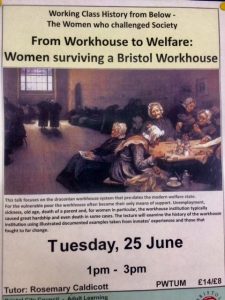
    ‘From Workhouse to Welfare: Women surviving a Bristol Workhouse’

    The Life and Death of Hannah Wiltshire
    by Rosemary L Caldicott
    The 2 hour talk will focus on the draconian workhouse system that pre-dates the modern welfare state. For the vulnerable poor the workhouse often became their only means of support. Unemployment, sickness, old age, death of a parent and, for women in particular, the workhouse institution typically caused great hardship and even death in some cases. The lecture will examine the history and reality of the workhouse institution using illustrated documented examples taken from inmates’ experiences.  Those who fought for change are recalled, along with examples of modern day memorialisation for the people that lived and died in our workhouses.

    Book here

    Or email: Heritage_found@yahoo.co.uk

    New talks!

    By invitation of Pill Library.
    Wednesday 19th February, 2 pm
    ‘Nautical Women. Women sailors and the women of sailor towns.’
    Sad, mad and tragic

    Author Rosemary Caldicott will be talking about her book in which she investigated the intriguing histories of  nautical women. These include stories of cross-dressing women who went to sea to earn a living and the mad, tragic and often funny consequences they encountered and endured. Living in Bristol, and Pill we’re all quite familiar with images of sailing ships – but the focus is usually on the men who built or worked on them. Rosemary wants to bring to life a forgotten history – women sailors and the women of sailor towns including Pill.

    AND 
    By invitation of Clevedon Library.
    Wednesday 11th March, 2 pm
     
    ‘The Life and Death of Hannah Wiltshire
    A Case Study of Bedminster Union Workhouse’.
     
    The talk focuses on the draconian workhouse system that housed the vulnerable poor, and in particular women and children.  Rosemary will be examining the history of the workhouse by offering an illustrated talk based on evidence extracted from reports published at the time about the violent death of Hannah Wiltshire who resided in Weston in Gordano. The involvement of Sir Arthur Elton of Clevedon Hall is pivotal to this true life story.

    New talks scheduled during 2020

    I am excited to announce my upcoming talks in Bristol during 2020.  There were 6 scheduled up until so far this year.  The dates and venues to be confirmed during this coming week. The talks will cover both workhouse history and the history of women sailors.

    Unfortunately now cancelled until further notice.  Please watch this space.

    They will be announced on here and on local radio once I am able to re-schedule.

    ‘Stay Alert’

    The Effects on our Rural Ancestors during the Agricultural Revolution

    The Employment of rural women in agriculture before and after the Agricultural Revolution 

    In 1750 England was still in the main an agricultural country, the greater part of which was the old type of rural organisation. This traditionally means with an open-field farming method, strip farming and most importantly these activities mainly took place on common lands. Farming was subsistence by nature and was a means of production to supply the needs of the immediate community. Women took on much of the work and often provided a surplus that could be sold on or exchanged for other goods.
    Over the next 70 years huge changes took place.

    The industrial world took the place of many domestic cottage industries, such as lace making, weaving, brush making, rope making for example, and many other forms of home-based manufacturing.  With enclosures the large enclosed farm was to take over, absorbing small crofters and other traditional occupations that once took place in the open village, such a meat curing, milking and threshing. The Commons, or the people reliant on the free right to graze their animals and grow limited crops – the ‘commoners’ – were to become a lifestyle of the past. 
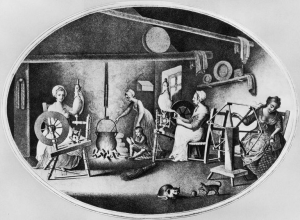
    The Industrial Revolution had many causes that deeply affected the lifestyles of the working classes, or landless poor, but one of the most important was the impact of the Agricultural Revolution.

    Firstly, The Agricultural Revolution involved many innovations in farming that led to a dramatic increase in food production. For example, Charles Townshend’s idea of crop rotation allowed farmers to grow more food, while Jethro Tull’s seed drill allowed faster and more farming differencing practices.  While these were important features of the Agricultural Revolution, there was another factor that also had a big impact on the working population, namely, the growth of enclosing the land through Acts of Parliament.

    Secondly, the Agricultural Revolution caused the growth and resurgence of the Enclosure Movement.  In the decades and centuries before the 1700s, British farmers planted their crops on small strips of land while allowing their animals to graze on common fields shared collectively and their rights protected by the Crown.

    However, in the 1700s, parliament passed successive legislation, referred to as the Enclosure Acts, which allowed the common areas to become privately owned, that increased private ownership, both of which led to another key characteristic of the Industrial Revolution. Wealthy farmers were buying up large sections of land in order to create larger and more complex farms. Ultimately, this forced smaller farmers off of their land.  Having lost their way of life, many of these farmers, landless labourers, trudged to local towns and cities in search of work.  This was important to the overall success of the Industrial Revolution, because it helped create a system that created a large readymade workforce desperate for employment and forced to work in the new factories and mines. The mines were expanded at the rapid rate, needed to fuel the fires to generate the power for the new factories. Privatisation of the land forced traditional farm labourers and families to migrate to centralized locations.  Therefore, historians often view Enclosures as one of the main foundations that established the Industrial Revolution.

    The aim of Enclosures was to consolidate the holders of land into the hands of a few, with most small farmers given no option but to now rent the land under the new system. For many the only course of action was to either leave the land entirely and to take up new occupations in the towns as many did, or to find employment as labourers on the new mechanised increasingly larger farms. Farming quickly became a capitalistic trade aiming to increase production to supply new markets in the growing industrial areas.

    These economic changes had far-reaching social effects. The old village organisation was broken-up and a new social structure evolved. A new and fast growing rural middle class was evolving through the profits obtained from greater production of food. (‘A Short History of Enclosure in Britain’ by Simon Fairlie. The Land Sept. 2009).

    But how did these changes affect rural women?

    The wife of a small holder or tenant farmer, who had lost his land, became dependent upon her husband for income because with the loss of land went her opportunity of her contributing to the resources of the family through her own labourers, such as cheese making, weaving growing crops etc. Whereas, the mistress of a large farm, now had an active concern in the management and productive work of a large household, with low waged servants, luxuries imported from abroad all within the private sphere, and with this increase in wealth she could join the ranks of the leisured classes.

    During the second half of the 18th century a speeding up of these economic changes occurred with a red line between large farms owners and the landless labourer. The new modern system, and means of production, meant that the localised subsistence farming was no longer economically possible. As I’ve mentioned women were traditionally employed in the home, meaning both in private and public spheres: with the management of stock, weaving, managing the kitchen garden and taking care of the needs of the family. Also, women were able to maintain their own economic independence to a point. But now rural women, on the whole, only had work at harvest time on the large farms, so therefore, women became dependent on the wages of their husbands.

    For large farmers and landowners this was a period of great prosperity. Artisans in the towns were earning higher wages in the industrial towns, and therefore, the demand for more food of high quality was in great demand.  But for those still residing in the rural community they often became pauperised and lived in acute distress, losing any few rights they held previously and often living on a reliance of out relief.

    In The Case of Labourers in Husbandry, published in 1795 by J. Davies.  He wrote:

    “Some of the more fortunate cottagers were allowed to retain their gardens, or were given a small allotment of land in exchange for common rights, and these, were able to “breed a few fowls, with which they buy what sheets and blankets they wants, but in many cases the cottages were pulled down, their gardens engrossed into farms and families crowded into old farmhouses with a scrap of garden where they were seldom allow to keep a pig or a chick”. He went on to write. “An amazing number of people have been reduced from a comfortable state of independence, to precarious condition of mere hirelings, who when out of work come immediately on the parish”.

    Davies wrote that widows and single women suffered the most as previously their common rights had always enabled them to provide for themselves. But now for many there was no alternative but to go on the parish. This meant to claim parish relief (charity) to subsidise low wages, or to enter the Workhouse. Some were able to earn a small wage by spinning or through domestic employments but there was just too many of them. Others earned money by becoming day labourers.

    This gradually led to a new underclass of women, known as ‘women day labourers’ and their pay was very poor.

    The plight of women day labours began to receive attention from the radical pamphleteers of the times and the anti-poor law league; as the lack of employment of women was regarded as one of the great and growing evils of the time.

    As I said women have always assisted with the harvest, in fact our school holidays still revolve around the harvest calendar. Parish records also suggest that in some thinly occupied areas they even paid for single women traveling expenses when labour was in short supply. Men and women were hired for a month at a time when they were able to travel. In 1764 women were paid 6s a week (£30 today) – with meat, drink, washing and lodging included. Still a very low wage. We have here a new class of workers due to women traditionally working for less than men, who in were themselves paid low wages and women were able to quickly adapt to the new social and economic circumstance they found themselves in.

    Women could also be employed to hoe turnips and other root crops for example, at a much cheaper rate than the men. Women, boys and girls were trained to do this work – which was actually considered a specialised job. They worked for half the rate as men. Previous to this men had travelled in gangs as specialists in turnip hoeing. 
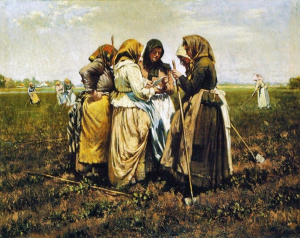
    In Gloucestershire by 1807 women had almost displaced men in corn hoeing because they worked for half the rate of men. In fact women would do most of this work. They could also earn much more for digging potatoes as it was such hard, heavy work. An example of other agricultural work undertaking by the cheaper female workforce was fruit picking, sowing carrots and hop picking. They earned between 10d to 14d a day (about £2 per day) with a quart of cider thrown in during 1807. (Women Workers and the Industrial Revolution 1750-1850 by Ivy Pinchbeck, p.60.)

    For over 500 years pamphleteers, politicians and historians have argued about enclosure. Those in favour insisting that it was necessary for economic development or land improvement to cope with a growing population. Those against claiming that it deprived the rural working class of their livelihoods and led to rural depopulation, vagrancy (that was and still is a criminal offence) and in many cases dependency on the brutal New Poor Law Act of 1834.

    Today we have a renewed interest in this topic because we can often see through our research that our families moved from a long found rural existence into our towns and cities. However, another reason for renewed interest may be due to the the most crucial issue of our time; the management of the global commons and the conflict between the global and the local, between development and diversity – between the landed and the landless and ultimately between man and nature.

    Recommending further reading ‘A Short History of Enclosure in Britain’. By Simon Fairlie. The Land. 7 September 2009 pp.16-31. Easily found online.


    Talk – Women in the Workhouse

    Tuesday 25th June I will be giving a 2 hours talk at Stoke Lodge, Bristol Courses on the workhouse system  Link here

    From Work House to Welfare

    ‘Women surviving a Bristol Workhouse’

    1pm – 3pm with Q & A at the end.

    The lecture focuses on the draconian workhouse system that housed the vulnerable poor, and in particular women and children.  I will be examining the history of the workhouse by offering an illustrated talk based on evidence extracted from reports published at the time.

    The Life and Death of Hannah Wiltshire. A Case Study of bedminster Union Workhouse and Victorian Social Attitudes on Epilepsy. (R. L. Caldicott. 2017),  a true story of how one woman’s life was ended in the workhouse, is included in the talk.