From Workhouse to Welfare: ‘Women surviving a Bristol Workhouse’

Lecture – 25 June 2019 

‘From Workhouse to Welfare: Women surviving a Bristol Workhouse’

The 2 hour talk will focus on the draconian workhouse system that pre-dates the modern welfare state. For the vulnerable poor the workhouse often became their only means of support. Unemployment, sickness, old age, death of a parent and, for women in particular, the workhouse institution typically caused great hardship and even death in some cases. The lecture will examine the history and reality of the workhouse institution using illustrated documented examples taken from inmates’ experiences.  Those who fought for change are recalled, along with examples of modern day memorialisation for the people that lived and died in our workhouses.

A 15 minute tea or coffee break is included within the 2 hour lecture and concludes with a Q&A session.

Book here: Stoke Lodge Shirehampton, Bristol 


Nautical Women by Rosemary L Caldicott

In Nautical Women, Rosemary Caldicott explores the stories of women whose lives were inextricably linked to the sea. She tells of the women of sailortowns struggling to keep out of the dreaded workhouse and resisting the prowling press gangs; and of the courageous and skilful cross-dressing women sailors who went to extraordinary lengths to hide their gender. We learn about these women’s motivation as well as their adventures and inevitable exposure.

Rosemary Caldicott also considers the fate of African women who were forced onto vessels to be traded and sold as slaves; the lives of black women soldiers and sailors, disguised as men, some of whom sailed on slave-ships to and from West Africa; and, in particular, the tragic voyage of the Hannibal in 1693.

Nautical Women challenges our stereotypes of women in earlier societies by exposing their struggles against poverty and forced-labour and revealing the courage of those who ‘ran away to sea’.

Available in good independent book shops, Tangent books, Foyles Book Shop and on line at google books and Amazon on line.

Range: 
Number: 43 
By: Rosemary L Caldicott 
Edition: 2019 
ISBN: 978-1-911522-46-1 
Number of pages: 116

Pauper death and burial in Eastville, Bristol

On 12 July a fascinating public walk and lecture about the history behind the unmarked pauper graves of Rosemary Green, situated on the outskirts of what was once Eastville Union Workhouse, Fishponds Road, Bristol.

After the 1834 Poor Law Act a paupers funeral was considered to be an extravagance that the parish should no longer pay for.  Before the 1834 Act, pauper funerals were paid for by the parish, with local persons attending to the traditional funeral rituals and necessities. In other words a person with no or little money who had died was treated with respect in death and buried as a human being as would be expected, albeit simple, within the cultural rituals of the time.

But after the Act was enforced the Poor Law Unions, in order to save money, and ‘demonstrate disgrace in death of those who had surrendered to poverty‘.  Death and burial practices were changed to become a disgraceful new attitude that resulted in approximately 4,000 men, women and children simply being wrapped in a shroud and dumped in unmarked graves in a small piece of land that sloped into a small river.   The pauper graveyard is located at Rosemary Green just opposite Greenbank Cemetery where there is also an older pauper grave yard.

Extensive research into Eastville workhouse has been undertaken by Bristol Radical History Group and published in 100 Fishponds Road.  (Book available from BRHG). Click here.

Many people have now contacted the BRHG as they suspect that their ancestors may have be buried at Rosemary Green. (Records of names still exist).  If you think that you may have an ancestor who might have died in a workhouse you can contact Heritage Found, free of change, to try to find out more.

At Rosemary Green there is now a touching monument to all those souls once buried beneath.

Made of slate it reads:

Rosemary Green Burial Ground

1851-1895

On this site over 4,000 men women and children

who died in Eastville Workhouse,

known as 100 Fishponds Road,

were buried in unmarked graves.

A further 118 were given to the medical school.

This memorial stands in recognition of all

who lived and died in the workhouse.

Not Forgotten

Please click here to discover more and see fascinating photographs of Eastville Workhouse.

18th May 2017 a talk about Bedminster Workhouse

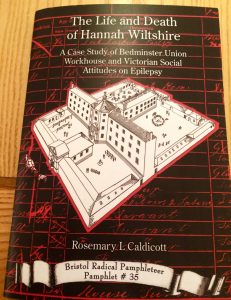
The Life and Death of Hannah Wiltshire

I will be giving a talk on Bedminster Union Workhouse. Bristol to the Clevedon History Group on the 18th May, 2017.  The talk will illustrate how during the year 1855 the workhouse Guardians neglected in their care and duty to protect a vulnerable young women, which resulted in her death. This lead to a public outcry and calls for the first mental health asylum to be built in Bristol.

Bedminster Union Workhouse was located Flax Burton, in North Somerset, England and served the parishes in the region of south west Bristol as well as Bedminster, Bristol.

Let me search for your ancestors and see if any of them were in a workhouse click