

Tips for Reading Old Handwriting
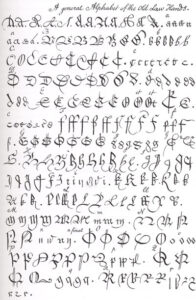 Family history is all about finding and reading documents, whether you look at scanned images on line or hunt for the originals in record offices. As you work your way back from recent certificates to older wills and parish registers, the writing on older documents becomes tricky. The words and their meanings—and even the shapes of the letters themselves—have changed over time. Understanding these documents correctly is time consuming but be the key to comprehending your ancestors’ lives.
Much of the reading relies on contextual clues because the language is outdated and will use an old-fashioned spelling and consistency of spelling prior to the introduction of compulsory schooling and advent of the modern dictionary.[i]
As you move into the 17th and 18th centuries, you will find far more variation. Spelling can be particularly difficult, as spellings were not standardized until compulsory education began around 1870. Surnames and place names in particular can have a wide variety of spellings, even on the same page! During this time most of the population could not write, so there was little need for a universal style.
Different styles of handwriting
The first style you will come across is Round Hand, a free-flowing, expressive way of writing is common in personal papers and letters from the 18th century. It’s not too far away from how we write today, although early examples may use different shapes for capital letters, almost interchangeable i’s and j’s, and a long s, f replaces s.
These variations are a hangover from the precursor to round hand, secretary hand. This style emerged in the 16th century and dominated in England for almost 200 years, so you will often come across it on parish registers. Secretary hand can look like nothing but scribbles at first but if you take the time to look at individual letters in turn you will often find you can decipher it.
Tips
- Print or enlarging the image.
- Scan or photograph original documents to zoom in.
- Read wills in short bursts and revisit from time to time.
Tricky letters, spellings, and abbreviations
- There were no standard spelling rules before 1755 in England and before 1828 in the United States.
- In the past, a long form of the letter s looked like our contemporary letter f.
- Words currently spelled with the letter i were often formerly spelled with the letter y; for example, “mine” was spelled “myne.”
- The letters u and v were frequently interchanged; the word “ever,” for example, was often spelled “euer.”
- The letter j was often replaced with i, so the name “James” may appear as “Iames.”
- The word cousin often meant niece or nephew.
- The title Mrs. could show high social status, not necessarily marital status.
- Good brother or good sister in a document means brother- or sister-in-law.
- The term in-law was also used to describe step-parents.
Common shorthand
The letter y often replaced the letters th; for example, “the” was often written “ye.”
The symbol @ sometimes replaced the word per, for example if you come across @week it most likely means “per week.”
Recommended
- Look up unfamiliar or archaic words and abbreviations online.
- Research the kind of document you are working with; certain documents may have specific phrases, jargon, and abbreviations. Understanding the document’s historical context can help you read the handwriting and understand its meaning.
- Read the document aloud; hearing it may help you to recognize unfamiliar words.
- Write the words yourself by placing tracing paper over a photocopy of your document and tracing each word. Creating the characters of the text may help you understand the words and the context.
- Make an alphabet chart as you go. Write out the alphabet on a separate piece of paper, then copy examples from the document for each letter, both lower- and uppercase. It is usually easiest to identify letters in more obvious words like names and places, then refer to your chart to help with more difficult words.
[i] Graham Jaunay. Cracking the code of old handwriting. Unlock the past. 2011