

The London death toll during the great plagues of the seventeenth century.
“Bring out your Dead”
Today we listen to the media or check Twitter to discover the latest death and infection rates for the Covid pandemic and it often makes for grim news. We check our apps to find out the infection rate in our local area, scan ourselves into cafes, libraries, pubs, and schools so we can be aware for our own safety and that of others. Government and private sector developed apps to provide test track and trace interventions. We have the advantage because we understand how coronaviruses spread from human to human, and we also know that we have modern medical science on our side. But in the past people had little to no understanding of how plague was rapidly spreading from house to house, killing as many as 100,000 people in the City of London during the years 1665-66, about one quarter of the population of London.[1] The Great Plague of London, lasting from 1665 to 1666, was the last major epidemic of the bubonic plague to occur in England. It happened within the centuries-long Second Pandemic.
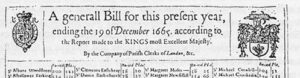
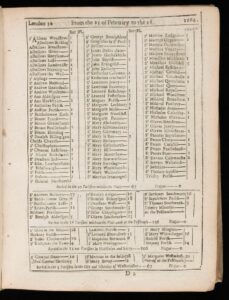
People would eagerly read, or as was more likely were read, the weekly Bill of Mortality double sided sheets informing citizens of the weekly death toll in all of the 130 parishes in London.
“the Bill of Mortality is of very great use…it giveth a general notice of the Plague, and a particular Accompt of the places which are therewith infected, to the end such places may be shunned and avoided.” [2]
Those that died from known illness would be recorded and in which parish they were buried. But for those who died of plague they were to become a disheartening numerical statistic at the bottom of the printed Bills, offering an early example of local public health initiative in an attempt to try and track the progress of the disease.
The Bills were particularly produced by the parishes of the City of London during outbreaks of plague. The first Bill is believed to date from November 1532 [3] and published on 21 December 1592 continuing until 18 December 1595. The practice was abandoned and then revived on 21 December 1603 when plague once again was in town. In 1611 the duty to produce weekly Bills each Thursday, was obligatory and the responsibility of the members of the Worshipful Company of Parish Clerks by a charter granted by James I. Annual returns were also printed each year on 21 December (the feast of St Thomas). New charters were granted by Charles I in 1636 and 1639. As London grew the Bills eventually covered 129 parishes at the granting of the 1639 charter. By 1570 the Bills included baptisms and in 1629 the cause of death was given. The Bills were published by the Worshipful Company of Parish Clerks in London, on a single double sided sheet of paper.
In the last week of July 1665, the London Bill of Mortality showed 3,014 deaths, of which 2,020 had died from the plague.
Corpses were buried quickly, often after being dropped out of upstairs windows or forcibly collected from their boarded-up houses, then to be placed unceremoniously into a mass grave pit such as the one hastily dug at Aldgate near the churchyard being 50 feet long and 20 feet wide. It is recorded that while labourers were still digging at one end dead-carts were tipping corpses in at the other end. When finally covered over 1,114 people were interned at this one site alone.
Such was the mental distress being caused to the people that it was ordered for dead-carts to only collect the bodies after dark. But eventually there were just too many victims and too few drivers that bodies were being stacked up along the sides of the very narrow streets. Daytime collection was resumed with the collector’s famously calling out around the city’s narrow streets “bring out your dead”.[4]
Usually there would be no member of the clergy to pray for the dead and oversee the burials; the clergy, along with the wealthy, had mostly fled to the countryside. Dignity in death for victims of the plague had all but vanished.
Women known as searchers were employed to ascertain the cause of death and search cellars, fields, and gardens for the dead, perhaps even transferring the fleas that carried the disease from house to house oblivious to the fact that they were probably further spreading the disease.
Niall Boyce in his recent article published in The Lancet [5] explains how these statistics were collected during a time of great fear and upheaval in London society. When a person died the parish church bell would ring and the sexton would alert the searchers. The searchers were usually pairs of older women who were paid by the parish to examine the dead to determine the cause. These women had no medical training. People were rightly suspicious of the searchers, believing they would steal from the homes of the dead and fail to inform family nearby of the death. What the older female searchers did have to offer was detailed local knowledge of the people who lived in the parish and possibly years of common sense medical knowledge. For example, women acted as midwives and herbalists often visiting the ill in their homes. Afterall it is highly doubtful if commercial doctors had any deeper knowledge and certainly had no viable medicines to offer the dying other than blood letting, herbs, crude operations and if lucky a little brandy.
During 1625 the Corporation of London published orders for the searchers to correctly report deaths indicating that cases were being under-reported.
“by virtue of their oath, make true report to the Constable of that precinct…to the intent that true notice may bee given…to the Clarke of the Parish, and from him to the Clarke of the parish Clarkes, their true certificate may be made.” [6]
If the searchers were found to be falsifying deaths or failing to notify the clerks in time they could be punished with “the Pillorie” and “corporall paine”, probably whipping.
As plague spread, a system of quarantine was introduced. In any house where someone had died of plague the home would be locked up and no one allowed to enter or leave for 40 days. Unfortunately this frequently led to the deaths of the other inhabitants, by neglect if not from the plague. A ‘plague house’ was marked with a red cross on the door with the words “Lord have mercy upon us”, and apparently in the early days a guard would stand outside.

The printing of the weekly mortality sheets was strictly controlled and sold to subscribers, including the royal households and also on the streets by hawkers to be distributed far and wide outside of London. The cost to the Company of Parish Clerks of their charter in the late 1630s was over £88, including a clock, a salmon, and ten sugar loaves for Archbishop William Laud. The City of London paid the Company of Parish Clerks £4 annually for the Bills of Mortality in 1624, and £15 in 1631; the purchase cost of the printed Bills was 1 penny each, or 4 shillings for an annual subscription. It is estimated a weekly circulation rate of 5000–6000 copies of the Bills of Mortality in the early 17th century. [7]
The Bills of Mortality may very well record family members for many of us with roots in the city. They demonstrate how precarious life was at the time because they detail how people perished according to the understanding of human disease at the time. Descriptions make vivid reading due to the high disease rates; rickets, still births and worms for example, accidents such as drowning, or in one case ‘Scalded in a Brewers mash, at St Giles Cripplegate’. For our ancestor’s life in seventeenth century London and across the country was often short and precarious.

Images of The Bills of Mortality can be viewed at the Wellcome Library Collection here.
[1] The Great Plague of London, 1665. Contagion, Historical Views of Diseases and Epidemics. Harvard University. 2 Mar 2015.
[2] London’s Remembrancer. John Bell, 1665. As cite by Niall Boyce. The Lancet Vol 395 April 11, 2020 p.1186.
[3] Adams H. Reginald. The Parish Clerks of London. 1971. Phillimore.
[4] Leasor, J. The Plague and the Fire. London: George Allen and Unwin. 1962 p.142.
[5] Niall Boyce. The art of medicine Bills of Mortality: tracking disease in early modern London. The Lancet. Vol 395 April 11, 2020 p.1186.
[6] Op. cit.
[7] Op. cit.
Images courtesy of The Wellcome Collection.