

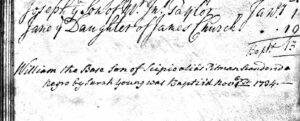
‘William the bastard son of Scipio alias Pitman Seandered(l?) a negro by Sarah Young was Baptised Nov 1st (4th?) 1724. -‘
Why is it so difficult to trace Black British ancestors?
Today while researching in the Bristol Archives and browsing the church records of Holy Trinity Church, Westbury on Trym, I came across an entry that highlights two of the many stigmas that our ancestors may have faced: Racism, illegitimacy, poverty, class, physical ailments and religious bigotry.
A baptism entry was deliberately singled out on a page in the church register, the baptism was of little William Seandered(l)-Young. The entry declares that William was the bastard child of Scipio, alias Pitman Seandered(l), and Sally Young. His baptism took place on November 1st or 4th, 1724. (Authors translation of script).
What do we know of his parents? Extraordinarily little. Young, being a common name, means that there were quite a few Sally Young’s residing in the region at this time who were single or married of childbearing age.
Scipio, or Pitman Seandered(l) is noted in the entry as being a negro, thereby deliberately marking him and his child as being ‘different’. There is no mention of the physical features of any of the other children in the records. Scipio was probably a Christian convert because if a servant he would have been baptised once landed in England. Yet his colour and what would have been considered his race was so important that it was deemed necessary to add to his baby’s baptism record. When plantation owners, or sea captains, purchased Black servants, they often had them baptised as adults, usually taking place upon arrival in England. However, these baptisms do not provide any information on their ancestral history. In fact the baptisms were often used purely as a tool to provide a new name and state their relationship to their master. Due to discrimination few questions would have been asked by the minister, and in many cases Black migrants simply did not know the family details of their past.
A good example is Scipio Africanus (the name of a Roman general), was given to a young African servant buried in Henbury, Bristol, in 1720. Despite the very grand gravestone erected by his master, the Earl of Suffolk and Brandon, there is no record of his burial in the church register. Could this be the answer as to why there appears to be no further mention in the records of Scipio Pitman Seandered(l)?
There are no other records of a man called Scipio Pitman Seandered(l) in the country at this time, not even a burial record. It might be that Scipio was a servant and staying in the town briefly with his master before sailing abroad again, or perhaps he was a sailor visiting the port of Bristol, we will never know. This is all circumspection and he probably was not in attendance at the religious ceremony and perhaps neither was Sarah the mother.
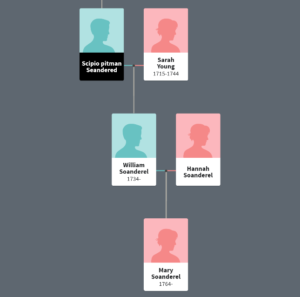
Unfortunately, we must only imagine the circumstances of how the parents continued with their lives and what became of little William. There are no further entries in the parish record book for Westbury on Trym, and therefore he and his mother did not stay in Westbury on Trym. However, a record has since been found in the Church Register Book for Stroud, Gloucestershire of a Mary Soanderal’s baptism on 10 August 1764. Her parents are recorded as being a William Soanderel and Hannah his wife. Could this be William thirty years on in his life? Very possibly, and also an example of how the spelling of names would change, particularly if William was illiterate which was extremely common.
Furthermore, a Sarah Young is recorded in the Book of Burials for Stroud in the parish of St Lawrence, Gloucestershire, as being buried on 24 February, 1744. This woman may perhaps of been William’s mother if she did not marry and meaning that William was only twenty years of age when his mother died.
As a supposed mixed-race child William would have certainly faced many prejudices during his life. This is the only fact that we can be certain of for a young mixed-race child growing up in a country that actively endorsed the enslavement of millions of Black people by racially profiling people of African descent as inferior in order to justify slavery and exploitation. Recent historical research has demonstrated that the free black population of England, as far back as the Elizabethan era, many of whom lived in our port cities such as Bristol and London, ran successful small business, inter-married and worked hard; in trades, in factories, and were of course active contributors within the community.
How has slavery affected Black genealogy?
The slave trade is the reason for the difficulties Black people face in tracing their ancestors. There was no documentation of the names of the African slaves forced upon the slave ships. People and their families were separated on capture and departure, or at the slave marketplace. The millions of displaced people were forced eventually to take on a new anglicised first name and eventually a surname. However, from this point on it is possible to find our ancestors living in the plantations or working as house servants in the Caribbean and Americas. Sources can be found in account books of the farms and plantations, and also in church attendance records, many of which have survived.
Tragically the slave trade changed family trees, by pregnancy from rape, the buying of Black people as domestic servants, and the loss of identity, culture and African names.
Names
The names that enslaved workers forcibly were given often related to the plantation they were living and working on or given the name of their owner; often these names were given to hundreds of people. Because of this, there is little information to trace further back. The amalgamation of hundreds of African communities meant that in many cases, tradition, language, and names were lost. The grouping together of hundreds of people under the same surname unfortunately means that searching beyond this is very difficult because the descendant tree records begin to overlap with the same few names. The examples above demonstrate why researching is complex and, in some cases, can never be fully verified.
Researchers are now assessing interraciality in Britain as having much deeper and diverse roots, with racial mixing and mixedness commonly occuring and being re-discovered in manuscripts, tax records and parish records as far back as the Tudor era. Much of this history has been told in the past through the perspectives of white acamedics and frequently in negative terms of assumed ‘orthodoxy of the interracial experience’ based on marginality, conflict, rejection and confusion. Now first person accounts are being given space and are challenging these outdated perceptions resulting in a contrasting picture of all our ancestry to emerge.
Suggested further reading:
Interraciality in Early Twentieth Century Britain: Challenging Traditional Conceptualisations through Accounts of ‘Ordinariness’. Genealogy 2019, 3(2), 21; https://doi.org/10.3390/genealogy3020021