Spring/Summer Family History Courses

Thursday 28 April 2022 and 16 June – spaces available on these 5 week Family History Courses that will boost your research and social history knowledge! 

New courses Family History Course for this Spring 2022 at Stoke Lodge Bristol now ready to book online. (Please note courses may move on line if government regulations change).

Details HERE

New course week 2: Birth, Marriage and Death

This week my class investigated searching for birth, marriage and death registrations. As our research progresses it is very rewarding to send off for copy certificates. I have sent off for a further two death certificates of ancestors or mine today. During the 19th century, and with couples usually having large families, it is sadly only too common to discover that several children had died during childhood within one household.  I personally find it fascinating to find out what had caused these children’s early demise. Unfortunately I discovered one child had drowned in a pond, but many others died of contagious infections which we no longer fear, such as whopping cough.

These tragedies would have affected the family very deeply, and this was perhaps one reason why people tended not to talk about their grief – because of the fear that life was very precarious for their children.

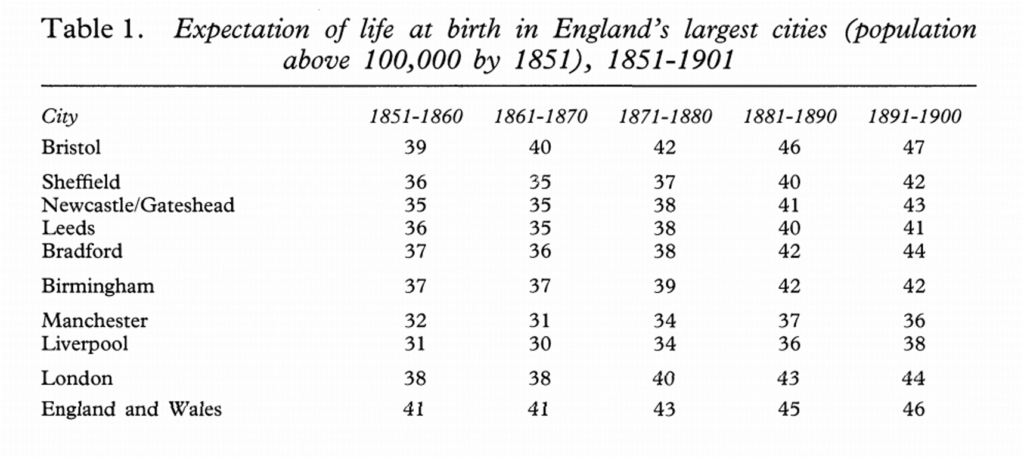
Life expectancy was low compared to today. One of the reasons was the death of infants and children from disease. However, poor housing, pollution, and lack of sanitation also resulted in causing early deaths in all ages.

To send off for a copy certificate is easy. As use the GRO web site as they are the cheapest option and the quickest. Send off HERE

New course: Researching you Family History – Part 2

Discover your Family History –  Introduction to Researching your Family History

Part 2 – Discover your Family History and so much more!

An exploration of Family History. This course will be delivered at Stoke Lodge but will move online if necessary using ZOOM.Heritage Found black and white image of family

Course code FHR2C.  Begins Thursday 10 March 2022 for 5 weeks. 14:00-16:00

A practical easy learning technique to learn how to research and record family history with confidence. A fun approach, in a safe, inclusive environment with other learners. Correct interpretation of vital records, including Parish Records, and tips on how to improve research techniques. Learners should be able to produce at least a 6-generation family tree by week 5. A fun approach, in a safe, inclusive environment with other learners. A mixture of lectures and practical work.

Join award winning tutor Rosemary Caldicott to better understand how to discover your ancestors.

FOR MORE INFORMATION ON ENROLMENT AND TO BOOK HERE

The U.K. 1921 Census will be released on 6 January 2022

What is the 1921 Census of England and Wales?

The 1921 Census gives us the names, ages, occupations and addresses of 38 million people living in the U.K. and are available online from 6 January 2022

The 1921 Census is very important due to the fact that the 1931 Census was destroyed in a fire. Then, the 1941 Census was cancelled due to the Second World War. Therefore the 1921 Census is the only record to become available for the next 30 years other than the 1939 registration war time mini-census.

It’s also the most documented record set up to that time because it was the first census to recognise divorce. For the first time we have documents that will reveal family secrets and surprises that this interwar census brings. These documents will also sadly reveal the many widows and children now living without husbands and fathers due to WWI.

The 1921 Census can be viewed at  findmypast.co.uk from 6 January 2022. The National Archives, Kew have worked with Find my Past to digitalise the documents.

For help to discover you family history contact Heritage Found!

NEW COURSES FOR THE AUTUMN TERM!

Discover your Family History –  Introduction to Researching your Family History

Part One       

A practical stepped learning technique to begin learning family history research with confidence. A fun approach, in a safe, inclusive environment with other learners. 

Correct interpretation of vital records and how to understand simple research techniques.  This course will be delivered at Stoke Lodge but will move online if necessary using ZOOM 

5 weeks. Begins Thursday 23 September 2pm to 4pm   With award winning tutor Rosemary Caldicott

(This course is sold out, but you can go on a wait list)

BOOK HERE

Part 2 – Discover your Family History and so much more!

Places still available.

A further exploration of Family History. This course will be delivered at Stoke Lodge but will move online if necessary using ZOOM.Heritage Found black and white image of family

Course code FHR2B.  Begins Thursday 11 November 2021 for 5 weeks. 14:00-16:00

A practical easy learning technique to begin learning family history research with confidence. A fun approach, in a safe, inclusive environment with other learners. Correct interpretation of vital records and how to understand simple research techniques. Be able to produce at least a 4-generation family tree by week 5. Practical learning for those who have already undertaken some family history research. A fun approach, in a safe, inclusive environment with other learners. Parish records, wills and social history explored. A mixture of lectures and practical work.

Join award winning tutor Rosemary Caldicott to better understand how to discover your ancestors.

FOR MORE INFORMATION ON ENROLMENT AND TO BOOK HERE

They are back! My ever popular Family History Research Talks!

A new series of talks that are designed to meet the needs of family history researchers whatever your level of experience. A chance to share your knowledge with other passionate researchers!  Tutor led direction that will enhance learners’ knowledge.

The first talk is :-

1. Understanding the UK Census   

Do you find census records confusing? Then this is a talk for you! The census records offer us a lot more information than is often realised.Heritage Found Family History Research short course This special session will be a detailed look at the census records. A comprehensive examination of the errors in the records and how to improve our searches.

Also, how to cross reference the years through a deeper understand of the census records.
Where to find lost census records. Keeping records.

This is a one off talk about reading a census document correctly. This course will be delivered online  using ZOOM 

Wednesday 6.30pm to 8.30pm. Rosemary Caldicott 

1 session on 20 October  

FOR MORE INFORMATION ON ENROLMENT AND TO BOOK HERE

2. Understanding the value of birth, marriage and death certificates to enhance your research. 

Often over-looked, but invaluable to further your research.  A detailed talk on how to order and interpret birth, marriage and death certificates. This course will be delivered online  using ZOOM 

We will take a look at birth, marriage and death (BMD) certificates are an invaluable resource for the family history researcher. These records offer us a lot more information than is often realised.  You will learn how to order copies, how to examine the documents correctly, how to cross-reference the information and how to record your evidence.

1 session to be held on Wednesday, 10 November 6.30pm to 8.30pm.

FOR MORE INFORMATION ON ENROLMENT AND TO BOOK HERE

New summer courses!

Hello!

Easter is behind us and now we are all looking forward to a warm summer, and hopefully more freedoms to be allowed to us. My courses are still available on line so you can participate safely from home, in fact from anywhere in the world. We have quite a story to tell our descendants: How we survived the great pandemic.

I am in the happy position to now be able to list my family history courses that will be running during this summer. For now all learning remains on line, which has proved a surprising success (see my feed back here).

If you are interested in researching your family history just click HERE for more information or go to the Courses & Talks page.

Best wishes

Rosemary

Reading Old Handwriting

Tips for Reading Old Handwriting

Family history is all about finding and reading documents, whether you look at scanned images on line or hunt for the originals in record offices. As you work your way back from recent certificates to older wills and parish registers, the writing on older documents becomes tricky. The words and their meanings—and even the shapes of the letters themselves—have changed over time. Understanding these documents correctly is time consuming but be the key to comprehending your ancestors’ lives.

Much of the reading relies on contextual clues because the language is outdated and will use an old-fashioned spelling and consistency of spelling prior to the introduction of compulsory schooling and advent of the modern dictionary.[i]

As you move into the 17th and 18th centuries, you will find far more variation. Spelling can be particularly difficult, as spellings were not standardized until compulsory education began around 1870. Surnames and place names in particular can have a wide variety of spellings, even on the same page! During this time most of the population could not write, so there was little need for a universal style.

Different styles of handwriting

The first style you will come across is Round Hand, a free-flowing, expressive way of writing is common in personal papers and letters from the 18th century. It’s not too far away from how we write today, although early examples may use different shapes for capital letters, almost interchangeable i’s and j’s, and a long s, f replaces s.

These variations are a hangover from the precursor to round hand, secretary hand. This style emerged in the 16th century and dominated in England for almost 200 years, so you will often come across it on parish registers. Secretary hand can look like nothing but scribbles at first but if you take the time to look at individual letters in turn you will often find you can decipher it.

Tips

  • Print or enlarging the image.
  • Scan or photograph original documents to zoom in.
  • Read wills in short bursts and revisit from time to time.

Tricky letters, spellings, and abbreviations

  • There were no standard spelling rules before 1755 in England and before 1828 in the United States.
  • In the past, a long form of the letter s looked like our contemporary letter f.
  • Words currently spelled with the letter i were often formerly spelled with the letter y; for example, “mine” was spelled “myne.”
  • The letters u and v were frequently interchanged; the word “ever,” for example, was often spelled “euer.”
  • The letter j was often replaced with i, so the name “James” may appear as “Iames.”
  • The word cousin often meant niece or nephew.
  • The title Mrs. could show high social status, not necessarily marital status.
  • Good brother or good sister in a document means brother- or sister-in-law.
  • The term in-law was also used to describe step-parents.

Common shorthand

The letter y often replaced the letters th; for example, “the” was often written “ye.”

The symbol @ sometimes replaced the word per, for example if you come across @week it most likely means “per week.”

Recommended

  1. Look up unfamiliar or archaic words and abbreviations online.
  2. Research the kind of document you are working with; certain documents may have specific phrases, jargon, and abbreviations. Understanding the document’s historical context can help you read the handwriting and understand its meaning.
  3. Read the document aloud; hearing it may help you to recognize unfamiliar words.
  4. Write the words yourself by placing tracing paper over a photocopy of your document and tracing each word. Creating the characters of the text may help you understand the words and the context.
  5. Make an alphabet chart as you go. Write out the alphabet on a separate piece of paper, then copy examples from the document for each letter, both lower- and uppercase. It is usually easiest to identify letters in more obvious words like names and places, then refer to your chart to help with more difficult words.

[i] Graham Jaunay. Cracking the code of old handwriting. Unlock the past. 2011

Thank you to Bristol Women’s Voice

Hello, Thank you so much for being involved in the Bristol Women’s Voice International Women’s Day 2021 programme – we have had some great feedback on the breadth of the programme and individual sessions and we couldn’t have done it without you!

It is always so nice to have positive feedback. I am so glad the attendees enjoyed by talk on Nautical Women. Great audience and some interesting questions at the end too.

I attended some of the other talks and events that BWV laid on, which I really enjoyed. Thank you for inviting me as a guest speaker BWV, and looking forward to another interesting program for next year.

You can purchase my book Nautical Women. Women sailors and the women of sailor towns: A forgotten diaspora c.1693-1902. HERE

International Women’s Day – Our Ancestors and Divorce

Occasionally we come across an old divorce petition, a legal document that will bare all.  These documents make incredibly sad reading, but at the same time offer us a fascinating insight into the lives of our ancestors. They can be a deeply private and intimate glimpse into a couple’s marriage; heart wrenching to read, with each person’s account laid bare in blunt legal descriptions, leaving us to judge which side is telling the truth.

Divorce cases were heard in public in open court during the 19th century and a legal separation or divorce was only for the very wealthy. A married woman’s property automatically became her husband’s, and upon divorce the children remained the property of their father which was of course used as a means to control women residing in unhappy marriages. Mothers who left a marriage risked being prevented from seeing their children following a divorce or separation.

Things begin change a little after the 1857 Matrimonial Causes Act, but the law was still stacked in favour of the man. Under the new law, women divorcing on the grounds of adultery not only had to prove that their husbands had been unfaithful, but also had to prove additional faults, which included cruelty, rape and incest. Men, of course, just had to prove their wives had been unfaithful and in an age before cameras, videos and smartphones, this was often a tricky task! Before 1857, divorce was mainly open only to men, and had to be granted by an Act of Parliament.

In 1858 the handling of the legal process for divorce was transferred from the ecclesiastical courts to a newly established civil court, the Court for Divorce and Matrimonial Causes. In 1873 responsibility was passed to a division of the new Supreme Court. All divorce cases took place in London, yet again restricting divorce to wealthier couples only.
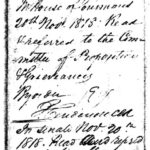
Recently, while researching a family tree I came across a divorce petition document dated 1875 which is stored at the National Archives in London. The couple were a moderate middle class farming couple who had been married for 25 years and were childless. This is a surprising case not only because of the financial implications for particularly the woman involved, but also because in the 19th century, divorce was extremely rare, and generally considered unthinkable for social, financial, and religious reasons. Unhappy couples would often separate but not legally get divorced as can be seen in family history archives. The petitioner in this case was the husband. I have changed the names and addresses in the following reproduction due to the sensitive nature of some of the central claims in the original legal document.
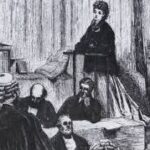
Victorian woman in divorce courtWe begin with the wife’s petition in this divorce case, dated February 1875 and claiming that her husband:

  • ‘the she denies that she was guilty of adultery as alleged.’
  • ‘That in or about the year 1865 the petitioner beat, assaulted and otherwise illtreated her threaten to kill her and greatly terrified her and on two occasions turned his wife out the house and kept her locked out all night refusing to allow her to enter’.
  • ‘That the petitioner on the 13th day of 1872 in ……….. Road, ……… swore at and threatened the wife and took from her her watch and guard wedding ring earrings cloak fur bag umbrella and other articles and insulted and swore at her on the public road in the presence of divers [others] persons strangers.’
  • ‘That on the 13th December 1872 at the house he refused her entry and has thrice hitherto refused to allow her to reside at or enter his said house and thence hitherto has wilfully separated himself from his wife without reasonable excuse and has deserted her.’
  • That in 1873 E.B. [servant] went to reside at the house with her husband that lived and cohabited and committed adultery with the said. E.B was delivered of a male child in said house on the 18th of January 1875 and the husband was the father.’
  • The respondent therefore humbly pray that your Lordship’s will be pleased to reject the pray of the said petitioner and to decree that the said marriage between the petitioner and his respondent be dissolved and that this respondent have such further and other relief in the premises as to your Lordships may [? ].

Her husband responds.

  • ‘That I am informed and verily believe that at divers [many] times …..that the aforesaid committed adultery with Thomas G the younger a butcher.’
  • ‘That I am informed and verily believe that on the 18th of July 1871, at Bath also committed adultery with the said Thomas G the younger.’
  • ‘That I am informed and verily believe that on the 5th day of July 1871 at Reading also committed adultery with the said Thomas G the younger.’
  • ‘That I am informed and verily believe that on the 5th day of January 1873 my wife in a lane call Gypsy Lane in the county of Somerset also committed adultery with the said Thomas G the younger.’
  • ‘That I am informed and verily believe that on the 14th day of April 1873 my wife at Cadbury Hill also committed adultery with the said Thomas G the younger’.
  • ‘That I am informed and verily believe that on a Sunday in the month of May 1873 my wife in a lane leading to the said Cadbury Hill also committed adultery with the said Thomas G the younger’.
  • ‘That I am informed and verily believe that on the 25th day of August 1873 my wife in a field at Hamstead also committed adultery with Thomas G the younger’.
  • ‘That I am informed and verily believe that on the 6th day of April 1874 my wife at Cadbury Hill also committed adultery with the said Thomas G the younger’.
  • ‘that there is no collusion or connivance between me and my wife in any way whatever’.

Thomas G, the butcher swore in his statement presented to the court that he denied any involvement or adultery with the wife.

The above 1875 petition document reveals the fees paid to take this case to court was a staggering £34,000 in today’s money. Unfortunately, the outcome and settlement of this case is not shown but it is doubtful if the wife in this case at this time had any claim over the family house, lands or other effects.

Divorce did not really open up for all classes until the 1920s with the provision of some local courts. In the 1920s and 1930s, English law did not allow for divorce by mutual consent, but rather required proof of adultery, or violence by one party; misconduct by both parties could lead to the divorce being refused. A further hurdle for a couple to obtain a divorce was that the law strictly prohibited “collusion” by the parties, and this is why in the above example the couple had to swear that they had not colluded.  A private members’ bill in 1923 made it easier for women to petition for divorce for adultery – but it still had to be proved.

The Matrimonial Causes Act 1937 changed the law to make divorce easier to access, particularly for women, who until then could not get a divorce merely on the grounds of adultery because a woman needed to show more causes than adultery, such as on the grounds of incest, sodomy, drunkenness, insanity, desertion, or cruelty. The need for the reforms was illustrated in the best-selling satirical novel Holy Deadlock by A E Herbert and published in 1934 which influenced a changing attitude towards a reform to English divorce law. However, there was a bar on petitions for the first three years of the marriage. In the late 1960s divorce was taken over by the county courts and most divorces now take place at county courts.

Finally, in 1969 the Divorce Reform Act was passed, allowing couples to divorce after they had been separated for two years (or five years if only one of them wanted a divorce, however this has proved controversial for some). A marriage could be ended if it had irretrievably broken down, and neither partner no longer had to prove “fault”.

What of our unhappy couple?

The 1881 census discloses that the ex-wife was now living in a neighbouring town with a Richard Pike who was a carpenter, and she is a recorded as a general servant, a term commonly used when a man and woman who were not married co-habited together. Interestingly she also says that her condition was being as married, perhaps meaning that a divorce was not granted in this case, and that Richard Pike was a widower.

The baby born in February 1875 was baptised with the father’s full name and with the mother’s maiden name appearing in the church register because she was an unmarried mother. The couple probably planned to be married once the divorce was finalised, but very sadly the mother (E.B.) died just four months following the child’s birth. The child remained at the family home and was brought up by another woman following the mother’s tragic death. The new couple lived together for over 35 years until the father finally died in 1908. They never married.


1834 Cholera came to the village of Braunston

Following a talk I gave yesterday about the 1832 Cholera Epidemic in Bristol one the attendees very kindly sent me a fascinating link to a cholera outbreak in the village of Braunston, Northamptonshire, during the last months in 1834.

I have posted the article below, which was published on Braunston Village of the Waterways web site (https://www.braunston.org.uk/).* The article contains a primary source written by a Baptist Minister named the Reverend R Miller and published in a leaflet during 1835.

He wrote the record “for the parishioners of Braunston…to lead them to see “the hand invisible that performs works of judgement and mercy”…..

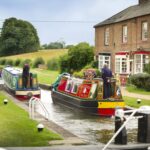
Braunston Canal image‘Cholera came to Braunston on the weekend of a Feast Day, the Feast of All Saints’tide. This was a great time in the village. There was no radio, no television, no outside entertainments to enjoy. The villagers congregated with friends and relatives, there were stalls on the Green, and the public houses were filled with folk.

The Rev Miller noted that no company was to abscene debauched, or viciously disposed to answer there purpose. He looked upon the Cholera as a divine intervention upon the evil ways of the villagers.’

In 1834, Cholera came to Braunston. It would seem likely that it had come from London by canal. It has been noted how the East End of London was badly infected by Cholera. Three suspicious cases were noted at Rotherhithe on the south bank of the Thames opposite Limehouse. The Regents Canal commences at the Regent Canal Dock in Limehouse. The canal proceeds north through London’s East End, then westward to reach the Grand Junction Canal at Brentford, from where the canal goes north to Braunston.

‘Our source for a description of the outbreak is in a leaflet printed by J Castell of High Street Daventry in 1835. It had been written by “A Looker-on”. We know that the” Looker-on” was the Baptist Minister at the time; the Rev R Miller. He wrote the record “for the parishioners of Braunston…to lead them to see “the hand invisible that performs works of judgement and mercy”

Cholera came to Braunston on the weekend of a Feast Day, the Feast of All Saints’tide. This was a great time in the village. There was no radio, no television, no outside entertainments to enjoy. The villagers congregated with friends and relatives, there were stalls on the Green, and the public houses were filled with folk.

The Rev Miller noted that no company was to abscene debauched, or viciously disposed to answer there purpose. He looked upon the Cholera as a divine intervention upon the evil ways of the villagers.

The first case occurred on 7th October 1834 from an infected boat. A bed from the boat was left with a Mrs L, for the bed to be washed. Mrs L caught Cholera and died.

About 2nd November, a legger named Patmore, who lived in Cross Lane in Braunston, died , but Cholera was not concidered to be the cause.

Then on 16th November, a Feast Sunday, a child of Patmore died, and another boatman named T Fall also died in Cross Lane. Fall had come from Derbyshire, and after feeling unwell, had left his boat at Crick Wharf a few days before.

The following Monday 17th November, the day of the Celebration of the Feast, there were stalls on the Green, side shows on the road and private parties in the houses with dancing and drinking. The public houses were full of people.

Continue reading “1834 Cholera came to the village of Braunston” →