
International Women’s Day – Our Ancestors and Divorce

Occasionally we come across an old divorce petition, a legal document that will bare all.  These documents make incredibly sad reading, but at the same time offer us a fascinating insight into the lives of our ancestors. They can be a deeply private and intimate glimpse into a couple’s marriage; heart wrenching to read, with each person’s account laid bare in blunt legal descriptions, leaving us to judge which side is telling the truth.

Divorce cases were heard in public in open court during the 19th century and a legal separation or divorce was only for the very wealthy. A married woman’s property automatically became her husband’s, and upon divorce the children remained the property of their father which was of course used as a means to control women residing in unhappy marriages. Mothers who left a marriage risked being prevented from seeing their children following a divorce or separation.

Things begin change a little after the 1857 Matrimonial Causes Act, but the law was still stacked in favour of the man. Under the new law, women divorcing on the grounds of adultery not only had to prove that their husbands had been unfaithful, but also had to prove additional faults, which included cruelty, rape and incest. Men, of course, just had to prove their wives had been unfaithful and in an age before cameras, videos and smartphones, this was often a tricky task! Before 1857, divorce was mainly open only to men, and had to be granted by an Act of Parliament.

In 1858 the handling of the legal process for divorce was transferred from the ecclesiastical courts to a newly established civil court, the Court for Divorce and Matrimonial Causes. In 1873 responsibility was passed to a division of the new Supreme Court. All divorce cases took place in London, yet again restricting divorce to wealthier couples only.
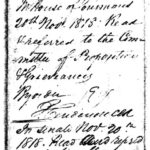
Recently, while researching a family tree I came across a divorce petition document dated 1875 which is stored at the National Archives in London. The couple were a moderate middle class farming couple who had been married for 25 years and were childless. This is a surprising case not only because of the financial implications for particularly the woman involved, but also because in the 19th century, divorce was extremely rare, and generally considered unthinkable for social, financial, and religious reasons. Unhappy couples would often separate but not legally get divorced as can be seen in family history archives. The petitioner in this case was the husband. I have changed the names and addresses in the following reproduction due to the sensitive nature of some of the central claims in the original legal document.
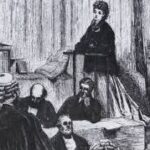
Victorian woman in divorce courtWe begin with the wife’s petition in this divorce case, dated February 1875 and claiming that her husband:

  • ‘the she denies that she was guilty of adultery as alleged.’
  • ‘That in or about the year 1865 the petitioner beat, assaulted and otherwise illtreated her threaten to kill her and greatly terrified her and on two occasions turned his wife out the house and kept her locked out all night refusing to allow her to enter’.
  • ‘That the petitioner on the 13th day of 1872 in ……….. Road, ……… swore at and threatened the wife and took from her her watch and guard wedding ring earrings cloak fur bag umbrella and other articles and insulted and swore at her on the public road in the presence of divers [others] persons strangers.’
  • ‘That on the 13th December 1872 at the house he refused her entry and has thrice hitherto refused to allow her to reside at or enter his said house and thence hitherto has wilfully separated himself from his wife without reasonable excuse and has deserted her.’
  • That in 1873 E.B. [servant] went to reside at the house with her husband that lived and cohabited and committed adultery with the said. E.B was delivered of a male child in said house on the 18th of January 1875 and the husband was the father.’
  • The respondent therefore humbly pray that your Lordship’s will be pleased to reject the pray of the said petitioner and to decree that the said marriage between the petitioner and his respondent be dissolved and that this respondent have such further and other relief in the premises as to your Lordships may [? ].

Her husband responds.

  • ‘That I am informed and verily believe that at divers [many] times …..that the aforesaid committed adultery with Thomas G the younger a butcher.’
  • ‘That I am informed and verily believe that on the 18th of July 1871, at Bath also committed adultery with the said Thomas G the younger.’
  • ‘That I am informed and verily believe that on the 5th day of July 1871 at Reading also committed adultery with the said Thomas G the younger.’
  • ‘That I am informed and verily believe that on the 5th day of January 1873 my wife in a lane call Gypsy Lane in the county of Somerset also committed adultery with the said Thomas G the younger.’
  • ‘That I am informed and verily believe that on the 14th day of April 1873 my wife at Cadbury Hill also committed adultery with the said Thomas G the younger’.
  • ‘That I am informed and verily believe that on a Sunday in the month of May 1873 my wife in a lane leading to the said Cadbury Hill also committed adultery with the said Thomas G the younger’.
  • ‘That I am informed and verily believe that on the 25th day of August 1873 my wife in a field at Hamstead also committed adultery with Thomas G the younger’.
  • ‘That I am informed and verily believe that on the 6th day of April 1874 my wife at Cadbury Hill also committed adultery with the said Thomas G the younger’.
  • ‘that there is no collusion or connivance between me and my wife in any way whatever’.

Thomas G, the butcher swore in his statement presented to the court that he denied any involvement or adultery with the wife.

The above 1875 petition document reveals the fees paid to take this case to court was a staggering £34,000 in today’s money. Unfortunately, the outcome and settlement of this case is not shown but it is doubtful if the wife in this case at this time had any claim over the family house, lands or other effects.

Divorce did not really open up for all classes until the 1920s with the provision of some local courts. In the 1920s and 1930s, English law did not allow for divorce by mutual consent, but rather required proof of adultery, or violence by one party; misconduct by both parties could lead to the divorce being refused. A further hurdle for a couple to obtain a divorce was that the law strictly prohibited “collusion” by the parties, and this is why in the above example the couple had to swear that they had not colluded.  A private members’ bill in 1923 made it easier for women to petition for divorce for adultery – but it still had to be proved.

The Matrimonial Causes Act 1937 changed the law to make divorce easier to access, particularly for women, who until then could not get a divorce merely on the grounds of adultery because a woman needed to show more causes than adultery, such as on the grounds of incest, sodomy, drunkenness, insanity, desertion, or cruelty. The need for the reforms was illustrated in the best-selling satirical novel Holy Deadlock by A E Herbert and published in 1934 which influenced a changing attitude towards a reform to English divorce law. However, there was a bar on petitions for the first three years of the marriage. In the late 1960s divorce was taken over by the county courts and most divorces now take place at county courts.

Finally, in 1969 the Divorce Reform Act was passed, allowing couples to divorce after they had been separated for two years (or five years if only one of them wanted a divorce, however this has proved controversial for some). A marriage could be ended if it had irretrievably broken down, and neither partner no longer had to prove “fault”.

What of our unhappy couple?

The 1881 census discloses that the ex-wife was now living in a neighbouring town with a Richard Pike who was a carpenter, and she is a recorded as a general servant, a term commonly used when a man and woman who were not married co-habited together. Interestingly she also says that her condition was being as married, perhaps meaning that a divorce was not granted in this case, and that Richard Pike was a widower.

The baby born in February 1875 was baptised with the father’s full name and with the mother’s maiden name appearing in the church register because she was an unmarried mother. The couple probably planned to be married once the divorce was finalised, but very sadly the mother (E.B.) died just four months following the child’s birth. The child remained at the family home and was brought up by another woman following the mother’s tragic death. The new couple lived together for over 35 years until the father finally died in 1908. They never married.
1834 Cholera came to the village of Braunston

Following a talk I gave yesterday about the 1832 Cholera Epidemic in Bristol one the attendees very kindly sent me a fascinating link to a cholera outbreak in the village of Braunston, Northamptonshire, during the last months in 1834.

I have posted the article below, which was published on Braunston Village of the Waterways web site (https://www.braunston.org.uk/).* The article contains a primary source written by a Baptist Minister named the Reverend R Miller and published in a leaflet during 1835.

He wrote the record “for the parishioners of Braunston…to lead them to see “the hand invisible that performs works of judgement and mercy”…..

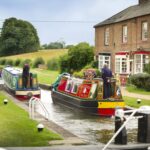
Braunston Canal image‘Cholera came to Braunston on the weekend of a Feast Day, the Feast of All Saints’tide. This was a great time in the village. There was no radio, no television, no outside entertainments to enjoy. The villagers congregated with friends and relatives, there were stalls on the Green, and the public houses were filled with folk.
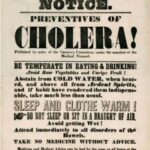
The Rev Miller noted that no company was to abscene debauched, or viciously disposed to answer there purpose. He looked upon the Cholera as a divine intervention upon the evil ways of the villagers.’

In 1834, Cholera came to Braunston. It would seem likely that it had come from London by canal. It has been noted how the East End of London was badly infected by Cholera. Three suspicious cases were noted at Rotherhithe on the south bank of the Thames opposite Limehouse. The Regents Canal commences at the Regent Canal Dock in Limehouse. The canal proceeds north through London’s East End, then westward to reach the Grand Junction Canal at Brentford, from where the canal goes north to Braunston.

‘Our source for a description of the outbreak is in a leaflet printed by J Castell of High Street Daventry in 1835. It had been written by “A Looker-on”. We know that the” Looker-on” was the Baptist Minister at the time; the Rev R Miller. He wrote the record “for the parishioners of Braunston…to lead them to see “the hand invisible that performs works of judgement and mercy”

Cholera came to Braunston on the weekend of a Feast Day, the Feast of All Saints’tide. This was a great time in the village. There was no radio, no television, no outside entertainments to enjoy. The villagers congregated with friends and relatives, there were stalls on the Green, and the public houses were filled with folk.

The Rev Miller noted that no company was to abscene debauched, or viciously disposed to answer there purpose. He looked upon the Cholera as a divine intervention upon the evil ways of the villagers.

The first case occurred on 7th October 1834 from an infected boat. A bed from the boat was left with a Mrs L, for the bed to be washed. Mrs L caught Cholera and died.

About 2nd November, a legger named Patmore, who lived in Cross Lane in Braunston, died , but Cholera was not concidered to be the cause.

Then on 16th November, a Feast Sunday, a child of Patmore died, and another boatman named T Fall also died in Cross Lane. Fall had come from Derbyshire, and after feeling unwell, had left his boat at Crick Wharf a few days before.

The following Monday 17th November, the day of the Celebration of the Feast, there were stalls on the Green, side shows on the road and private parties in the houses with dancing and drinking. The public houses were full of people.

Continue reading “1834 Cholera came to the village of Braunston” →

The Bristol Cholera Epidemic of 1832: Have we learnt any lessons?

New Eventbrite talk 7th February at 7pm! (To book see below)

Cholera reached Bristol on July 11, 1832. The following day, the papers reported that they had reason to fear that cholera had arrived in earnest in the city. There had been four reported cases and three deaths. A notice to this effect had been posted on the Custom House. It was from T. Morris and John Brickdale (MP) and read as follows:

‘Notice is hereby given that the secretary to the board of health established in this port has signified to the Collector and Comptroller that three cases of malignant cholera appeared yesterday in the city, that two deaths have ensued, and the other patient not expected to live’.

Poster warning of CholeraThe following week the newspapers were reporting on further cholera deaths and the use of chloride of lime to fumigate and sanitise infected buildings. There was also the report of six cases in the Gaol. The Bristol Mirror reported a special General Committee of the Corporation of the Poor at St. Peter’s Hospital had been established in order to deal with communications from the Board of Health. The committee also voted for the foundation of a cholera hospital (never built).
How did Bristol’s merchants, doctors and population respond to the disease arriving in the city and were senior physicians’ reports to the authorities acted upon?

To learn the full story join me at Eventbrite on 7th February 2021 & 7pm. To book click HERE

I came across a Higgler

Hannah Knight of West Milton England. A Higgler
Hannah Knight, A Higgler.

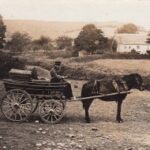
Many localised names for occupations have been lost over the years. I recently came across a man who was listed as a ‘higgler’ on the 1851 census. He lived in Harlow, Essex, England. This was certainly a trade I have never come across before. It turns out a higgler was a person who travelled around country districts selling useful things like saucepans, or ribbons and patent medicines. However, the intriguing aspect to a higgler was that he would commonly accept farm produce, like rabbits, cheese chickens or ducks perhaps to sell onto others, perhaps at a market place. They were hagglers, trading using the age old barter system and the word haggler is still used today. These men and women were essentially middlemen.

According to World Wide Words. Investigating the English language across the Globe the word higgler has survived in the Caribbean islands, especially in Jamaica, where it is used to describe a market trader.

In The Surgeon’s Daughter (1827) Walter Scott wrote:

‘The labours of a higgler, who travels scores of miles to barter pins, ribbons, snuff and tobacco, against the housewife’s private stock of eggs, mort-skins [sheep skins], and tallow’

However, higglers could have a bad reputation with the authorities who were suspicious of them. Bearing in mind that the authorities themselves would manipulate prices a higgler worked outside of their control.

The Times of London reported on 10 June 1800:

‘A meeting was held at Poole, on Friday last, to take into consideration the propriety of the inhabitants in general refraining from the use of butter, till the price is reduced to One Shilling a pound; when it was unanimously resolved by all reduced, and even then, to use it in their families with great economy and moderation … and proper people are appointed to keep a constant watch on the Higglers on Market-day who are the principal cause of the great prices of many of the necessaries of life.

I am sure that higglers were not to blame, after all they could not have been the only persons selling butter in Poole! This statement was more likely to be based on local prejudice and suspicion against travelling higglers.

The Effects on our Rural Ancestors during the Agricultural Revolution

The Employment of rural women in agriculture before and after the Agricultural Revolution 

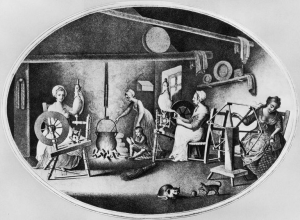
In 1750 England was still in the main an agricultural country, the greater part of which was the old type of rural organisation. This traditionally means with an open-field farming method, strip farming and most importantly these activities mainly took place on common lands. Farming was subsistence by nature and was a means of production to supply the needs of the immediate community. Women took on much of the work and often provided a surplus that could be sold on or exchanged for other goods.
Over the next 70 years huge changes took place.

The industrial world took the place of many domestic cottage industries, such as lace making, weaving, brush making, rope making for example, and many other forms of home-based manufacturing.  With enclosures the large enclosed farm was to take over, absorbing small crofters and other traditional occupations that once took place in the open village, such a meat curing, milking and threshing. The Commons, or the people reliant on the free right to graze their animals and grow limited crops – the ‘commoners’ – were to become a lifestyle of the past. 

The Industrial Revolution had many causes that deeply affected the lifestyles of the working classes, or landless poor, but one of the most important was the impact of the Agricultural Revolution.

Firstly, The Agricultural Revolution involved many innovations in farming that led to a dramatic increase in food production. For example, Charles Townshend’s idea of crop rotation allowed farmers to grow more food, while Jethro Tull’s seed drill allowed faster and more farming differencing practices.  While these were important features of the Agricultural Revolution, there was another factor that also had a big impact on the working population, namely, the growth of enclosing the land through Acts of Parliament.

Secondly, the Agricultural Revolution caused the growth and resurgence of the Enclosure Movement.  In the decades and centuries before the 1700s, British farmers planted their crops on small strips of land while allowing their animals to graze on common fields shared collectively and their rights protected by the Crown.

However, in the 1700s, parliament passed successive legislation, referred to as the Enclosure Acts, which allowed the common areas to become privately owned, that increased private ownership, both of which led to another key characteristic of the Industrial Revolution. Wealthy farmers were buying up large sections of land in order to create larger and more complex farms. Ultimately, this forced smaller farmers off of their land.  Having lost their way of life, many of these farmers, landless labourers, trudged to local towns and cities in search of work.  This was important to the overall success of the Industrial Revolution, because it helped create a system that created a large readymade workforce desperate for employment and forced to work in the new factories and mines. The mines were expanded at the rapid rate, needed to fuel the fires to generate the power for the new factories. Privatisation of the land forced traditional farm labourers and families to migrate to centralized locations.  Therefore, historians often view Enclosures as one of the main foundations that established the Industrial Revolution.

The aim of Enclosures was to consolidate the holders of land into the hands of a few, with most small farmers given no option but to now rent the land under the new system. For many the only course of action was to either leave the land entirely and to take up new occupations in the towns as many did, or to find employment as labourers on the new mechanised increasingly larger farms. Farming quickly became a capitalistic trade aiming to increase production to supply new markets in the growing industrial areas.

These economic changes had far-reaching social effects. The old village organisation was broken-up and a new social structure evolved. A new and fast growing rural middle class was evolving through the profits obtained from greater production of food. (‘A Short History of Enclosure in Britain’ by Simon Fairlie. The Land Sept. 2009).

But how did these changes affect rural women?

The wife of a small holder or tenant farmer, who had lost his land, became dependent upon her husband for income because with the loss of land went her opportunity of her contributing to the resources of the family through her own labourers, such as cheese making, weaving growing crops etc. Whereas, the mistress of a large farm, now had an active concern in the management and productive work of a large household, with low waged servants, luxuries imported from abroad all within the private sphere, and with this increase in wealth she could join the ranks of the leisured classes.

During the second half of the 18th century a speeding up of these economic changes occurred with a red line between large farms owners and the landless labourer. The new modern system, and means of production, meant that the localised subsistence farming was no longer economically possible. As I’ve mentioned women were traditionally employed in the home, meaning both in private and public spheres: with the management of stock, weaving, managing the kitchen garden and taking care of the needs of the family. Also, women were able to maintain their own economic independence to a point. But now rural women, on the whole, only had work at harvest time on the large farms, so therefore, women became dependent on the wages of their husbands.

For large farmers and landowners this was a period of great prosperity. Artisans in the towns were earning higher wages in the industrial towns, and therefore, the demand for more food of high quality was in great demand.  But for those still residing in the rural community they often became pauperised and lived in acute distress, losing any few rights they held previously and often living on a reliance of out relief.

In The Case of Labourers in Husbandry, published in 1795 by J. Davies.  He wrote:

“Some of the more fortunate cottagers were allowed to retain their gardens, or were given a small allotment of land in exchange for common rights, and these, were able to “breed a few fowls, with which they buy what sheets and blankets they wants, but in many cases the cottages were pulled down, their gardens engrossed into farms and families crowded into old farmhouses with a scrap of garden where they were seldom allow to keep a pig or a chick”. He went on to write. “An amazing number of people have been reduced from a comfortable state of independence, to precarious condition of mere hirelings, who when out of work come immediately on the parish”.

Davies wrote that widows and single women suffered the most as previously their common rights had always enabled them to provide for themselves. But now for many there was no alternative but to go on the parish. This meant to claim parish relief (charity) to subsidise low wages, or to enter the Workhouse. Some were able to earn a small wage by spinning or through domestic employments but there was just too many of them. Others earned money by becoming day labourers.

This gradually led to a new underclass of women, known as ‘women day labourers’ and their pay was very poor.

The plight of women day labours began to receive attention from the radical pamphleteers of the times and the anti-poor law league; as the lack of employment of women was regarded as one of the great and growing evils of the time.

As I said women have always assisted with the harvest, in fact our school holidays still revolve around the harvest calendar. Parish records also suggest that in some thinly occupied areas they even paid for single women traveling expenses when labour was in short supply. Men and women were hired for a month at a time when they were able to travel. In 1764 women were paid 6s a week (£30 today) – with meat, drink, washing and lodging included. Still a very low wage. We have here a new class of workers due to women traditionally working for less than men, who in were themselves paid low wages and women were able to quickly adapt to the new social and economic circumstance they found themselves in.

Women could also be employed to hoe turnips and other root crops for example, at a much cheaper rate than the men. Women, boys and girls were trained to do this work – which was actually considered a specialised job. They worked for half the rate as men. Previous to this men had travelled in gangs as specialists in turnip hoeing. 

In Gloucestershire by 1807 women had almost displaced men in corn hoeing because they worked for half the rate of men. In fact women would do most of this work. They could also earn much more for digging potatoes as it was such hard, heavy work. An example of other agricultural work undertaking by the cheaper female workforce was fruit picking, sowing carrots and hop picking. They earned between 10d to 14d a day (about £2 per day) with a quart of cider thrown in during 1807. (Women Workers and the Industrial Revolution 1750-1850 by Ivy Pinchbeck, p.60.)

For over 500 years pamphleteers, politicians and historians have argued about enclosure. Those in favour insisting that it was necessary for economic development or land improvement to cope with a growing population. Those against claiming that it deprived the rural working class of their livelihoods and led to rural depopulation, vagrancy (that was and still is a criminal offence) and in many cases dependency on the brutal New Poor Law Act of 1834.

Today we have a renewed interest in this topic because we can often see through our research that our families moved from a long found rural existence into our towns and cities. However, another reason for renewed interest may be due to the the most crucial issue of our time; the management of the global commons and the conflict between the global and the local, between development and diversity – between the landed and the landless and ultimately between man and nature.

Recommending further reading ‘A Short History of Enclosure in Britain’. By Simon Fairlie. The Land. 7 September 2009 pp.16-31. Easily found online.

Talk – Bristol Harbour Festival. 21 September: ‘Nautical Women and the Rum Do’

‘Nautical Women and the Rum Do’

Followed by traditional quayside selling of ethically sourced cargo and book signing.

Bristol Harbour Festival
Saturday 21st September at 3.30pm
By kind invitation of New Dawn Traders and introducing their ethical trading ship De Gallant.

Rosemary Caldicott will talk about extraordinary women sailors in history, accompanied by the Rum Do Crew, traditional sea shanty singers, to entertain and uplift us all.
Our musical and talking event will be held at:
Bristol Harbour Masters Office, Underfall Yard, Cumberland Road, Bristol, BS1 6XG
New Dawn Traders ships producers goods using the power of the wind. They also provide environmentally friendly passage for climate change, oceanographers, marine biology scientists and general seadogs to sail on a non polluting ship for their missions.
‘Nautical Women’, by Rosemary L Caldicott

New course: Working Class History from Below

The Women who challenged Society in Bristol and further afield.

A new series of lectures that aim to present a different perspective of our collective history, the history of working class people, and in particular working class women. Topics covered amongst others will be Women in Port Cities, Women surviving a Bristol workhouse, and Pioneering Bristol Women in the Trades Union Movement

Enrol online here.

Course Dates 2019 – 2020

These courses take place at Stoke Lodge, Bristol

Tuesday 1pm – 3 pm Rosemary Caldicott

  • 4 sessions 12 November
  • 4 sessions 14 January
  • 4 sessions 3 March
  • 4 sessions 28 April