

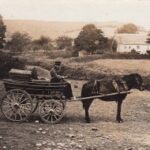
Many localised names for occupations have been lost over the years. I recently came across a man who was listed as a ‘higgler’ on the 1851 census. He lived in Harlow, Essex, England. This was certainly a trade I have never come across before. It turns out a higgler was a person who travelled around country districts selling useful things like saucepans, or ribbons and patent medicines. However, the intriguing aspect to a higgler was that he would commonly accept farm produce, like rabbits, cheese chickens or ducks perhaps to sell onto others, perhaps at a market place. They were hagglers, trading using the age old barter system and the word haggler is still used today. These men and women were essentially middlemen.
According to World Wide Words. Investigating the English language across the Globe the word higgler has survived in the Caribbean islands, especially in Jamaica, where it is used to describe a market trader.
In The Surgeon’s Daughter (1827) Walter Scott wrote:
‘The labours of a higgler, who travels scores of miles to barter pins, ribbons, snuff and tobacco, against the housewife’s private stock of eggs, mort-skins [sheep skins], and tallow’
However, higglers could have a bad reputation with the authorities who were suspicious of them. Bearing in mind that the authorities themselves would manipulate prices a higgler worked outside of their control.
The Times of London reported on 10 June 1800:
‘A meeting was held at Poole, on Friday last, to take into consideration the propriety of the inhabitants in general refraining from the use of butter, till the price is reduced to One Shilling a pound; when it was unanimously resolved by all reduced, and even then, to use it in their families with great economy and moderation … and proper people are appointed to keep a constant watch on the Higglers on Market-day who are the principal cause of the great prices of many of the necessaries of life.
I am sure that higglers were not to blame, after all they could not have been the only persons selling butter in Poole! This statement was more likely to be based on local prejudice and suspicion against travelling higglers.