Announcing 4 new Family History Courses – Starting January 2021

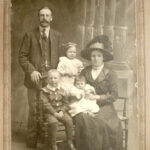
Heritage Found black and white image of familyA Beginners Introduction to Family History Research – Taster class

A two hour class, delivered online via Zoom, by award winning tutor. Learners will be given examples of how to undertake family history correctly. The census records will be examined and the many potential pitfalls will explained. Designed for complete beginners.

Thursday 12 January. 2pm – 4pm.

Book Here

Heritage Found Family History course Stage 1 Family History Course starts January 2021Family History Stage 1

A five week online course  to learn with ease the correct interpretation of vital records and how to understand simple research techniques. The course aims for learners to be able to produce at least a 4- generation family tree by week 5. Delivered via zoom and open for anyone.

Thursday 14 January.1.30pm to 4pm 

Book Here

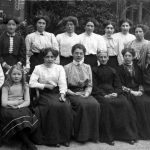
Heritage Found Family History Research short courseFamily History Intensive Research Afternoon

For the novice or experienced genealogist!  Designed to advance your ancestral research development, to explore areas of your research that have been neglected or to assist you to begin a new search. Delivered online via zoom.

Tuesday 23 February 2pm to 4.30pm 

Book Here

Heritage Found Stage 2 5 week Family History research course
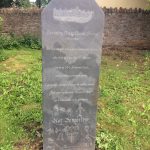
A monument to all those that were buried at Eastville workhouse Bristol.

Family History Stage 2

A practical, 5 week, stepped learning technique for those have already undertaken some family history research. A fun approach, in a safe, inclusive environment with other learners. Parish records, wills and social history are just some of the topics to be explored and explained.

Correct interpretation of vital records and how to understand simple research techniques. Aspects of social history will be investigated too. The course aims for learners to be able to produce at least a 6-generation family tree by week 5.

Thursday 25 February. 1.30pm to 4pm

Book Here

Researching old Wills – Part One

As you travel further back into your ancestors past and into the realms of parish records you will stumble upon wills. Millions of these old documents are now available on sites such as Ancestry and at county and national archive record sites.

Bequests in early wills often included bed linen, a bed, silver spoons and brassware, these were items of great value. Terms used such as cousin, stepson or daughter-in-law did not have the same meaning as they do now, so modern interpretations of old wills can be tricky. They are a good source of discovering other members of the family not previously know about.

The handwriting will vary greatly, from fine quilled scripted writing, to Latin and incomprehensible scribble, suggesting they were hastily written up by candlelight in the dying persons bed chamber. But the more you train your eye to read these documents the easier it will become. Much of these documents will mention at great length ‘duty to god’ which will sometimes be laid down in Latin: the effect of Christianity upon the will was very marked. In England and Wales until 1858 the Church ran probate courts to ensure the terms of a will were followed. Members of the clergy often drew up parishioners’ wills if they could not afford a lawyer, or by choice.

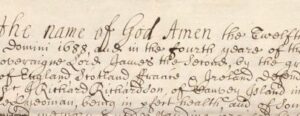
Wills written in the 19th century tend to follow a general pattern, usually beginning with the words, ‘In the name of God Amen’. The testator then states his mental competence. Often, will writing only took place when death was imminent, and wills usually contained instructions about the disposal of the body and what form the memorial took. Gifts for mourners, favoured servants and local residents also featured in many wills, then the list of bequests. Wills usually ended with the date and the point that all former wills were revoked. Then, the testator and two witnesses signed the document. It can be exciting to see an ancestor’s signature (often by shaky hand) on a sixteenth century will.

In 1858, the authorities established the Principal Probate Registry where a copy of every will provided was kept, as well as letters of administration. When the registry was established, district probate registries were created around the country.

However, it must be remembered that in the mid-19th century, the bulk of people did not leave wills thanks to the vast differences between the rich and poor. However, I have come across poor cottagers’ wills, leaving only a few pieces of furniture to a son or daughter being written up by the local curate.

Also, to be encouraged, before embarking on a long sea voyage or taking part in military campaigns was often for people (men) to leave wills. We must remember that in the not so distant past sudden deaths happened frequently, and often family members were forced to apply for letters of administration when a person who held substantial assets died intestate.

BRITISH BLACK HISTORY MONTH 2020: Why is it so difficult to trace Black British ancestors?

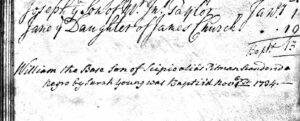
‘William the bastard son of Scipio alias Pitman Seandered(l?) a negro by Sarah Young was Baptised Nov 1st (4th?) 1724. -‘ 

Why is it so difficult to trace Black British ancestors?

Today while researching in the Bristol Archives and browsing the church records of Holy Trinity Church, Westbury on Trym, I came across an entry that highlights two of the many stigmas that our ancestors may have faced: Racism, illegitimacy, poverty, class, physical ailments and religious bigotry.

A baptism entry was deliberately singled out on a page in the church register, the baptism was of little William Seandered(l)-Young. The entry declares that William was the bastard child of Scipio, alias Pitman Seandered(l), and Sally Young. His baptism took place on November 1st or 4th, 1724. (Authors translation of script).

What do we know of his parents? Extraordinarily little. Young, being a common name, means that there were quite a few Sally Young’s residing in the region at this time who were single or married of childbearing age.

Scipio, or Pitman Seandered(l) is noted in the entry as being a negro, thereby deliberately marking him and his child as being ‘different’. There is no mention of the physical features of any of the other children in the records. Scipio was probably a Christian convert because if a servant he would have been baptised once landed in England. Yet his colour and what would have been considered his race was so important that it was deemed necessary to add to his baby’s baptism record. When plantation owners, or sea captains, purchased Black servants, they often had them baptised as adults, usually taking place upon arrival in England. However, these baptisms do not provide any information on their ancestral history. In fact the baptisms were often used purely as a tool to provide a new name and state their relationship to their master. Due to discrimination few questions would have been asked by the minister, and in many cases Black migrants simply did not know the family details of their past.

A good example is Scipio Africanus (the name of a Roman general), was given to a young African servant buried in Henbury, Bristol, in 1720. Despite the very grand gravestone erected by his master, the Earl of Suffolk and Brandon, there is no record of his burial in the church register. Could this be the answer as to why there appears to be no further mention in the records of Scipio Pitman Seandered(l)?

There are no other records of a man called Scipio Pitman Seandered(l) in the country at this time, not even a burial record.  It might be that Scipio was a servant and staying in the town briefly with his master before sailing abroad again, or perhaps he was a sailor visiting the port of Bristol, we will never know. This is all circumspection and he probably was not in attendance at the religious ceremony and perhaps neither was Sarah the mother.

Unfortunately, we must only imagine the circumstances of how the parents continued with their lives and what became of little William.  There are no further entries in the parish record book for Westbury on Trym, and therefore he and his mother did not stay in Westbury on Trym.  However, a record has since been found in the Church Register Book for Stroud, Gloucestershire of a Mary Soanderal’s baptism on 10 August 1764. Her parents are recorded as being a William Soanderel and Hannah his wife. Could this be William thirty years on in his life? Very possibly, and also an example of how the spelling of names would change, particularly if William was illiterate which was extremely common.

Continue reading “BRITISH BLACK HISTORY MONTH 2020: Why is it so difficult to trace Black British ancestors?” →


You need patience to research parish records

Parish Records, or the registers, were the accounts and vital records collected about the lives of local people living in parishes across the U.K. Although the records consist of tax and rate collections, leases, and even the chimney taxation returns they often have names of the people in connection to the event.

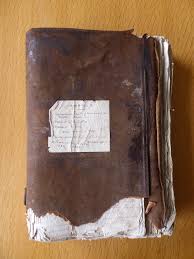
But immediately important for us it is the church record books, the registers, where our families ‘rights of passage’ are recorded. Baptisms, Marriages and Burials with dates names will be found in these books. Most are available online through various web sites, but sometimes it will still be necessary to visit the local record office to find our ancestors within these records. The digital church books are amazing to browse through. Make sure you turn the pages as you will probably find other members of the family within the same book. The further you dwell back in time unfortunately the harder the hand writing becomes to read.

It is a time consuming exercise and patience will be required so set aside a quiet time and be sure to do a thorough search. Do not be tempted to skip a page or two. If the sound of this chore bores the pants off of you perhaps your Heritage Found might be able to assist you.

A BIG thank you to my learners!

Over the summer I have been offering my courses and talks online for the first time ever.  For me this proved to be an enjoyable experience and I hope for my learners too!

Learners, who participated over the internet have been very supportive and kind, and here is a sample of feedback emails I have received.  Thank you very much, your comments are very much appreciated and help me to improve delivery of courses and talks ‘In the Time of Covid’.

         Many thanks Rosemary- excellent lecture as always- I’ve already signed up for  the Hannah Wiltshire                 and Black Death lectures in the autumn so look forward to joining you again then! S.S. Aug. 2020
        Thank you to or SUCH an interesting talk this afternoon. I really enjoyed it. June 2020 M.C.
Firstly, thank you very much for running the course – I found it very interesting and very helpful.  When the lockdown first came in, I assumed that the course wouldn’t be running, so it was a pleasant surprise (and very good timing from the point of view of my own research) to hear that it would be.  We all seem to be doing everything by Zoom nowadays, so thank you for getting to grips with the process and making it work so well. Your presentations came over fine on the screen.  My only comment would be that it might be an idea to break them up a bit more, maybe pause every 20 minutes or so and do a short Q&A session or something before resuming.  G.P.
Thanks so much for the Family History classes. I’ve really enjoyed them and found them very useful. I appreciate all the work you have done to put the classes online – from my supply-teaching experience I know it can’t have been easy. J.
Thanks again Rosemary for great content, entertaining delivery and incredible patience with the technology.  I’m so glad you persevered and will look forward to more.  J.P.
This is a very belated e mail to say thank you very much for all of the very interesting material regarding the workhouses P.D.
Many thanks for the attached. It was a very interesting talk particularly as you concentrated on the Bristol area. When I was thinking about the talk I was reminded that up until the 60’s if a girl became pregnant outside wedlock in Bristol she could be sent to the local mental home to have her baby without anyone knowing. There was a home in Stoke Bishop as well where the babies were prepared to fostering and adoption. A.E

1841 Census – pit falls

The 1841 census is the first census that was undertaken to cover England and Wales to include family names, street names, occupation and if born in the county or not.

A key feature to be considered when searching back through British census records is that the 1841 census rounded down adult ages to the nearest 5 years. For example, 53 becomes 50 and 28 becomes 25.  This can easily throw us off course when looking for similar names in a small geographical area, a common problem my learners come across!  However, matching up occupation can help us have some confidence that we have in fact found the correct people.  Luckily though children’s ages up to 14 are given their exact age even down to the day of a newborn which I find rather touching.

You will not find house or flat numbers under the address column, only a street name, or less.  In 1841 the state in the U.K. did not consider it necessary to know such facts. Also, it must be remembered that postage was hardly used at this time and that government were simply not interested to know precisely where each person lived. Most homes did not have a number with the feature only being developed as urbanization grew larger across the country. However, by the coming of the 1851 census dwelling numbers were beginning to be added to the census schedules.

2020 Autumn Courses: online from 9.30am Thursday 27 August!

2020 Programme

All autumn term courses will be available to book from 9.30am on Thursday 27 August.

We encourage those of you who can, to book online (some hints and tips below).
direct link to online booking

Our friendly staff will be in the office to take phone bookings from 9.30 on Thursday and Friday.
Please bear with us, we expect phone lines to be busy.

Tel: 0117 903 8844 Bristol City Council – Adult Learning

Thank you for your patience and support in this challenging time.

Top tips for booking online:

  • Set up an account and keep your password somewhere safe.
  • If you have enrolled before and given us your email but never enrolled online, you will have an existing account and will need to request a password reset to sign in on our booking page.
  • Accounts are individual – so if you and your partner usually book together make sure you both have an account (you will each need a separate email address). You can’t book 2 places with one account.
  • When you get to the online booking page log in and this will allow you to enrol and put courses in your basket.
  • When you pay for your courses you should receive 2 email confirmations. One confirming your payment has been taken and a second (and most important!) confirming your place on the course and course details.

English and Welsh Death Certificates – a valuable resource often overlooked.

Death certificates are a very under valued family research source.

On the one hand they do give less information than a birth and marriage certificate, but death certificates offer us an understanding of the end of a life.  They also give us links with wills, burial, newspaper reports, workhouse infirmary reports and an deeper connection with people.

A death certificate will give you the full name of the deceased, their sex, age (post 1866), occupation, cause of death, where the person died, address of the informant, the date of registration and finally the signature of the registrar.

Be aware when searching though the vital indexes (required to send off for a copy death certificate) that before 1866 the persons date of birth and age was not included. This means that, especially with common names, that it can be difficult to track down the correct person.

Unbelievably it was only from April 1969 that the deceased date and place of birth are given, and the maiden name of married and widowed women.

As you go back in time, especially before mass vaccination being introduced in the early 1940s, it is shocking to see how many children were lost to contagious diseases. One family living in London I researched sadly lost four young children, one each year between 1865 to 1870 to whooping cough. Also, you will discover many people dying from infections easily treatable today with antibiotics. Certainly a stark glimpse into our ancestors precarious lives.

Second Life Marketplace - CLEARANCE - 90% OFF! Montagne Noire ...

Intensive Family History research day – Saturday 16th May

Intensiv

e research day running from 10.30 a.m. to 3.30. p.m.

The day is designed to run via zoom to advance your ancestral research development.  There will be a mixture of talks, guidance, several breaks with time to undertake your own research the assistance of an expert genealogist tutor to hand.

  • 1 session only this summer term on 16 May

To book or for more information just telephone 0117 903 884 or book on line here Book

A message to my learners – Online support tutoring

Hello everyone

As you will have heard Stoke Lodge was closed today due to the ongoing health crisis.  This decision was a very sad one for all of us at Stoke Lodge, but we will reopen as soon as we are able.

In the meantime I will be publishing online support via this website each weekend.  I will also be offering a once a week phone call to each of you so you can ask me questions concerning your family history research projects.  There will be articles appearing on these pages that we would have covered over the next few weeks in class.  As well as this I will be adding  links to online resources that will support your learning.

If you would like to take advantage of weekly phone-in support, to be set at time to suit us both, over the next few weeks, please send me your email address to:

heritage_found@yahoo.co.uk

Your email address will be deleted at the end of the normal term time.

This is a good time to pull together your ongoing research.  Having projects such as these, while we are stuck at home, helps to take our minds off the current crisis and will relieve boredom.

In the meantime I leave you with a thought provoking quote from Daniel Defoe:

“All the plays and interludes which had been set up, and began to increase among us, were forbid to act: the gaming-tables, public dancing-rooms, and music-houses, which multiplied and began to debauch the manners of the people, were shut up and suppressed; and the jack-puddings, merry-andrews, puppet-shows, rope-dancers, and such-like doings, which had bewitched the poor common people, shut up their shops, finding indeed no trade; for the minds of the people were agitated with other things” (Daniel Defoe, A Journal of the Plague Year, 1722).