Last day for my learners

Today was the last day of my Stage 2 Family History Course that I run at Stoke Lodge Bristol. 

Some of the learners gave fabulous presentations of their family history research and very interesting their research proved to be!  We all learned a lot from how they undertook their research, and I was impressed at the hard work and many hours that had been undertaken.
Thank you to the whole class for making this course very interesting for all of us.  I hope you continue to to pursue your wonderful research and that my course has inspired you to overcome the inevitable obstacles that will pop up from time to time.

Happy Christmas Everyone! 

New class starts this week

Family History and ancestry classes, Bristol

I am very much looking forward to meeting my new learners on Thursday at Stoke Lodge.

Its that time of year again and a new year begins with family history and ancestry classes in Bristol.  I wonder what intrigues await the learners this year? They will uncover their ancestors lives and learn the correct methodology to undertake their research successfully. Correct interpretation is key to stay focused on their sources. The step by step course will go through each basic area of family history research with plenty of time to do lots of online searches.

Welcome everyone!


Your unique family social history, and how to reveal it.

It is very rewarding to research your unique family social history and discover what, where, when and why your ancestors made certain life choices in the family’s best interest.  Although clearly there are many examples of individuals who turn out to be black sheep, or through no fault of their own made a wrong life-changing decision.  However, fascinatingly, all our ancestors have a very interesting life course story.

It is very important to try and place ourselves in their shoes in order to appreciate how society was organised in the past.  For example, class restraints were deeply ingrained in the human psyche and this resulted in a lack of social mobility.  Furthermore, our ancestors were victims of war, famine and contagious disease – all of which led to the death of children and homelessness.

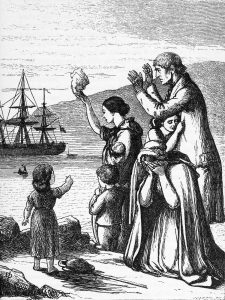
Leaving Ireland, Henry Doyle 1827-1892. Mary Frances Cusack. Illustrated History of Ireland, 1968.

It is relatively easy to discover why your ancestors migrated from the land into the new growing cities, or even further afield across vast oceans. Simply search on line to see what was going on in their local area at the time to understand the factors that caused them to make a drastic move from all they knew.

I can recommend a simple google search.  It is also very revealing to search on the British Newspaper Archives, free in our libraries and schools. You will be amazed what you might discover!


Tracing our Ancestors and Heritage in small island communities in the Caribbean region.

Due to populations voluntarily, or more often than not, involuntarily, moving across vast oceans it can put some people off attempting to trace their ancestors. This is particularly true for those of us who have Caribbean roots, living in the U.K.

However, it is amazing how many original records have actually survived because colonial bureaucracy was meticulous. Of course these records are a difficult and distressing read as they detail the selling of humans in slave markets in the Caribbean, while at the same time listing the names of the plantation owners. Infantries were undertaken by plantation owners from time to time and many of these documents have survived too. The records can be sourced on line going back to 1720 in many cases and more of these records are becoming digitally available for us to view on-line. Interestingly the earlier records often also give us details of where a person originated from in Africa, making it possible to go even further back in time.
It is also possible to telephone or email the islands library service, archive office or museum on the island you suspect your ancestors may have inhabited and ask for help with your research.  However, it is sometimes necessary to actually visit the island or region in question to gain full access to the tens of thousands of records held in the archives.
It does help to know a few details of the family member you are searching for.  Even just having a last name will help immensely. Other details may include:
  • The name of the slave and the slave owner, including possible variations in spelling.
  • where they lived, including the parish if possible.
  • as much information as possible about dates of births, marriages and deaths.
Below are a few further search suggestions:
Link to: The national Archives, London
The national Archives have slave registered from 1812-1834 (the date of Caribbean abolition).
Link to: Barbados National Archives
The Barbados National Archives is a very useful source of information for persons conducting genealogical research and tracing their family tree. The Archives houses parish documents such as births, baptisms, marriages, deeds and wills.
Link to Antigua National Archives

Welcome to the Antigua and Barbuda National Archives


Discovering Scottish Ancestry – which McIntosh am I looking at?

During my latest new teaching session there were quite a few learners who were trying to discover their Scottish links.  Scottish records can be difficult as so many families share the same surnames and lived relatively near to each other.  However, there are a few ways to check that you have the right people in your line.  For example, are the names of the children concurrent with baptism parental names, in particular the mother’s surname? Also, are there any middle names?  The registrration of birth, deaths and marriages has been conpulsory in Scotland since 1 January 1855.

Another clue can be found under occupations that appear on the Scottish census returns. (1851-1911). People tended to remain within their ‘born into occupational class’.  It is highly unlikely that a boy of sixteen working in a mill will appear thirty years later as a lawyer.  Yet the 2 differing lines may have even given their children all the same names!  So double check the children’s birth year and baptism record (if you have found it), and with time you can even crossing reference with cousins and other family members to see if there is a match.

Earlier Scottish records can be found in church records and these can be found on line if they have survived. Before 1855 Scottish births, deaths and marriages and burials will be found in the church registers.  However, they often contain only a simple index of names depending on the church and parish recorder. Presbyterian church records are available from 1716.

Heritage Found can help you with this research.

More information can been found at http://www.scotlandspeople.gov.uk/guides/


New Bristol Family History Course dates – 2018-2019 book now!

New course dates

The new course dates are available and bookable now though Bristol City Council’s web site. Please link to the Book tab below this post for details of the Family History courses running in Bristol 2018-2019.

The courses are aimed for beginners and for those who have already undertaken some research.

Stage 1 – Six classes begin for 6 weeks on each Thursday. Starts 20th September 2018.

Also, 10th January, 2019 and 25th April, 2019

Stage 2 – Six classes begin for 6 weeks on each Thursday. Starts 8th November 2018.

Also, 28 February, 2019 and 6 June, 2019.

Saturday Taster Days – 6th October, 2018 and 2nd February, 2019

Also, an Intensive One Day Course.   The idea is for you to find the space and time to enable you to get on with fresh research through the aid of on-line records.  The days are tutor led and will be in tune with the individuals progress so far – even if you are just beginning!  Saturdays – 1st December 2018, and 23rd March, 2019.

For more details and to book click the link  Book 

Family History Courses starting in September in Bristol

Bristol Adult Learning at Stoke Lodge, Shirehampton, Bristol will be issuing their new course brochure during mid July.  My family history courses are staggered for different abilities and depending on how much research you might have already undertaken.  But the first course will be ideal for complete beginners.

The courses have always received fabulous feed-back from learners and come highly recommended.

Courses can be found at Bristol Courses (click for link).


Thank you to my learners – great work

Just finished my latest family history course.  The learners were very enthusiastic and managed to trace their family heritage back to the 1841 census.  This was the goal for the Stage 1 course.

Some found that family stories helped to validate the records they discovered.  While some discovered that the records only disproved what they had been told!   This is often the case.  Over time family memories and stories are re-told and often vital facts are forgotten, names forgotten, or dates are simply made up.  It is only by sourcing the records accurately, which can be very time consuming, can we prove, or disprove our family history.

This takes great discipline, concentration and good record keeping.  The learners found the time and space in their weekly class, and afterwards felt they had a better understanding of the process. I hope they all felt they had made really good progress and will continue with their research.

Well done everyone!

Genealogy discoveries and mysteries still to be solved – The lost marriage

Lost, First Marriage

Over the summer I have been busy with solving a couple of genealogy mysteries on behalf of clients. The one, below, involves a lost first marriage.  Let me explain:

The first involved a lady who believed her mother may have been married before her mother and father met and married.  When this lady was a child an elderly aunt had once told her that her mother had been married before, and that she, this lady had a brother.  The revelation remained a secret and was never spoken of again.  Her mother died in her fifties and now this lady wanted to know if she did in fact have a half brother.

I was able to help her by searching her genealogy through the marriage records and birth records. Unfortunately her mother had a common name, and came from a city.  This meant cross referencing with over 40 possible matches with the mothers names.  I had to check for deaths of some of these 40 women and birth records around the correct time.  But in the end I found her mothers first marriage, which took place in a different city.  This is probably why her family did not know of her first marriage or birth of her first son, who was born just 3 months after the marriage.

The story turned out to be true and the lady is now hoping to contact her half brother.  However, I did not find a divorce record for her mother, so we believe her father did not know of the previous marriage or child.  I hope very much that this lady finds her half brother and gets to hear all about his life story.

(The client granted her permission for me to blog her story).

Sign up for one of my courses and you could discover your family history Courses

Second story to follow soon…..

Pauper death and burial in Eastville, Bristol

On 12 July a fascinating public walk and lecture about the history behind the unmarked pauper graves of Rosemary Green, situated on the outskirts of what was once Eastville Union Workhouse, Fishponds Road, Bristol.

After the 1834 Poor Law Act a paupers funeral was considered to be an extravagance that the parish should no longer pay for.  Before the 1834 Act, pauper funerals were paid for by the parish, with local persons attending to the traditional funeral rituals and necessities. In other words a person with no or little money who had died was treated with respect in death and buried as a human being as would be expected, albeit simple, within the cultural rituals of the time.

But after the Act was enforced the Poor Law Unions, in order to save money, and ‘demonstrate disgrace in death of those who had surrendered to poverty‘.  Death and burial practices were changed to become a disgraceful new attitude that resulted in approximately 4,000 men, women and children simply being wrapped in a shroud and dumped in unmarked graves in a small piece of land that sloped into a small river.   The pauper graveyard is located at Rosemary Green just opposite Greenbank Cemetery where there is also an older pauper grave yard.

Extensive research into Eastville workhouse has been undertaken by Bristol Radical History Group and published in 100 Fishponds Road.  (Book available from BRHG). Click here.

Many people have now contacted the BRHG as they suspect that their ancestors may have be buried at Rosemary Green. (Records of names still exist).  If you think that you may have an ancestor who might have died in a workhouse you can contact Heritage Found, free of change, to try to find out more.

At Rosemary Green there is now a touching monument to all those souls once buried beneath.

Made of slate it reads:

Rosemary Green Burial Ground

1851-1895

On this site over 4,000 men women and children

who died in Eastville Workhouse,

known as 100 Fishponds Road,

were buried in unmarked graves.

A further 118 were given to the medical school.

This memorial stands in recognition of all

who lived and died in the workhouse.

Not Forgotten

Please click here to discover more and see fascinating photographs of Eastville Workhouse.