The Employment of rural women in agriculture before and after the Agricultural Revolution
In 1750 England was still in the main an agricultural country, the greater part of which was the old type of rural organisation. This traditionally means with an open-field farming method, strip farming and most importantly these activities mainly took place on common lands. Farming was subsistence by nature and was a means of production to supply the needs of the immediate community. Women took on much of the work and often provided a surplus that could be sold on or exchanged for other goods.
Over the next 70 years huge changes took place.
The industrial world took the place of many domestic cottage industries, such as lace making, weaving, brush making, rope making for example, and many other forms of home-based manufacturing. With enclosures the large enclosed farm was to take over, absorbing small crofters and other traditional occupations that once took place in the open village, such a meat curing, milking and threshing. The Commons, or the people reliant on the free right to graze their animals and grow limited crops – the ‘commoners’ – were to become a lifestyle of the past. 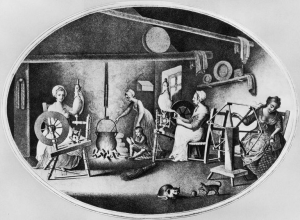
The Industrial Revolution had many causes that deeply affected the lifestyles of the working classes, or landless poor, but one of the most important was the impact of the Agricultural Revolution.
Firstly, The Agricultural Revolution involved many innovations in farming that led to a dramatic increase in food production. For example, Charles Townshend’s idea of crop rotation allowed farmers to grow more food, while Jethro Tull’s seed drill allowed faster and more farming differencing practices. While these were important features of the Agricultural Revolution, there was another factor that also had a big impact on the working population, namely, the growth of enclosing the land through Acts of Parliament.
Secondly, the Agricultural Revolution caused the growth and resurgence of the Enclosure Movement. In the decades and centuries before the 1700s, British farmers planted their crops on small strips of land while allowing their animals to graze on common fields shared collectively and their rights protected by the Crown.
However, in the 1700s, parliament passed successive legislation, referred to as the Enclosure Acts, which allowed the common areas to become privately owned, that increased private ownership, both of which led to another key characteristic of the Industrial Revolution. Wealthy farmers were buying up large sections of land in order to create larger and more complex farms. Ultimately, this forced smaller farmers off of their land. Having lost their way of life, many of these farmers, landless labourers, trudged to local towns and cities in search of work. This was important to the overall success of the Industrial Revolution, because it helped create a system that created a large readymade workforce desperate for employment and forced to work in the new factories and mines. The mines were expanded at the rapid rate, needed to fuel the fires to generate the power for the new factories. Privatisation of the land forced traditional farm labourers and families to migrate to centralized locations. Therefore, historians often view Enclosures as one of the main foundations that established the Industrial Revolution.
The aim of Enclosures was to consolidate the holders of land into the hands of a few, with most small farmers given no option but to now rent the land under the new system. For many the only course of action was to either leave the land entirely and to take up new occupations in the towns as many did, or to find employment as labourers on the new mechanised increasingly larger farms. Farming quickly became a capitalistic trade aiming to increase production to supply new markets in the growing industrial areas.
These economic changes had far-reaching social effects. The old village organisation was broken-up and a new social structure evolved. A new and fast growing rural middle class was evolving through the profits obtained from greater production of food. (‘A Short History of Enclosure in Britain’ by Simon Fairlie. The Land Sept. 2009).
But how did these changes affect rural women?
The wife of a small holder or tenant farmer, who had lost his land, became dependent upon her husband for income because with the loss of land went her opportunity of her contributing to the resources of the family through her own labourers, such as cheese making, weaving growing crops etc. Whereas, the mistress of a large farm, now had an active concern in the management and productive work of a large household, with low waged servants, luxuries imported from abroad all within the private sphere, and with this increase in wealth she could join the ranks of the leisured classes.
During the second half of the 18th century a speeding up of these economic changes occurred with a red line between large farms owners and the landless labourer. The new modern system, and means of production, meant that the localised subsistence farming was no longer economically possible. As I’ve mentioned women were traditionally employed in the home, meaning both in private and public spheres: with the management of stock, weaving, managing the kitchen garden and taking care of the needs of the family. Also, women were able to maintain their own economic independence to a point. But now rural women, on the whole, only had work at harvest time on the large farms, so therefore, women became dependent on the wages of their husbands.
For large farmers and landowners this was a period of great prosperity. Artisans in the towns were earning higher wages in the industrial towns, and therefore, the demand for more food of high quality was in great demand. But for those still residing in the rural community they often became pauperised and lived in acute distress, losing any few rights they held previously and often living on a reliance of out relief.
In The Case of Labourers in Husbandry, published in 1795 by J. Davies. He wrote:
“Some of the more fortunate cottagers were allowed to retain their gardens, or were given a small allotment of land in exchange for common rights, and these, were able to “breed a few fowls, with which they buy what sheets and blankets they wants, but in many cases the cottages were pulled down, their gardens engrossed into farms and families crowded into old farmhouses with a scrap of garden where they were seldom allow to keep a pig or a chick”. He went on to write. “An amazing number of people have been reduced from a comfortable state of independence, to precarious condition of mere hirelings, who when out of work come immediately on the parish”.
Davies wrote that widows and single women suffered the most as previously their common rights had always enabled them to provide for themselves. But now for many there was no alternative but to go on the parish. This meant to claim parish relief (charity) to subsidise low wages, or to enter the Workhouse. Some were able to earn a small wage by spinning or through domestic employments but there was just too many of them. Others earned money by becoming day labourers.
This gradually led to a new underclass of women, known as ‘women day labourers’ and their pay was very poor.
The plight of women day labours began to receive attention from the radical pamphleteers of the times and the anti-poor law league; as the lack of employment of women was regarded as one of the great and growing evils of the time.
As I said women have always assisted with the harvest, in fact our school holidays still revolve around the harvest calendar. Parish records also suggest that in some thinly occupied areas they even paid for single women traveling expenses when labour was in short supply. Men and women were hired for a month at a time when they were able to travel. In 1764 women were paid 6s a week (£30 today) – with meat, drink, washing and lodging included. Still a very low wage. We have here a new class of workers due to women traditionally working for less than men, who in were themselves paid low wages and women were able to quickly adapt to the new social and economic circumstance they found themselves in.
Women could also be employed to hoe turnips and other root crops for example, at a much cheaper rate than the men. Women, boys and girls were trained to do this work – which was actually considered a specialised job. They worked for half the rate as men. Previous to this men had travelled in gangs as specialists in turnip hoeing. 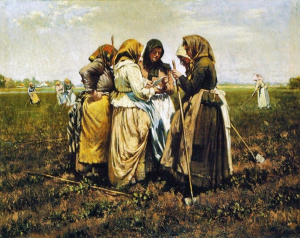
In Gloucestershire by 1807 women had almost displaced men in corn hoeing because they worked for half the rate of men. In fact women would do most of this work. They could also earn much more for digging potatoes as it was such hard, heavy work. An example of other agricultural work undertaking by the cheaper female workforce was fruit picking, sowing carrots and hop picking. They earned between 10d to 14d a day (about £2 per day) with a quart of cider thrown in during 1807. (Women Workers and the Industrial Revolution 1750-1850 by Ivy Pinchbeck, p.60.)
For over 500 years pamphleteers, politicians and historians have argued about enclosure. Those in favour insisting that it was necessary for economic development or land improvement to cope with a growing population. Those against claiming that it deprived the rural working class of their livelihoods and led to rural depopulation, vagrancy (that was and still is a criminal offence) and in many cases dependency on the brutal New Poor Law Act of 1834.
Today we have a renewed interest in this topic because we can often see through our research that our families moved from a long found rural existence into our towns and cities. However, another reason for renewed interest may be due to the the most crucial issue of our time; the management of the global commons and the conflict between the global and the local, between development and diversity – between the landed and the landless and ultimately between man and nature.
Recommending further reading ‘A Short History of Enclosure in Britain’. By Simon Fairlie. The Land. 7 September 2009 pp.16-31. Easily found online.




 Lots of people attended my talk on Nautical Women in history and I thoroughly enjoyed talking to such an attentive, enthusiastic and inspiring audience. Thank you.