New Family History course starts on-line Thursday 23 April 2020

Dear Bristol Learners

Thank you for your support whilst we have been converting our courses to a virtual format. 

My courses will run on zoom, with lecture notes, lectures, Q&A time and discussion.

To book my Family History courses just visit the Bristol Adult Learning page here 

Family History Stage One begins on Thursday 23 April at 1.30 pm.  

We will create an invigorating and supportive e-teaching space. This is a great way to pass the time, and discover your amazing family history.

A message to my learners – Online support tutoring

Hello everyone

As you will have heard Stoke Lodge was closed today due to the ongoing health crisis.  This decision was a very sad one for all of us at Stoke Lodge, but we will reopen as soon as we are able.

In the meantime I will be publishing online support via this website each weekend.  I will also be offering a once a week phone call to each of you so you can ask me questions concerning your family history research projects.  There will be articles appearing on these pages that we would have covered over the next few weeks in class.  As well as this I will be adding  links to online resources that will support your learning.

If you would like to take advantage of weekly phone-in support, to be set at time to suit us both, over the next few weeks, please send me your email address to:

heritage_found@yahoo.co.uk

Your email address will be deleted at the end of the normal term time.

This is a good time to pull together your ongoing research.  Having projects such as these, while we are stuck at home, helps to take our minds off the current crisis and will relieve boredom.

In the meantime I leave you with a thought provoking quote from Daniel Defoe:

“All the plays and interludes which had been set up, and began to increase among us, were forbid to act: the gaming-tables, public dancing-rooms, and music-houses, which multiplied and began to debauch the manners of the people, were shut up and suppressed; and the jack-puddings, merry-andrews, puppet-shows, rope-dancers, and such-like doings, which had bewitched the poor common people, shut up their shops, finding indeed no trade; for the minds of the people were agitated with other things” (Daniel Defoe, A Journal of the Plague Year, 1722).

Last day for my learners

Today was the last day of my Stage 2 Family History Course that I run at Stoke Lodge Bristol. 

Some of the learners gave fabulous presentations of their family history research and very interesting their research proved to be!  We all learned a lot from how they undertook their research, and I was impressed at the hard work and many hours that had been undertaken.
Thank you to the whole class for making this course very interesting for all of us.  I hope you continue to to pursue your wonderful research and that my course has inspired you to overcome the inevitable obstacles that will pop up from time to time.

Happy Christmas Everyone! 

Pleased to announce a new talk to a local history group by Heritage Found

Woman Sailor climbing the rigging

Nautical Women

To be held at Redcliffe 6th Form College
By kind invitation of CLASS.
‘Nautical Women. Women sailors and the women of sailortowns.’
Author Rosemary Caldicott will be talking about her new book in which she investigated the intriguing histories of  nautical women. Stories of cross-dressing women who went to sea to earn a living and the mad, tragic and often funny consequences they encountered and endured. Rosemary brings to life a forgotten history – women sailors and the women of sailor towns.
10th December at 10.30am.
Dulverton House, Redcliff Hill, Bristol BS1 6RB

New class starts this week

Family History and ancestry classes, Bristol

I am very much looking forward to meeting my new learners on Thursday at Stoke Lodge.

Its that time of year again and a new year begins with family history and ancestry classes in Bristol.  I wonder what intrigues await the learners this year? They will uncover their ancestors lives and learn the correct methodology to undertake their research successfully. Correct interpretation is key to stay focused on their sources. The step by step course will go through each basic area of family history research with plenty of time to do lots of online searches.

Welcome everyone!


New course: Working Class History from Below

The Women who challenged Society in Bristol and further afield.

A new series of lectures that aim to present a different perspective of our collective history, the history of working class people, and in particular working class women. Topics covered amongst others will be Women in Port Cities, Women surviving a Bristol workhouse, and Pioneering Bristol Women in the Trades Union Movement

Enrol online here.

Course Dates 2019 – 2020

These courses take place at Stoke Lodge, Bristol

Tuesday 1pm – 3 pm Rosemary Caldicott

  • 4 sessions 12 November
  • 4 sessions 14 January
  • 4 sessions 3 March
  • 4 sessions 28 April

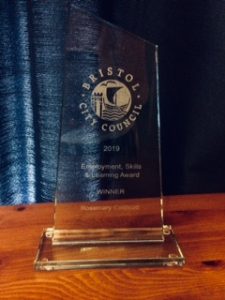
Some things in life come when you least expect them: A family history teaching Award

“Somethings in life come when you least expect them”.

A wonderful surprise to receive this award for my contribution at Bristol Adult Learning, teaching Family History and (soon to be) Working Class History from Below.  A lovely afternoon tea was enjoyed by the many award winners at City Hall, Bristol making for a very happy occasion.  Thank you to all the team at Stoke Lodge who work so hard to achieve a fantastic service to our community of learners.


Talk – Women in the Workhouse

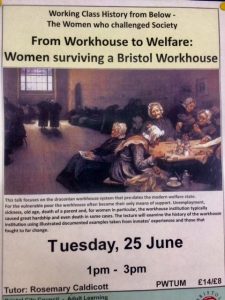
Tuesday 25th June I will be giving a 2 hours talk at Stoke Lodge, Bristol Courses on the workhouse system  Link here

From Work House to Welfare

‘Women surviving a Bristol Workhouse’

1pm – 3pm with Q & A at the end.

The lecture focuses on the draconian workhouse system that housed the vulnerable poor, and in particular women and children.  I will be examining the history of the workhouse by offering an illustrated talk based on evidence extracted from reports published at the time.

The Life and Death of Hannah Wiltshire. A Case Study of bedminster Union Workhouse and Victorian Social Attitudes on Epilepsy. (R. L. Caldicott. 2017),  a true story of how one woman’s life was ended in the workhouse, is included in the talk.

From Workhouse to Welfare: ‘Women surviving a Bristol Workhouse’

Lecture – 25 June 2019 

‘From Workhouse to Welfare: Women surviving a Bristol Workhouse’

The 2 hour talk will focus on the draconian workhouse system that pre-dates the modern welfare state. For the vulnerable poor the workhouse often became their only means of support. Unemployment, sickness, old age, death of a parent and, for women in particular, the workhouse institution typically caused great hardship and even death in some cases. The lecture will examine the history and reality of the workhouse institution using illustrated documented examples taken from inmates’ experiences.  Those who fought for change are recalled, along with examples of modern day memorialisation for the people that lived and died in our workhouses.

A 15 minute tea or coffee break is included within the 2 hour lecture and concludes with a Q&A session.

Book here: Stoke Lodge Shirehampton, Bristol 


Discovering Scottish Ancestry – which McIntosh am I looking at?

During my latest new teaching session there were quite a few learners who were trying to discover their Scottish links.  Scottish records can be difficult as so many families share the same surnames and lived relatively near to each other.  However, there are a few ways to check that you have the right people in your line.  For example, are the names of the children concurrent with baptism parental names, in particular the mother’s surname? Also, are there any middle names?  The registrration of birth, deaths and marriages has been conpulsory in Scotland since 1 January 1855.

Another clue can be found under occupations that appear on the Scottish census returns. (1851-1911). People tended to remain within their ‘born into occupational class’.  It is highly unlikely that a boy of sixteen working in a mill will appear thirty years later as a lawyer.  Yet the 2 differing lines may have even given their children all the same names!  So double check the children’s birth year and baptism record (if you have found it), and with time you can even crossing reference with cousins and other family members to see if there is a match.

Earlier Scottish records can be found in church records and these can be found on line if they have survived. Before 1855 Scottish births, deaths and marriages and burials will be found in the church registers.  However, they often contain only a simple index of names depending on the church and parish recorder. Presbyterian church records are available from 1716.

Heritage Found can help you with this research.

More information can been found at http://www.scotlandspeople.gov.uk/guides/