My latest book is soon to be published! This work tells the story of the women who lived both on the sea and on the shore line during the 17th, 18th and 19th centuries. Their lives were mainly dependent on an income generated directly from the many industries connected with seafaring.
Women and their families were directly impacted when their men-folk would be forceably pressed into the Royal Navy. The men would often leave their wives and families desitute because they were not paid until they returned home, which could mean months and even years going without pay. Included are many tales of women who attacked and even murdered members of the press-gang to drive them out of town and prevent their men-folk being snatched away.
Another aspect of Nautical Women is the sub-culture that existed of women dressing up as men and disguising themselves as sailors. Small glimpses of the the roles played by these women are to be found secreted in ships’ journals, court records, ballads and artistic portrayals. Women who wanted to escape poverty, had a lust for travel, or might be even trying to find a lost sailor lover would sail for many months along side the male sailors before being discovered. Of course it is only the ones that were discovered that we know about. Some appeared in court, while others made sensational news copy.
But the women who were left behind, often living in poverty in our British port towns had to survive the best way they could, and the book takes a look at how women found work, or not, as the case may be.
Available in good independent book shops, Tangent books, Foyles Book Shop and on line at google books and Amazon on line.
A particular interest to many people is when they discover their ancesters sailed the high seas in the Age of Sail, or during the era of steam ships. Maritime history has many facets, and perhaps your ancesters had sea, river or naval links.
They risked their lives as sailor’s, as well as families undertaking dangerous mass migaration for a better
Merseyside Maritime Museum; Supplied by The Public Catalogue Foundation
life. However, some people also perished as a result of the slave trade. Below is my latest article that tells the true story of a slave ship called the Hannibal, her captain, Thomas Phillips, from Brecon, Wales, and the fate of the African people on board. It is a heartfelt story, and perhaps one of our ancestor’s might have even been on board? You never know what you might uncover when reserching your family history.
Captain Thomas Phillips, Slave Trader. (circa 1664-1713)
by Rosemary Caldicott
If you were to walk around the rear side of the former house and hoe of Captain Thomas Phillips in Brecon, located along Captains Walk, you will notice a rather handsome slate plaque memorialising his life. The Phillips’ family house is now St Ursula’s Convent, a former catholic school. The plaque was paid for by the people of Brecon, and was erected (though not without controversy), in 2010. It reads innocently enough:
CAPTAIN THOMAS PHILLIPS
Havard House, Brecon
First made this Captain’s Walk
Author of A Journal of a Voyage
Made in the Hannibal 1693-94
To Africa and Barbadoes
The plaque has a glaring omission in the chosen inscription at the time of its conception. Fast forward eight years later, and, in what should be more enlightened times, we still find a memorial in situ that fails to mention a sincere interpretation of the life and barbarous activities of Captain Thomas Phillips.
Phillips, at the age of 29 years and on his second voyage, became the captain of the infamous slave ship the Hannibal. Under his command he was directly responsible for the tragic deaths of 328 (47 per cent) of the 700 enslaved African women, men and children on board, along with 18 of his crew of 70. A very large number of people died in the cruellest of ways, people who would still have been in shock having being stolen from their families, homes and culture.[1]
Let me be frank about the sort of man Captain Phillips was. Before boarding the Hannibal the male slaves were cuffed to one another in irons, and in pairs at their wrists and legs to prevent rebellion and to avoid the enslaved attempting to jump overboard and escape. (Phillips writes in his journal of how men who jumped overboard would then be eaten by the many sharks that swam in the shallows). Phillips also states in his journal that before boarding the ship all the slaves, including around 50 children, would be branded on the chest with a small capital “H” to claim them for the Hannibal. Phillips writes in his journal that the branding left a white mark and ‘generally’ healed up within 4 to 5 days because of their ‘applying palm oil before hand to smooth the wound’. This effectively meant they were in fact frying human skin and guilty of torturing their captives, including the children. Phillips knew that his activities were immoral, even in the era of the late seventeenth century, as he wrestled with his conscience whilst writing his journal.[2]
Phillips had a 10 per cent financial stake in the ship. His patron Sir Jeffery Jefferys [3], a wealthy slave trading West India merchant and manager in the Royal African Company, personally chose Phillips to be commander of the Hannibal, which had been converted into a slave ship under the observance of Phillips in person. This meant the fitting of small cramped lower decks where the slaves would be shackled for most of the voyage, without enough room to sit up right. Phillips was now deeply involved in the slave trade, in which he had hoped to make a great deal of personal wealth by selling his tortured and humiliated human cargo. Their suffering was of little or no consequence to Phillips. In his journal he appears to attempt to offer a sort of reasoning to justify his cruelty, this being based on the fact that black slaves were heathens and as such were a lower caste that Christian people. One cannot help but notice the irony that this plaque was dedicated by an elderly nun and local historian from St Ursula’s Convent, who was fully aware that Phillips was a slaver.
The Hannibal was converted into a slave ship from a previous frigate, part of the merchant fleet of the Royal African Company and was to sail the very profitable triangular trade route. Goods were transported down to the west coast of Africa, including in this case cloth made in Brecon, iron bars and other such useful goods that could be bartered in order to trade with African chiefs for elephant’s teeth (tusks), gold dust and enslaved Africans. The ship was then to sail west, across the Atlantic to the West Indies and the British owned island of Barbados. The slaves would be sold onto waiting plantation owners. The return trip back to England would involve carrying a cargo of tobacco, sugar, spices and other valuable slave-produced commodities, including in the case of the Hannibal two chests of gold from the sale of African people.
When the ship arrived in the ‘New World’ in November 1694, only 372 enslaved Africans out of an original number of 700 remained alive on board. Horrifically 328 women men and children had died while in transit. Some had succumbed to an outbreak of dysentery and smallpox because of the dreadful conditions on board, while others had perished jumping overboard out of terror. It is even alleged that some of the slaves, including women, were dumped overboard by the crew while still alive, as had happened previously on other slave ships. This murderous crime was committed in order that insurance claims money – for loss of goods in transit – could be collected to assure a reprehensible trade was still profitable because the slave traders only received payment for the slaves (‘cargo’) who were delivered alive. A young male slave could be insured for £30 and they were considered ‘cargo’. Phillips told an inquiry about twelve of the slaves: “We had about 12 negroes who did wilfully drowned themselves during the voyage and others persistently refused food, starving themselves to death”.[4]
We need to consider who the plaque is for. For example, is the memorial for the towns’ people to enjoy? Or, perhaps it was erected as a signage marker for tourists? Is the plaque to act as an elegant landmark to gentrify the town of Brecon along the Captains Walk trail? Can it be that the honouring of Captain Phillips is meant to educate the children who come across his name that the town has produced quite a few famous seafarers? Perhaps the plaque is a mixture of all of the above. Disappointingly the plaque fails to mention that Captain Thomas Phillips was a slave trader which is a serious inadequacy considering that this is the only fact that characterises Phillips as a notable in history. That is, other than the fact that, few slave-ship captains had presided over such catastrophic suffering and loss of life in a single voyage.
The persons, our civic leaders, who decide who and what should be commemorated need to consider that they are forming the foundations of a collective memory and this is why it is so important that people in history are remembered with integrity and directness. Without this consideration we are as a society guilty of a social construct that is inauthentic, and therefore might be construed as social propaganda. Memorials are about not only commemorating the great and good, but also areas of our nation’s history that are sad and notable for previous acts of violence that are condemned today, because our interpretation of history evolves as societies attitudes toward our fellow humans change and our awareness about the true facts of history are widely available.
The social construct of memorialisation is very powerful and therefore our elected and non-elected representatives have a duty – a civic responsibility – to interpret our nation’s history with integrity and openness. Some would argue that monuments represent an ideology imposed on our collective landscapes which may give a false interpretation of a privileged heritage, and therefore an elitist interpretation of our history. If this is the case then it can also equally be argued that we need to open up our interpretations of our collective history, by bringing a challenge of rectitude for all our communities during the 21st century. It is a huge responsibility on the part of local officials to decide who they will choose to commemorate in our towns and parks and in which style of iconography would best serve the history of our nation.
The plaque memorialising this seafaring captain had a glaring omission at the time of its conception and eight years later, and in what should be more enlightened times, we still have a memorial that very controversially fails to convey a sincere interpretation of the life and barbarous activities of a previous inhabitant of Brecon, who remains part of our collective past; that of Captain Thomas Phillips, Slave Trader. Not something to commemorate though is it really?
Rosemary Caldicott is an author of history books about women in history as well as being a broadcaster, teacher and public speaker. Shortly to be published ‘Nautical Women. Women sailors and the Women of Sailortowns: A Forgotten Diaspora. c.1693 – 1902.
[1] The Trans-Atlantic Slave Trade Database, http://www.slavevoyages.org/assessment/essay (accessed August, 2018).
[2] Phillips T. A Journal of a Voyage made in the Hannibal of London, Ann. 1693, 1694, From England to Cape Monseradoe, in Africa, and thence along the Coast of Guiney to Whidaw, the Island of St. Thomas, and so forward to Barbadoes. With a Cursory Account of the Country, the People, their Manners, Forts, Trade, etc. p.3. Published by Churchill 1732, within a Collection of Voyages and Travels. Vol.I.
[3] Jefferys purchased Brecon Priory estate, became a town councillor and MP for Brecon in 1690, holding the position for the majority of the next two decades. Hayton, D. W. “ JEFFREYS, Jeffrey (c.1652-1709), of St. Mary Axe, London and The Priory, Brecon” in D. Hayton, E. Cruickshanks, S. Handley (Eds) The History of Parliament: the House of Commons 1690-1715 . (London: Boydell and Brewer, 2002)
[4] Murdoch S. ‘john Brown: A Black female Soldier in the Royal African Company’. World History Connected. Vol.1, is. 2. p.4
On 12 July a fascinating public walk and lecture about the history behind the unmarked pauper graves of Rosemary Green, situated on the outskirts of what was once Eastville Union Workhouse, Fishponds Road, Bristol.
After the 1834 Poor Law Act a paupers funeral was considered to be an extravagance that the parish should no longer pay for. Before the 1834 Act, pauper funerals were paid for by the parish, with local persons attending to the traditional funeral rituals and necessities. In other words a person with no or little money who had died was treated with respect in death and buried as a human being as would be expected, albeit simple, within the cultural rituals of the time.
But after the Act was enforced the Poor Law Unions, in order to save money, and ‘demonstrate disgrace in death of those who had surrendered to poverty‘. Death and burial practices were changed to become a disgraceful new attitude that resulted in approximately 4,000 men, women and children simply being wrapped in a shroud and dumped in unmarked graves in a small piece of land that sloped into a small river. The pauper graveyard is located at Rosemary Green just opposite Greenbank Cemetery where there is also an older pauper grave yard.
Extensive research into Eastville workhouse has been undertaken by Bristol Radical History Group and published in 100 Fishponds Road. (Book available from BRHG). Click here.
Many people have now contacted the BRHG as they suspect that their ancestors may have be buried at Rosemary Green. (Records of names still exist). If you think that you may have an ancestor who might have died in a workhouse you can contact Heritage Found, free of change, to try to find out more.
At Rosemary Green there is now a touching monument to all those souls once buried beneath.
Made of slate it reads:
Rosemary Green Burial Ground
1851-1895
On this site over 4,000 men women and children
who died in Eastville Workhouse,
known as 100 Fishponds Road,
were buried in unmarked graves.
A further 118 were given to the medical school.
This memorial stands in recognition of all
who lived and died in the workhouse.
Not Forgotten
Please click here to discover more and see fascinating photographs of Eastville Workhouse.
I will be giving a talk on Bedminster Union Workhouse. Bristol to the Clevedon History Group on the 18th May, 2017. The talk will illustrate how during the year 1855 the workhouse Guardians neglected in their care and duty to protect a vulnerable young women, which resulted in her death. This lead to a public outcry and calls for the first mental health asylum to be built in Bristol.
Bedminster Union Workhouse was located Flax Burton, in North Somerset, England and served the parishes in the region of south west Bristol as well as Bedminster, Bristol.
Let me search for your ancestors and see if any of them were in a workhouse click
‘Lady Blackshirts. The Perils of Perception – suffragettes who became fascists’
This is the true story of suffragettes who became fascists during the inter war years.
During the 1930’s a small group of ultra-nationalistic women, who considered themselves feminists, joined Oswald Mosley’s British Union of Fascists. Surprisingly some of these women were former high ranking members of the suffragette movement.
This work examines the political and social tensions that confronted women in the 1930’s and also the tensions that arose within Mosley’s ranks. Issues that were so profound, that some women were drawn into the world of the fascist political elite, and became ‘militant women citizens’ advocating and endorsing fascism.
Available in good independent book shops, Tangent books, Foyles Book Shop and on line at google books and Amazon on line.
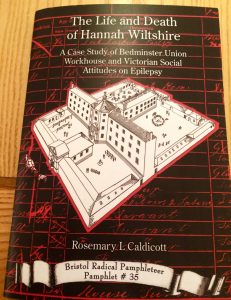
The Life and Death of Hannah Wiltshire – Available in good independent book shops, Tangent books, Foyles Book Shop and on line at google books and Amazon on line.
New booklet, available now through this website: ‘A Case Study of Bedminster Union Workhouse and Victorian Social Attitudes on Epilepsy’ Author: Rosemary L Caldicott




 After the 1834 Poor Law Act a paupers funeral was considered to be an extravagance that the parish should no longer pay for. Before the 1834 Act, pauper funerals were paid for by the parish, with local persons attending to the traditional funeral rituals and necessities. In other words a person with no or little money who had died was treated with respect in death and buried as a human being as would be expected, albeit simple, within the cultural rituals of the time.
 At Rosemary Green there is now a touching monument to all those souls once buried beneath.