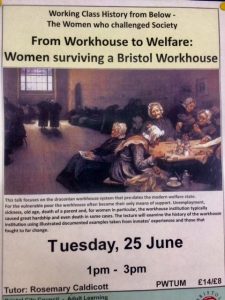
Talk – Women in the Workhouse

Tuesday 25th June I will be giving a 2 hours talk at Stoke Lodge, Bristol Courses on the workhouse system  Link here

From Work House to Welfare

‘Women surviving a Bristol Workhouse’

1pm – 3pm with Q & A at the end.

The lecture focuses on the draconian workhouse system that housed the vulnerable poor, and in particular women and children.  I will be examining the history of the workhouse by offering an illustrated talk based on evidence extracted from reports published at the time.

The Life and Death of Hannah Wiltshire. A Case Study of bedminster Union Workhouse and Victorian Social Attitudes on Epilepsy. (R. L. Caldicott. 2017),  a true story of how one woman’s life was ended in the workhouse, is included in the talk.

Tracing our Ancestors and Heritage in small island communities in the Caribbean region.

Due to populations voluntarily, or more often than not, involuntarily, moving across vast oceans it can put some people off attempting to trace their ancestors. This is particularly true for those of us who have Caribbean roots, living in the U.K.

However, it is amazing how many original records have actually survived because colonial bureaucracy was meticulous. Of course these records are a difficult and distressing read as they detail the selling of humans in slave markets in the Caribbean, while at the same time listing the names of the plantation owners. Infantries were undertaken by plantation owners from time to time and many of these documents have survived too. The records can be sourced on line going back to 1720 in many cases and more of these records are becoming digitally available for us to view on-line. Interestingly the earlier records often also give us details of where a person originated from in Africa, making it possible to go even further back in time.
It is also possible to telephone or email the islands library service, archive office or museum on the island you suspect your ancestors may have inhabited and ask for help with your research.  However, it is sometimes necessary to actually visit the island or region in question to gain full access to the tens of thousands of records held in the archives.
It does help to know a few details of the family member you are searching for.  Even just having a last name will help immensely. Other details may include:
  • The name of the slave and the slave owner, including possible variations in spelling.
  • where they lived, including the parish if possible.
  • as much information as possible about dates of births, marriages and deaths.
Below are a few further search suggestions:
Link to: The national Archives, London
The national Archives have slave registered from 1812-1834 (the date of Caribbean abolition).
Link to: Barbados National Archives
The Barbados National Archives is a very useful source of information for persons conducting genealogical research and tracing their family tree. The Archives houses parish documents such as births, baptisms, marriages, deeds and wills.
Link to Antigua National Archives

Welcome to the Antigua and Barbuda National Archives


New Bristol Family History Course dates – 2018-2019 book now!

New course dates

The new course dates are available and bookable now though Bristol City Council’s web site. Please link to the Book tab below this post for details of the Family History courses running in Bristol 2018-2019.

The courses are aimed for beginners and for those who have already undertaken some research.

Stage 1 – Six classes begin for 6 weeks on each Thursday. Starts 20th September 2018.

Also, 10th January, 2019 and 25th April, 2019

Stage 2 – Six classes begin for 6 weeks on each Thursday. Starts 8th November 2018.

Also, 28 February, 2019 and 6 June, 2019.

Saturday Taster Days – 6th October, 2018 and 2nd February, 2019

Also, an Intensive One Day Course.   The idea is for you to find the space and time to enable you to get on with fresh research through the aid of on-line records.  The days are tutor led and will be in tune with the individuals progress so far – even if you are just beginning!  Saturdays – 1st December 2018, and 23rd March, 2019.

For more details and to book click the link  Book 

Pauper death and burial in Eastville, Bristol

On 12 July a fascinating public walk and lecture about the history behind the unmarked pauper graves of Rosemary Green, situated on the outskirts of what was once Eastville Union Workhouse, Fishponds Road, Bristol.

After the 1834 Poor Law Act a paupers funeral was considered to be an extravagance that the parish should no longer pay for.  Before the 1834 Act, pauper funerals were paid for by the parish, with local persons attending to the traditional funeral rituals and necessities. In other words a person with no or little money who had died was treated with respect in death and buried as a human being as would be expected, albeit simple, within the cultural rituals of the time.

But after the Act was enforced the Poor Law Unions, in order to save money, and ‘demonstrate disgrace in death of those who had surrendered to poverty‘.  Death and burial practices were changed to become a disgraceful new attitude that resulted in approximately 4,000 men, women and children simply being wrapped in a shroud and dumped in unmarked graves in a small piece of land that sloped into a small river.   The pauper graveyard is located at Rosemary Green just opposite Greenbank Cemetery where there is also an older pauper grave yard.

Extensive research into Eastville workhouse has been undertaken by Bristol Radical History Group and published in 100 Fishponds Road.  (Book available from BRHG). Click here.

Many people have now contacted the BRHG as they suspect that their ancestors may have be buried at Rosemary Green. (Records of names still exist).  If you think that you may have an ancestor who might have died in a workhouse you can contact Heritage Found, free of change, to try to find out more.

At Rosemary Green there is now a touching monument to all those souls once buried beneath.

Made of slate it reads:

Rosemary Green Burial Ground

1851-1895

On this site over 4,000 men women and children

who died in Eastville Workhouse,

known as 100 Fishponds Road,

were buried in unmarked graves.

A further 118 were given to the medical school.

This memorial stands in recognition of all

who lived and died in the workhouse.

Not Forgotten

Please click here to discover more and see fascinating photographs of Eastville Workhouse.

18th May 2017 a talk about Bedminster Workhouse

The Life and Death of Hannah Wiltshire

I will be giving a talk on Bedminster Union Workhouse. Bristol to the Clevedon History Group on the 18th May, 2017.  The talk will illustrate how during the year 1855 the workhouse Guardians neglected in their care and duty to protect a vulnerable young women, which resulted in her death. This lead to a public outcry and calls for the first mental health asylum to be built in Bristol.

Bedminster Union Workhouse was located Flax Burton, in North Somerset, England and served the parishes in the region of south west Bristol as well as Bedminster, Bristol.

Let me search for your ancestors and see if any of them were in a workhouse click